
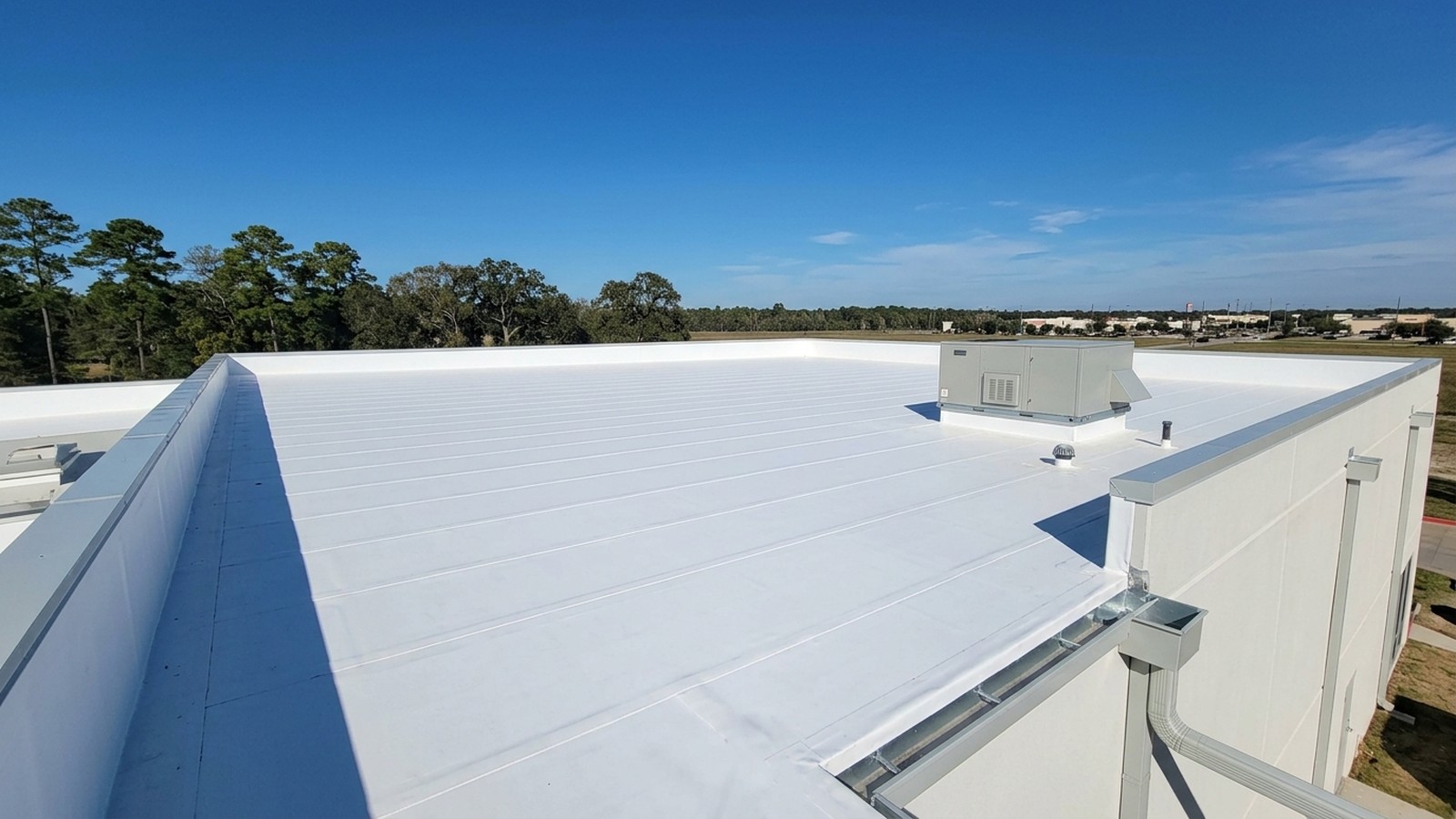
TPO is a single reflective sheet that is fastest to install and coolest in the Texas sun, modified bitumen is an asphalt sheet with real redundancy and easy repairability, and built-up roofing is the multi-ply asphalt system that trades install time for durability. Those three tradeoffs are the whole decision, and which one wins depends on your building rather than on which system is generally better.
Most Katy building owners meet this question at the worst possible moment, when the existing roof has failed and someone is asking for a decision this week. This guide covers how each system is actually built, what it does well, what it does badly in a Gulf Coast climate, and the questions to ask before you sign anything.
What are the three main low-slope roof systems?
Low-slope roofs generally fall into single-ply membranes, asphalt-based multi-ply systems, and asphalt-based sheet systems. Each solves the same problem, which is a roof too flat to shed water by gravity alone, in a different way.
TPO is a thermoplastic polyolefin single-ply membrane. It arrives as wide rolls, gets mechanically fastened or adhered to the insulation, and the seams are heat welded into a continuous sheet. It is almost always white.
Modified bitumen is asphalt with a polymer added to it, reinforced with fabric and factory-made into sheets. The Asphalt Roofing Manufacturers Association describes modified bitumen sheets as polymer modified bitumen reinforced with one or more plies of fabric such as polyester, glass fiber or a combination of both, made to consistent thickness under factory quality control. The two polymer families are APP, which ARMA says increases resistance to ultraviolet light, and SBS, which it credits with superior elongation and recovery across temperature extremes.
Built-up roofing, or BUR, is the oldest of the three and still the most redundant. ARMA describes BUR as multiple layers of bitumen alternated with ply sheets, particularly advantageous for flat or low-sloped applications, applied with hot asphalt or with cold adhesives.
How do TPO, modified bitumen and built-up roofing compare?
| TPO | Modified bitumen | Built-up (BUR) | |
|---|---|---|---|
| What it is | Single-ply thermoplastic sheet | Polymer-modified asphalt sheet, one or two plies | Multiple alternating layers of bitumen and ply felts |
| Seams | Heat welded into a continuous membrane | Torch, hot asphalt, cold adhesive or self-adhering | Overlapped and bedded in bitumen, no discrete seams to weld |
| Redundancy | One layer of waterproofing | Two layers in a typical two-ply assembly | Usually three or four plies |
| Reflectivity | White, high solar reflectance out of the box | Granule-surfaced options including reflective granules | Depends entirely on the surfacing or coating |
| Repairs | Weld a patch, requires the right equipment and a clean surface | Straightforward, widely understood by most crews | Straightforward but messy and labor-heavy |
| Install disruption | Low, no fumes or open flame in adhered and fastened applications | Torch application brings fire risk; cold and self-adhering options avoid it | Hot asphalt means kettles, odor and heavy logistics |
| Best fit | Large open decks where energy cost matters | Buildings with heavy foot traffic and frequent service work | Buildings wanting maximum redundancy and long service where weight is not an issue |
| Common weak point | Seam quality and fastener-related punctures | Seam detailing on torch applications | Weight, install complexity and surfacing maintenance |
No system on that table is the wrong answer. The wrong answer is picking one because it is what the contractor in front of you installs.
Does a reflective roof actually matter in Katy?
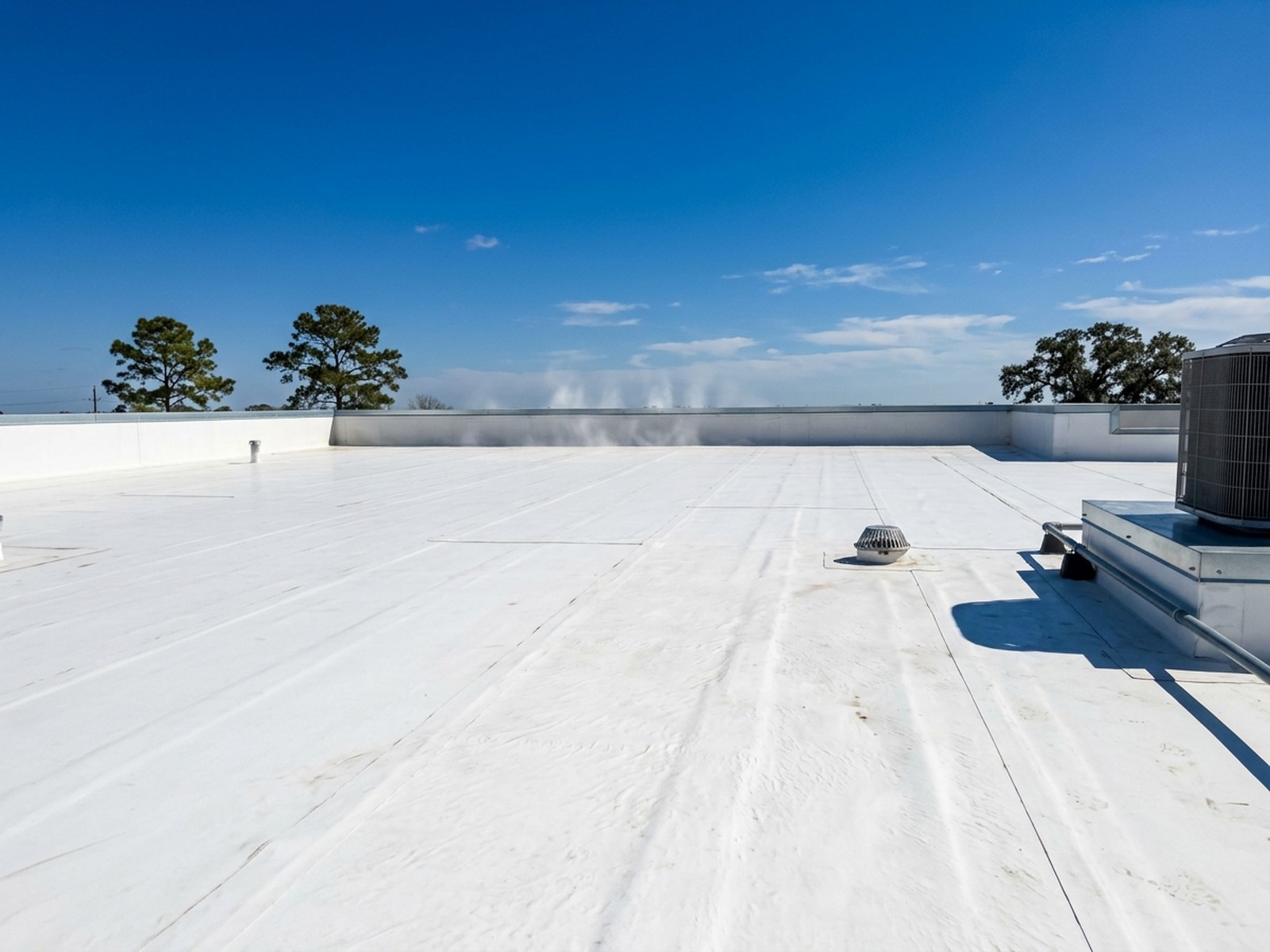
Yes, and more here than in most of the country, because a west Houston roof sits under high sun and long cooling seasons. Reflectivity changes both the energy bill and the aging rate of the membrane underneath it.
ENERGY STAR cites Lawrence Berkeley National Laboratory's finding that on a typical summer afternoon, a clean white roof that reflects 80 percent of sunlight will stay about 50°F cooler than a grey roof that reflects only 20 percent. The EPA puts numbers on the building side, reporting that reflective surfaces on air-conditioned buildings can reduce peak cooling demand by 11 to 27 percent.
That advantage is not exclusive to TPO. The EPA lists cool options for low-slope roofs including asphaltic membranes surfaced with reflective granules, light or cool-colored liquid-applied coatings, fluid-applied membranes, and single-ply membranes with cool pigments. A granule-surfaced modified bitumen cap sheet or a coated BUR can both be specified as a cool roof.
Two practical caveats. Reflectance is a measured property, so ask for the product's Cool Roof Rating Council rating rather than taking "it's white" as an answer. The CRRC's building owner resources explain how those ratings work. And reflectance degrades with dirt, which the EPA notes plainly: keeping the roof clean is part of keeping the benefit.
Which low-slope system should a Katy building use?
Match the system to how the building is actually used rather than to a general ranking.
Choose TPO when the roof is large and open, cooling cost is a live concern, there is little rooftop foot traffic, and the deck has few penetrations. Big-box retail, warehouse and distribution buildings are the classic fit.
Choose modified bitumen when the roof gets walked on regularly, has a lot of curbs, ducts and equipment, or serves a tenant whose service contractors are on the roof monthly. Asphalt sheet systems take abuse and repair predictably, which matters more than a percentage point of reflectance when somebody is dropping tools every week.
Choose built-up when redundancy is the priority, the structure can carry the weight, and the building is expected to hold the same roof for a long time without a reroof event. It is less common on new work than it was, and it is still a good answer for the right building.
Do not choose based on which system the first contractor quoted, or on price per square alone. A cheap system on the wrong building costs more over ten years than the right system did up front.
Three questions matter more than the membrane choice itself:
- Does the roof drain? A system installed over a drainage problem will fail regardless of type, and ponding can limit or void many manufacturer warranties.
- Is the existing insulation dry? Wet insulation left in place under a new roof is the most expensive shortcut in commercial roofing.
- Who maintains it? Every system on that table lasts longer on a maintenance program than off one.
What should a commercial roofing quote actually tell you?

A quote you can compare has the system spelled out, not just a name. Before you put three bids side by side, make sure each one states:
- The specific manufacturer and product, not just "TPO" or "mod bit"
- Membrane thickness and, for single-ply, the attachment method
- The insulation type, thickness and R-value, and how it is attached
- Whether tapered insulation is included and what slope it achieves
- What happens to the existing roof: tear-off, recover, or partial
- How wet insulation and deteriorated decking are handled and priced if found
- Every flashing, curb, drain, scupper and penetration detail
- The manufacturer warranty on offer, its term, what it excludes, and whether it covers labor
- The contractor's own workmanship warranty, separately stated
Two bids that look ten percent apart are frequently not quoting the same roof at all. The one that is cheaper because it recovers over a wet assembly is not cheaper.
How do you pick the contractor rather than just the system?
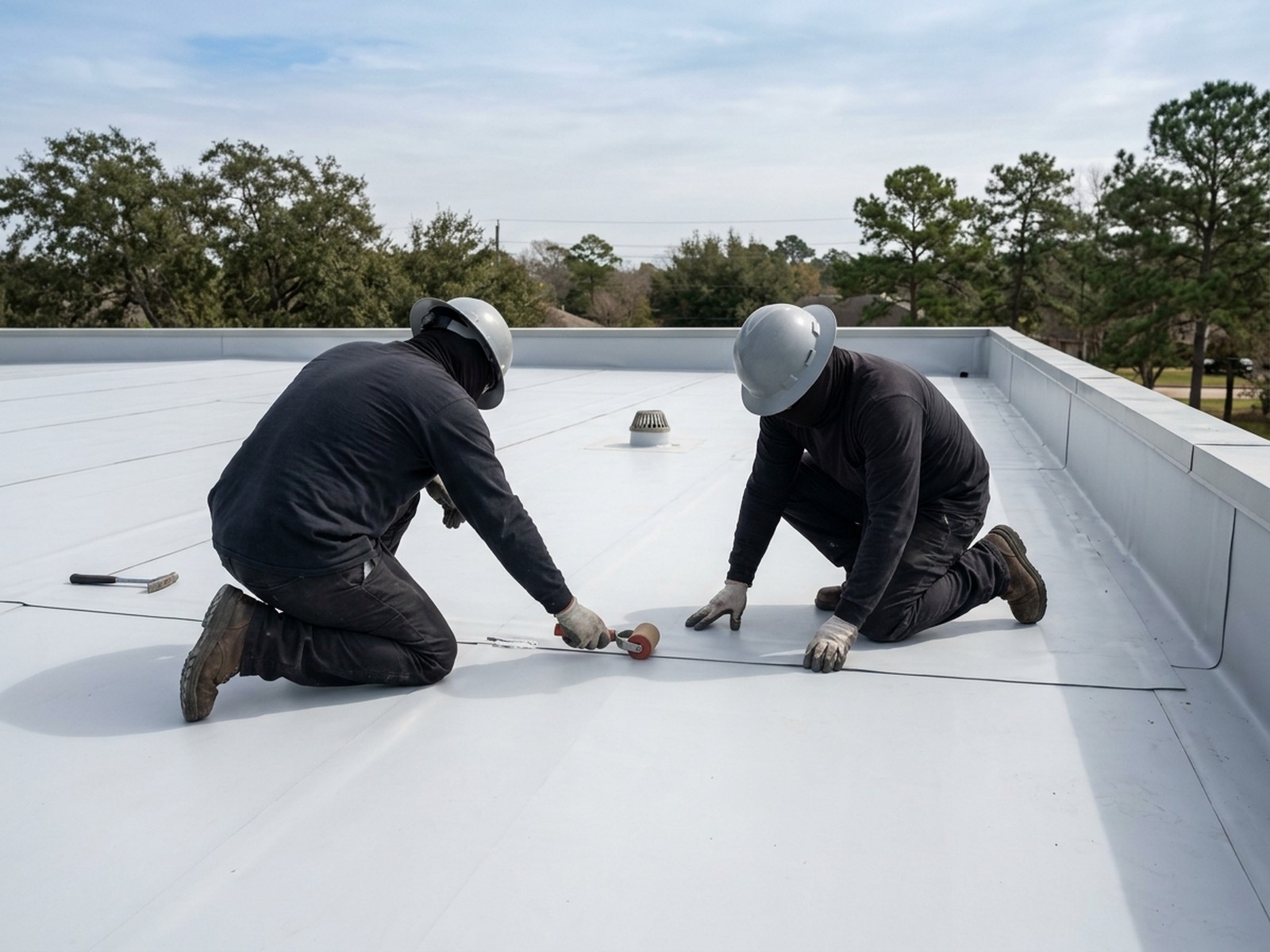
The contractor matters at least as much as the membrane, because every one of these systems fails at the details rather than in the middle of the field. Seams, flashings, curbs and terminations are where workmanship shows up.
Look for a contractor with a permanent local address, crews trained on the specific system being installed, and manufacturer approval where the warranty requires it. Ask to see a roof they installed three or four years ago rather than one finished last month. Ask what they do when they open the roof and find wet insulation, because the honest answer involves a written change and a conversation, not a crew quietly covering it.
Blue Rhino Roofing is Katy based and owner led, and our commercial roofing work runs across the 50-mile service area. The assessment comes back in writing with photographs before anyone talks about a system.
Frequently asked questions
Is TPO better than modified bitumen?
Neither is better in general. TPO is more reflective and faster to install on large open decks, and modified bitumen is more forgiving of foot traffic and easier for most crews to repair. The right answer depends on roof size, penetrations, traffic and how the building is used.
How long does a commercial flat roof last?
Service life depends on the system, the installation quality, the drainage and the maintenance, so no single number is honest. What consistently shortens life on Katy roofs is ponding water, deferred drain maintenance and unrepaired punctures from service traffic.
Can you install a new flat roof over the old one?
Sometimes. A recover can be a legitimate option when the existing assembly is dry and sound and the code path allows the added layer. It is the wrong option when insulation is wet, and finding out requires core samples or a moisture survey rather than a guess from the surface.
Is built-up roofing obsolete?
No. It is less common on new commercial work than it once was, but multi-ply BUR still offers redundancy that single-ply cannot match, and it remains a reasonable specification for buildings that can carry the weight.
What is a cool roof, and do I need one in Texas?
A cool roof is one with high solar reflectance and thermal emittance, rated by the Cool Roof Rating Council. In the Houston climate the cooling-season case is strong, and reflective options exist across single-ply, modified bitumen and coated built-up systems, so it is not a reason to pick one membrane type over another.
Does insurance cover a commercial roof replacement?
It depends on the cause and the policy. Sudden damage from a covered event is treated differently from wear, age and deferred maintenance, and commercial policies vary widely. Read your policy and talk to your carrier or broker.
Get the roof assessed before you pick a system
If your Katy building needs a low-slope roof and you are being handed quotes for three different systems, an independent written assessment of the existing assembly is the thing that makes those quotes comparable. Blue Rhino Roofing handles commercial flat and low-slope roofing across Katy and west Houston, and the assessment covers drainage, insulation condition and the details that will decide how long the next roof lasts.
Call (346) 733-8558 to schedule.

Shawn Swearingen
Shawn Swearingen leads Blue Rhino Roofing, a BBB A+ accredited, Texas-licensed roofing company based in Katy. He's on the roof and on the phone, and known for telling homeowners the straight truth about whether they need a repair or a replacement.