
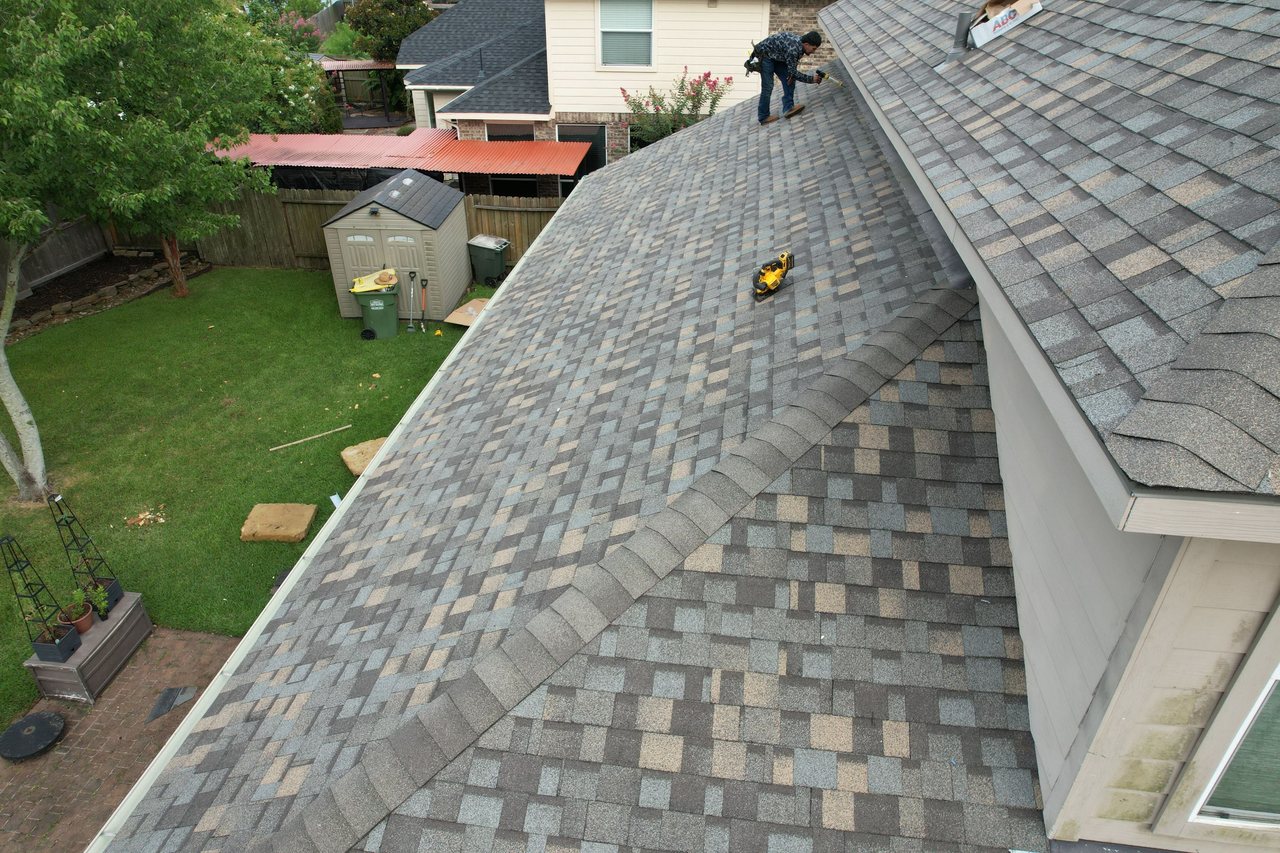
Here is the frustrating thing about hail damage: from your driveway, a hail-hit roof can look completely fine. The damage is real, but it is subtle, and that is exactly why so many homeowners miss it until a leak shows up months later. Let's walk through what real hail damage looks like up close, on each part of the roof, and how to tell it apart from ordinary wear.
Hail damage on asphalt shingles
This is where most Katy roofs take the hit. A genuine hail strike on a shingle typically shows:
- Bruises, dark spots where the granules were knocked away and the asphalt mat is exposed. Press one and it often feels soft, like a bruise on fruit.
- Round dents with no clear pattern, scattered randomly across the slope.
- Granule loss concentrated in dings, not the even fading of age.
- Cracks or fractures in the shingle from a hard, direct hit.
The random, scattered pattern is the giveaway. Hail does not aim, so real hits are inconsistent across the roof.
Hail damage on metal and soft components
Metal tells the clearest story. Because it dents instead of bruising, hail leaves obvious marks on:
- Gutters and downspouts, dimples and dents along the tops and faces.
- Roof vents, caps, and flashing, dented or knocked askew.
- Your AC condenser fins, a great tell, if the unit's fins are dented, the roof almost certainly took hits too.
We often check soft metals first, because if they are dented, the shingles deserve a close look.
"People stand in the driveway, look up, and say the roof looks fine. It usually does. Hail damage hides until you are standing on the roof with your hand on it. That is why a ground-level glance is not enough after a hailstorm."
Shawn Swearingen, Blue Rhino RoofingReal damage vs. just cosmetic wear
| Sign | Hail damage | Normal wear |
|---|---|---|
| Pattern | Random, scattered hits | Even, uniform across roof |
| Granule loss | Concentrated in dings | Gradual, all over |
| Texture | Soft bruise, exposed mat | Brittle, curled edges |
| Metals | Fresh dents | Oxidation, no dents |
| Timing | Appears right after a storm | Builds up over years |
Why hail damage matters even without a leak
A bruised shingle has lost the granules that protect it from the sun. Even if it is not leaking today, that spot will age and fail faster, and in our heat that happens quickly. Catching hail damage early means it can often be addressed as a hail damage roof repair and, when a storm caused it, may be a covered insurance loss. For the broader picture, see the general signs of roof storm damage.
Easy hail checks you can do safely
- Look at gutters and downspouts for fresh dents.
- Check the AC condenser fins for dimpling.
- Scoop gutters, lots of granules means hail likely hit the shingles.
- Look at painted surfaces and the mailbox for impact marks.
- If you see any of these, get a professional roof inspection.
The bottom line
Hail damage is real even when it is hard to see, bruised shingles, lost granules, and dented metals that quietly shorten your roof's life. If hail has hit your area, the smart move is a close inspection by someone who knows the difference between a genuine hit and normal wear. We will document what we find and tell you straight whether it warrants a repair or an insurance claim. Book a free inspection or call Shawn Swearingen at 346-733-8558.

Shawn Swearingen
Shawn Swearingen leads Blue Rhino Roofing, a BBB A+ accredited, Texas-licensed roofing company based in Katy. He's on the roof and on the phone, and known for telling homeowners the straight truth about whether they need a repair or a replacement.