
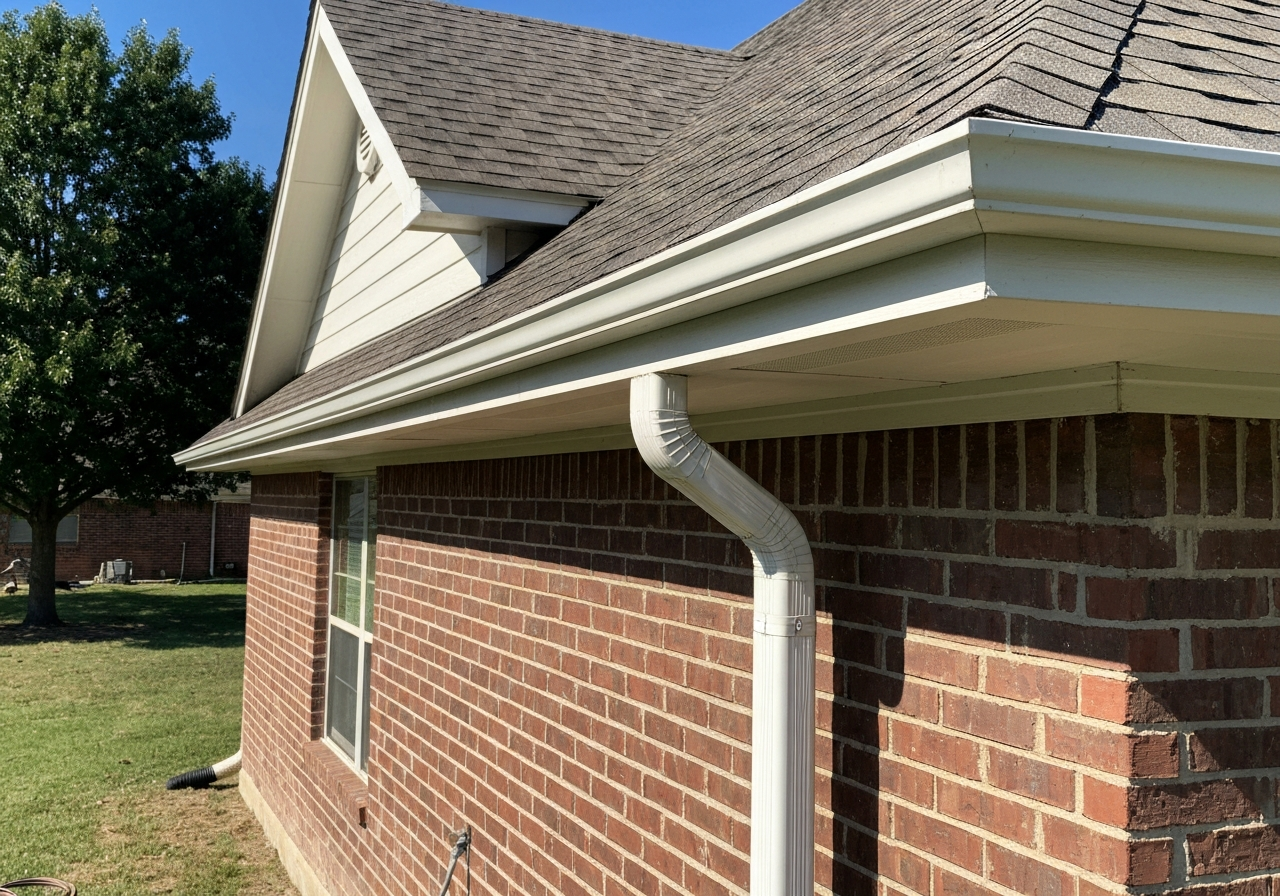
Many Houston-area homeowners do not know how much gutters should cost locally, which makes it easy to overpay or accept quotes that omit important line items. Unclear pricing leads to budget surprises, missed warranty protection, and repairs that are deferred until storm season creates urgent demand.
Local roof geometry, number of stories, and material choice drive most of the variation, so clear, comparable estimates are the fastest way to protect property value and avoid unnecessary upsells. Accurate expectations also make financing and scheduling simpler when crews are busiest.
This guide covers the materials and pricing breakdown; a material comparison table; seamless versus sectional options and cost differences; gutter guards and their suitability for Houston; local cost drivers; worked linear‑foot examples; why gutter work can seem expensive; how to read and compare quotes; common red flags; financing and the company’s free inspection + financing; local neighborhood and code considerations; maintenance and lifecycle planning; related resources and a closing call to action with FAQs.
Start with the materials and pricing breakdown to align your budget with the right system for your home.
Gutter installation cost — quick summary for Houston (Katy TX)
- Per-linear-foot ranges (estimates): Aluminum $5–$9/ft, Vinyl $3–$6/ft, Steel $6–$10/ft, Copper $15–$30/ft (all figures are estimates).
- Typical installed-project totals (estimates): 1,500 sq ft — Single-story $1,000–$2,500, Two-story $1,500–$3,500; 2,000 sq ft — Single-story $1,500–$3,500, Two-story $2,000–$4,500; 3,000 sq ft — Single-story $2,000–$5,000, Two-story $3,000–$7,000 (estimates).
- Service note: Free inspection + financing is available.
Assumptions: estimates assume standard eaves, no major fascia replacement, average roof complexity, and a typical number of downspouts.
Next: Materials and pricing breakdown.
Per-linear-foot ranges
Per-linear-foot prices below include material + standard labor for seamless K-style gutters and basic hangers (hidden hangers or strap hangers depending on installer); each number is an estimate and linked to source(s).
- Aluminum: $4–$12 per linear foot (low/mid/high) — estimate. Price drivers: gauge (.027–.032 commonly used), finish, color match, and ease of access. Sources: Bob Vila (aluminum ranges), Modernize (aluminum range) — both are estimates.
- Galvanized steel: $8–$18 per linear foot (low/mid/high) — estimate. Price drivers: thickness, rust-resistant coatings, and need for special brackets or rust treatment. Source: [This Old House / industry guides] (https://www.thisoldhouse.com/gutters/seamless-gutters-cost) and aggregated cost guides — estimate.
- Copper: $20–$45+ per linear foot (low/mid/high) — estimate. Price drivers: raw copper market, soldered seams vs. mechanical seams, and ornamental profiles. Source: [Fixr / This Old House] (https://www.fixr.com/costs/copper-gutters-installation), (https://www.thisoldhouse.com/gutters/seamless-gutters-cost) — estimate.
- Vinyl (PVC): $3–$10 per linear foot (low/mid/high) — estimate. Price drivers: UV-stabilized vs. economy vinyl, temperature suitability for Houston-area climate, and warranty. Source: [CostHelper / This Old House] (https://home.costhelper.com/gutters.html), (https://www.thisoldhouse.com/gutters/seamless-gutters-cost) — estimate.
data_ideas:
- Per-foot ranges as listed above (label each as estimate).
- Driver list per material (gauge, finish, access, slope, number of miters/corners).
Installed-system example ranges
Table shows installed-project totals for common system lengths. Totals are estimates and assume seamless K-style gutters, labor included, no fascia replacement, and typical accessory counts described below.
| Project LF | Low total (vinyl/aluminum) — estimate | Mid total (aluminum/steel) — estimate | High total (copper/high-end steel) — estimate |
|---|---|---|---|
| 40 ft | $120 — $480 | $240 — $720 | $800 — $1,800 |
| 100 ft | $300 — $1,000 | $800 — $1,800 | $2,000 — $4,500 |
| 150 ft | $450 — $1,500 | $1,200 — $2,700 | $3,000 — $6,750 |
| 200 ft | $600 — $2,000 | $1,600 — $3,600 | $4,000 — $9,000 |
Notes on table and ranges (all estimates):
- Low column examples use vinyl at the very low end and basic aluminum at the low-mid end (sources: CostHelper, This Old House).
- Mid column generally reflects aluminum typical installations or galvanized steel mid-pack (sources: Modernize, Angi).
- High column reflects copper or specialty steel with premium labor/complex rooflines (sources: Fixr, Bob Vila).
Example home-size scenarios — all numbers are estimates:
- Small bungalow (~40–60 LF): expect $200–$900 — estimate depending on material.
- Average single-family home (~120–180 LF): expect $900–$3,500 — estimate depending on material.
- Large two-story or complex roof (~200+ LF): expect $2,000–$9,000+ — estimate for copper/ specialty systems.
Assumptions and what's included / excluded
- Included (typical for per-foot estimates): seamless K-style gutters, standard hangers (hidden or strap per installer), cutting/mitering at corners, basic downspouts (price per downspout may be extra), on-site labor, and ordinary debris disposal. All dollar figures above are labeled estimate.
- Assumed downspouts: 1 downspout per 40–60 linear feet for the installed totals unless otherwise noted; additional downspouts add cost (typical downspout: $50–$250 each — estimate from industry guides).
- Single- vs two-story: two-story installations generally add 20–50% labor cost due to safety setup and height — estimate. Table mid/high ranges account for some complexity but exact quote depends on roof access.
- Excluded: fascia replacement or repair, major soffit work, custom gutter guards, extensive paint/finish work, structural repairs, permits beyond standard local requirements (if required), and ornate ornamental work (copper flashing, custom profiles) unless specified.
- Hanger types referenced: hidden hangers, spike-and-ferrule, and strap hangers; stronger hangers or specialty brackets may increase labor/material costs.
Material comparison — how Houston's heat, high humidity, and frequent storms affect gutter choice
Material comparison (cost, lifespan, pros/cons)
| Material | Estimate (typical cost per linear foot) | Durability / Lifespan | Pros / Cons | Best use |
|---|---|---|---|---|
| Aluminum | $5–$10/ft | 20–30 years | Pros: lightweight, corrosion-resistant; Cons: can dent in storms | Most homes — balanced cost and performance |
| Steel (galvanized or painted) | $4–$8/ft | 20–40 years (galvanized) | Pros: very strong; Cons: can rust if coating fails, heavier | Areas with heavy debris or impact risk |
| Copper | $15–$30/ft | 50+ years | Pros: very durable, low maintenance; Cons: high upfront cost | High-end homes, architectural projects |
| Vinyl (PVC) | $3–$6/ft | 10–20 years | Pros: low cost, corrosion-proof; Cons: brittle in heat/UV, can warp in storms | Budget installs, mild climates or short-term solutions |
| Seamless vs Sectional (cost difference) | Seamless: typically $1–$3/ft more than sectional | Lifespan similar to material; fewer leaks for seamless | Seamless: fewer joints → less leaking; Sectional: cheaper, easier DIY | Seamless for long runs and reduced leaks; sectional for tight budgets |
Transition to seamless vs sectional
Next, we’ll break down Seamless vs Sectional gutters so you can see how joint count, leak risk, and installation method affect total cost and performance.
Seamless vs sectional gutters — cost differences, pros/cons, when to pick which
Definitions
Seamless gutters are continuous lengths of gutter custom-extruded on-site to fit your roofline with only end caps and downspouts; sectional (or sectional/assembled) gutters are factory-cut pieces joined at seams and secured together on the house.
Cost difference
- Seamless premium (vs. sectional): expect about $2–4 per linear foot more for seamless on average (varies by material and region).
- Sectional cost: typically $0–$2 per linear foot less than seamless — often the lowest upfront option.
- One-time setup / truck fee (for seamless installs): $100–$300 to cover the on-site extrusion machine, truck setup and delivery — this is a common added charge for smaller jobs.
- Labor and material variance: both systems’ installed costs depend on material (aluminum, steel, copper, etc.), roof complexity, and local labor — expect wider installed-system ranges after material choice.
Pros / Cons
Seamless gutters
Pros
- Fewer leaks — only end caps and downspouts create joints, reducing leak points.
- Cleaner look — continuous runs look more finished and can match trim better.
- Lower maintenance — fewer seams mean fewer places for debris to jam and rot.
- Custom fit — made on-site for exact roofline lengths.
Cons
- Higher upfront cost — typically $2–4/lf premium plus setup/truck fee.
- Requires on-site machine — not always economical for very small jobs.
- Transportation limits — very long seamless runs may still require seams or specialty equipment.
Sectional gutters
Pros
- Lower initial price — generally the most budget-friendly option.
- Easier DIY or quick replacements — available off-the-shelf in standard lengths.
- No machine/setup fee — no on-site extrusion required for most jobs.
Cons
- More seams = more leak points — each joint is a potential failure.
- Less polished appearance — visible seams and joiners along the run.
- Higher maintenance over time — seams can collect debris and may need resealing.
When to choose which — quick decision checklist
- Choose seamless if you want lower long-term maintenance, a clean, professional look, and your project is large enough to justify the $100–$300 setup and $2–4/lf premium. Good for long rooflines, high-value homes, or climates with heavy rain.
- Choose sectional if you need the lowest upfront cost, want a quick or DIY install, or only need a short replacement where the seamless setup fee wouldn’t be economical. Ideal for small budgets or short runs.
Gutter guards: types, cost ranges, lifespan, and suitability for Houston
Guard types and short definition
- Mesh (screen) guards — metal or plastic mesh panels that sit over the gutter and filter leaves while letting water pass through. Simple, widely used, and available in coarse and fine weaves.
- Micro-mesh guards — very fine stainless-steel or aluminum mesh that blocks even small debris (pine needles, shingle grit) while allowing water through; usually installed on a solid frame.
- Reverse-curve (surface-tension) guards — smooth, contoured covers that direct water into the gutter by surface tension while most debris slides off the edge. They sit on top of the gutter and often look like a solid cover.
- Brush / foam (insert) guards — tubular brushes or foam inserts placed inside the gutter to block large debris. Low-cost and easy to install, but they are the lowest-performing class for fine debris.
Cost ranges & lifespan
- Mesh (screen)
- Cost (installed): Low–$4–$6 / ft, Mid–$6–$10 / ft, High–$10–$14 / ft (depending on metal type and manufacturer)
- Lifespan: ~10–15 years (shorter for cheaper plastics; metal lasts longer)
- Micro-mesh
- Cost (installed): Low–$8–$12 / ft, Mid–$12–$18 / ft, High–$18–$25 / ft
- Lifespan: ~15–25 years (stainless options at the high end)
- Reverse-curve (surface-tension)
- Cost (installed): Low–$6–$9 / ft, Mid–$9–$14 / ft, High–$14–$20 / ft
- Lifespan: ~10–15 years, performance and longevity depend on design and professional install
- Brush / foam inserts
- Cost (installed): Low–$2–$4 / ft, Mid–$4–$6 / ft, High–$6–$8 / ft
- Lifespan: ~3–7 years (foam can compress and brushes trap fine debris faster)
(Note: ranges reflect typical installed-per-foot pricing and vary by material quality, roof access, and labor. High-end products and professional warranties sit at the top of each range.)
Houston suitability
Houston homes see a mix of oak leaves, pine needles, seed pods, and heavy storm-driven debris, plus frequent heavy rain and occasional hail. That profile matters when choosing a guard:
- Micro-mesh performs better for Houston if your roof sheds fine debris (pine needles, shingle grit) and you want the least cleaning. It also handles heavy rain well.
- Mesh is a practical, cost-effective option where larger leaves are the main issue but may let needles through.
- Reverse-curve can perform well in heavy rain but may be less reliable with high volumes of small debris or if clogged by sticky wet leaves.
- Brush/foam are the lowest-cost options but perform worse for pine needles and sticky oak debris, requiring more frequent replacement or cleaning—generally not recommended as a long-term solution in Houston neighborhoods with heavy tree cover.
Choose based on the local tree types around your home, gutter pitch, and how much maintenance you want to avoid.
Maintenance impacts
- Cleaning frequency: Micro-mesh and high-quality mesh reduce cleaning frequency the most; brush/foam and low-end mesh require the most frequent attention.
- Inspection & repairs: Reverse-curve and metal micro-mesh systems need occasional checks for fastener integrity after storms; foam/brush may need seasonal replacement.
- Roof & gutter health: Better-fitting guards (micro-mesh, quality mesh) lower overflow and reduce fascia/soffit water damage risk over time.
Next, we’ll look at how these material choices and system quality drive actual installed costs in Houston neighborhoods — including per-linear-foot material pricing and typical installed-system ranges.
Main Houston/Texas cost drivers (local context and neighborhoods)
Labor & scheduling
Local labor rates and lead times affect gutter-installation cost in the Houston metro. Expect higher prices during spring and late summer (peak storm season) when roofers and gutter crews are busiest; emergency repairs after storms can push rates even higher. Blue Rhino Roofing usually schedules routine installs within a few weeks, but storm-related demand can extend lead times to several weeks.
Roofing/fascia condition
Gutters attach to the fascia and sometimes the roof edge; damaged fascia or rotten trim increases cost because contractors must repair or reinforce attachment points before installing gutters. Example fascia-repair price ranges (labor + materials): $100–$350 per linear section (estimate) for minor patch/trim work, $300–$800 per section (estimate) for full fascia replacement — ask your contractor for a site-specific quote and verify these estimates with an on-site inspection.
Suggested note: Verify fascia repair scope and pricing directly with your contractor during the free inspection — prices vary with material, rot extent, and if soffit or rafter tails are also affected.
Height & access
Extra charges commonly apply when crews need special equipment or extra time:
- Two-story homes: additional climb/time premium.
- Three-story homes: larger premium and likely lift rental.
- Dense trees or landscaping: added labor to protect vegetation and create safe access.
- Lift rental: typically required for 2–3 story installs in tight yards.
Roof complexity & downspouts
Complex rooflines add labor and parts: valleys, multiple dormers, and irregular eaves take more time to measure, fit, and fasten gutters. Expect junctions, miters, and extra hangers to raise cost compared with a simple, single-plane roof. Typical charge per additional downspout (beyond the basic layout): $75–$175 per downspout (estimate) — this covers materials and extra labor for routing and splash blocks. Confirm per-downspout pricing with your contractor because placement and length change costs.
Permits/disposal
- When permits are needed: small residential gutter installs usually don’t need a building permit, but larger exterior renovations, structural fascia replacement, or projects bundled with roofing work may trigger local permit requirements. Check with your city or county permitting office if the job is part of larger exterior work.
- Disposal and dumpster fees: contractors often include a disposal line item for tear-off debris or removed fascia. Typical disposal/dumpster fee when included on a job: $75–$300 (estimate) depending on haul distance and debris volume — get this confirmed in writing.
- For local permit guidance and to verify requirements, consult the official TDLR / local permit pages:
Verification steps homeowners should take:
- Check your city/county permit portal for "exterior repairs" or "roofing/gutters."
- Ask your contractor which permits they pull (if any) and request permit numbers.
- If in a deed-restricted neighborhood or HOA, confirm HOA approval rules before work begins.
These local cost drivers influence per-linear-foot pricing — next, we’ll show linear-foot examples and installed-system ranges.
Linear-foot pricing breakdown and real examples (40 ft, 100 ft, 150 ft, 200 ft)
How contractors measure linear footage
Contractors measure gutter length by running a tape along the outside edge where gutters will sit — from corner to corner, including all roof eaves. Measurements are typically rounded up to the nearest whole foot; complex corners may add short runs that are also rounded. All amounts below are estimates.
Example 1 — 40 ft (simple single-story)
- Assumptions:
- Home type: single-story bungalow
- Roof complexity: simple, single plane
- Number of downspouts: 2
- Per-foot rates: low $4/ft, mid $6/ft, high $8/ft
- Downspout cost (each): low $50, mid $75, high $100 (est.)
- Setup / mobilization: low $75, mid $125, high $200 (est.)
Calculations:
- Low estimate:
- Material & labor: $4/ft × 40 ft = $160 (est.)
- Downspouts: 2 × $50 = $100 (est.)
- Setup: $75 (est.)
- Total low = $160 + $100 + $75 = $335 (estimate)
- Mid estimate:
- Material & labor: $6/ft × 40 ft = $240 (est.)
- Downspouts: 2 × $75 = $150 (est.)
- Setup: $125 (est.)
- Total mid = $240 + $150 + $125 = $515 (estimate)
- High estimate:
- Material & labor: $8/ft × 40 ft = $320 (est.)
- Downspouts: 2 × $100 = $200 (est.)
- Setup: $200 (est.)
- Total high = $320 + $200 + $200 = $720 (estimate)
Example 2 — 100 ft (typical)
- Assumptions:
- Home type: average single-story ranch
- Roof complexity: typical with one valley
- Number of downspouts: 4
- Per-foot rates: low $4/ft, mid $6/ft, high $8/ft
- Downspout cost (each): low $50, mid $75, high $100 (est.)
- Setup / mobilization: low $100, mid $150, high $250 (est.)
Calculations:
- Low estimate:
- Material & labor: $4/ft × 100 ft = $400 (est.)
- Downspouts: 4 × $50 = $200 (est.)
- Setup: $100 (est.)
- Total low = $400 + $200 + $100 = $700 (estimate)
- Mid estimate:
- Material & labor: $6/ft × 100 ft = $600 (est.)
- Downspouts: 4 × $75 = $300 (est.)
- Setup: $150 (est.)
- Total mid = $600 + $300 + $150 = $1,050 (estimate)
- High estimate:
- Material & labor: $8/ft × 100 ft = $800 (est.)
- Downspouts: 4 × $100 = $400 (est.)
- Setup: $250 (est.)
- Total high = $800 + $400 + $250 = $1,450 (estimate)
Example 3 — 150 ft (two-story, moderate complexity)
- Assumptions:
- Home type: two-story colonial
- Roof complexity: moderate (multiple planes, one valley)
- Number of downspouts: 5
- Per-foot rates: low $5/ft, mid $7/ft, high $9/ft (slightly higher for two-story work)
- Downspout cost (each): low $60, mid $85, high $110 (est.)
- Setup / mobilization & safety: low $150, mid $250, high $400 (est.)
Calculations:
- Low estimate:
- Material & labor: $5/ft × 150 ft = $750 (est.)
- Downspouts: 5 × $60 = $300 (est.)
- Setup: $150 (est.)
- Total low = $750 + $300 + $150 = $1,200 (estimate)
- Mid estimate:
- Material & labor: $7/ft × 150 ft = $1,050 (est.)
- Downspouts: 5 × $85 = $425 (est.)
- Setup: $250 (est.)
- Total mid = $1,050 + $425 + $250 = $1,725 (estimate)
- High estimate:
- Material & labor: $9/ft × 150 ft = $1,350 (est.)
- Downspouts: 5 × $110 = $550 (est.)
- Setup: $400 (est.)
- Total high = $1,350 + $550 + $400 = $2,300 (estimate)
Example 4 — 200 ft (large, complex roof)
- Assumptions:
- Home type: large multi-plane two-story
- Roof complexity: high — multiple valleys, many corners
- Number of downspouts: 6
- Per-foot rates: low $6/ft, mid $8/ft, high $10/ft (complexity premium)
- Downspout cost (each): low $70, mid $100, high $130 (est.)
- Setup / mobilization & extra labor: low $200, mid $350, high $600 (est.)
Calculations:
- Low estimate:
- Material & labor: $6/ft × 200 ft = $1,200 (est.)
- Downspouts: 6 × $70 = $420 (est.)
- Setup: $200 (est.)
- Total low = $1,200 + $420 + $200 = $1,820 (estimate)
- Mid estimate:
- Material & labor: $8/ft × 200 ft = $1,600 (est.)
- Downspouts: 6 × $100 = $600 (est.)
- Setup: $350 (est.)
- Total mid = $1,600 + $600 + $350 = $2,550 (estimate)
- High estimate:
- Material & labor: $10/ft × 200 ft = $2,000 (est.)
- Downspouts: 6 × $130 = $780 (est.)
- Setup: $600 (est.)
- Total high = $2,000 + $780 + $600 = $3,380 (estimate)
Summary
Estimated totals (low → mid → high) for the four example jobs: 40 ft = $335 → $515 → $720 (est.), 100 ft = $700 → $1,050 → $1,450 (est.), 150 ft = $1,200 → $1,725 → $2,300 (est.), 200 ft = $1,820 → $2,550 → $3,380 (est.). Next: why costs are high and which material choices drive price differences.
Why gutter work can seem expensive (main reasons)
Labor, safety & equipment
Gutter installation and repair are labor-intensive and require trained crews who work on ladders and roofs — not just quick backyard jobs. In Houston, crews also need to be ready for seasonal demand spikes (storm season) which can raise labor rates and wait times.
- Crew labor: A typical 2‑person crew for a straightforward residential gutter install can take 4–8 hours depending on roof complexity and length. Estimated labor cost drivers: $40–$85 per crew-hour (estimate; varies by company and demand).
- Safety & insurance: Roofing/gutter work requires liability and workers’ comp coverage. Contractors factor these insurance costs into bids to cover on-the-job risk and potential claims.
- Equipment & access: Professional jobs use lift trucks, scaffolding, commercial seamers and power tools. Example estimated equipment costs: boom lift rental $250–$600/day; scaffolding setup $200–$800 (job-dependent). Using proper equipment increases safety and speed but raises installed cost.
All figures above are estimates and can vary with local market conditions, crew experience, and peak-season demand in the greater Houston area.
Removal, disposal & unexpected repairs
Quotes often look higher because installers price for what’s visible and the likely hidden work under gutters.
- Removal & disposal: Old gutters, fascia, and flashing must be removed and hauled away; disposal fees and recycling/scrap handling are factored into the price.
- Hidden repairs: Common hidden issues found during removal include rotten fascia or rafter tails, damaged roof edge flashing, insect/termite damage, and undersized or clogged downspouts. Each can add labor and materials — for example, replacing a rotten fascia board might add $75–$250 (estimate) for materials and labor per affected section.
- Site conditions: Two‑story homes, tight access, or heavy landscaping (which protects from trucks) increase time and care required, adding to cost.
Because Houston sees heavy rains and storm events, installers frequently encounter water damage or corrosion during removal — that’s a common reason final invoices can rise from initial ballpark quotes.
Warranty & compliance costs
Contractors build regulatory and warranty obligations into pricing. Typical cost items include:
- Insurance premiums and claims reserves (general liability, workers’ comp)
- Licensing, permit fees, and local code compliance (city/municipal requirements)
- Manufacturer and installer warranties (labor warranties, product guarantees) — note: language that promises absolute guarantees should be softened to reflect terms and exclusions in a written warranty
Transition to next section
Understanding these cost drivers makes it easier to compare bids — next, learn how gutter material and complete installed-system choices translate into per-linear-foot and total installed cost ranges.
How to read a gutter installation quote — line items and common abbreviations
Expected line items — what you should see on a quote (and whether they’re commonly included or optional)
- Materials — gutters (per linear foot) — describes type (aluminum, steel, copper, K-style, half-round). Commonly included.
- Materials — downspouts (each/EA) — number and size of downspouts listed. Commonly included.
- Fascia/trim prep and repair — any replacement or repair of fascia/trim needed to attach gutters. Sometimes included (often shown as optional or priced separately).
- Hangars/brackets/fasteners — hardware type and spacing (e.g., hidden hangers). Commonly included.
- Seam sealants and splash guards — materials for joints and water deflection. Sometimes included (may be optional).
- End caps, miters, and corners — fabrication and installation of special pieces. Commonly included (but separate line items).
- Elbows and offsets — for routing downspouts around obstacles. Optional (only if needed).
- Gutter guards/leaf protection — product type and coverage (partial or full). Optional.
- Downspout extensions and drains — routing water away from foundation (e.g., pop-up drains). Optional.
- Labor — installation (HR or flat) — estimated hours or fixed labor price. Commonly included.
- Removal and disposal (R&R if replacing existing) — removing old gutters and hauling away debris. Commonly included if this is a replacement; optional for new construction.
- Permit fees — any local permit costs if required. Optional (depends on local rules).
- Site cleanup — final cleanup and magnet sweep for nails/metal. Commonly included.
- Warranty — materials and workmanship — length and coverage details. Commonly included (but terms vary).
- Insurance and licensing statement — proof of liability and worker’s comp coverage or license numbers. Commonly included (should always be present).
- Sales tax — shown as a separate line where applicable. Commonly included.
- Miscellaneous or allowance — contingency amounts for unforeseen issues (listed as allowance). Optional.
Common abbreviations and meanings
- LF — Linear Foot (measurement used for gutter length)
- EA — Each (unit price per individual item, e.g., downspout)
- HR — Hour / Hourly (labor time or hourly rate)
- R&R — Remove & Replace (taking out old material and installing new)
- SSP — Supply, Service, and Protect (or sometimes Supply & Service Price) — clarify with contractor if used; typically refers to bundled supply and service pricing
- SS — Stainless Steel (material type)
Bid comparison checklist — step-by-step
- Normalize materials — ensure each bid specifies the same gutter profile and material (e.g., 5" K-style aluminum). If one bid is aluminum and another is steel or includes gutter guards, ask for alternate pricing so you can compare like-for-like.
- Count downspouts and routing — verify the number, size, and location of downspouts are the same across bids; differences here can change cost and performance.
- Confirm scope for fascia/repairs — check whether fascia/trim prep or replacement is included or quoted as an extra; factor repair costs into the total.
- Compare labor descriptions and hours (HR) — look at whether labor is charged hourly or as a flat rate and whether it includes site cleanup and debris disposal.
- Verify hardware and workmanship details — compare hanger spacing, fastener types, seam techniques, and whether gutters are soldered, riveted, or sealed.
- Check warranty terms — confirm length and what’s covered (materials vs workmanship) and whether warranty is backed by manufacturer or the contractor.
- Confirm timeline and project start/end dates — ensure the schedule suits your needs and that the bid includes estimated completion.
- Verify insurance and licenses — ask for proof of liability insurance, worker’s comp, and contractor license (if required locally). Do not accept a verbal claim — request documentation.
- Compare removal/disposal and cleanup — ensure removal of old gutters and final cleanup are included, or add those costs when comparing.
- Normalize taxes, permits, and allowances — make sure sales tax, permit fees, and any contingency allowances are treated consistently across bids.
- Ask about change-order pricing — confirm how unforeseen issues (rotted fascia, hidden damage) will be priced and approved.
- Total the out-the-door price — include materials, labor, disposal, permits, taxes, and any optional add-ons to get a true apples-to-apples comparison.
If any bid omits the items above, lists vague abbreviations without explanation, or refuses to provide proof of insurance/licenses, treat those as red flags and ask questions or consider other contractors before deciding.
Top red flags — what to watch for and what to do instead
- No proof of license or insurance
Why this is a problem: Without a license or liability/workers’ comp insurance, you may be responsible for damages or injuries — and some local permits require licensed contractors.
What to do instead: Ask for the contractor’s license number and an insurance certificate before any work starts; verify both with the issuing agency and the insurer.
- Demands full payment up front
Why this is a problem: Paying 100% before work begins removes leverage and increases the risk of delays or unfinished work.
What to do instead: Agree to a reasonable payment schedule (for example, deposit + progress payments + final payment when work is complete) and get it in writing.
- Vague or no written contract
Why this is a problem: Oral promises leave scope, materials, timelines, and warranty terms unclear and hard to enforce.
What to do instead: Require a written contract that lists scope, materials, brand/model, start and completion dates, cleanup responsibilities, payment schedule, and warranty details.
- Extremely low estimate compared with others
Why this is a problem: A much lower price might mean cut corners, inferior materials, or surprise change orders later.
What to do instead: Ask for a line-item estimate and compare materials and labor. If a bid is far lower, request explanations and references.
- No local references or poor reviews
Why this is a problem: Lack of local references or negative feedback can indicate inconsistent work quality or poor communication.
What to do instead: Request recent, local references and check online reviews. Follow up with homeowners who had similar work done.
- Pressures to sign immediately or uses high-pressure sales tactics
Why this is a problem: Pressure can lead to rushed decisions and missed red flags in the contract.
What to do instead: Take time to compare bids, read the contract, and get a second opinion — reputable contractors expect you to shop around.
What to request instead
- State contractor license number (verify with the state licensing board)
- Certificate of Insurance (COI) showing general liability and workers’ compensation coverage and the insurer’s contact info
- Written, itemized contract with scope, materials (brands/models), timeline, payment schedule, cleanup and disposal terms, and penalties for missed deadlines
- Written warranty (product and workmanship) that clearly states duration and who honors it
- Local references with recent projects similar to yours (include contact info)
- Permit documentation or confirmation that permits will be pulled and inspections scheduled if required by your city or county
If you get these documents and the answers you need, you’ll be in a much stronger position to choose a reliable contractor. Next, consider financing options and schedule a free inspection to get an accurate, on-site estimate.
Typical financing options
- Contractor financing (in-house or partnered) — Example terms: 6–18 months deferred interest or 12–60 month installment plans (these are estimates).
- Pros: Fast, one application with the contractor, often streamlined approval.
- Cons: Deferred-interest plans can be costly if balance isn’t paid before promo ends; read fine print.
- Third‑party installment loans (lender or marketplace) — Example terms: 12–60 month fixed payments (estimate).
- Pros: Predictable monthly payments, can shop for competitive interest rates.
- Cons: Requires credit check; rates vary with credit score.
- Credit card — Example terms: standard credit card APRs or short promotional 0% offers (estimate).
- Pros: Convenient, potential rewards/points, short-term promotional offers possible.
- Cons: High APRs after promos; may not be best for larger projects.
- Home Equity Line of Credit (HELOC) / Home equity loan — Example terms: variable or fixed rates over 5–15 years (estimate).
- Pros: Often lower interest rates because loan is secured by your home; good for larger projects.
- Cons: Puts your home at risk if payments aren’t made; closing costs may apply.
(All sample terms above are estimates. Exact offers vary by lender, credit profile, and time.)
Payment schedules & deposits
It’s common to see a deposit of about 10–30% (estimate) when scheduling gutter work, followed by staged payments as work progresses (for example: deposit, mid‑project draw, and final payment on completion). Ask for a written payment schedule in the contract. Be cautious if a contractor demands full payment upfront — that’s a red flag; similarly, vague milestones or refusal to provide a clear timeline and lien waiver on final payment should prompt second opinions.
Inspection & estimate
We offer a quick, no‑pressure free inspection + financing option to review your gutters, provide an itemized estimate, and discuss payment choices.
Local considerations — Houston neighborhoods, climate, HOAs, and codes
Climate impacts
Houston’s climate — intense sun, heavy rain, frequent storms, high humidity, and coastal salt air in some areas — affects gutter performance and material longevity. Choose materials that resist UV degradation, corrosion from salt and moisture, and handle heavy downpours and high winds; those factors influence profile, seam type, and fastener choice as much as upfront cost.
Neighborhood notes
- Katy: Newer subdivisions often use modern homes with low-slope roofs — seamless aluminum or K-style gutters are common. Expect HOA guidelines in many communities.
- Sugar Land: Mix of master-planned communities and older areas — durability and curb appeal matter; many homeowners prefer painted aluminum.
- Richmond: Some rural lots and older homes — consider robust mounting for wind and debris from nearby trees.
- Cypress: Heavily treed neighborhoods — leaf protection and larger downspouts are often needed.
- The Woodlands: High tree density and strict aesthetics — gutter guards and a neat finish are typical homeowner priorities.
- Conroe: More rural and wooded properties — heavy debris and wind resistance should guide choices.
- Pearland: Coastal humidity and storms — corrosion-resistant materials and secure fastenings recommended.
- Missouri City: Varied home ages and styles — match gutters to home style while prioritizing water capacity.
- Pasadena: Coastal influence and older neighborhoods — choose materials with good corrosion resistance and inspect for storm damage risk.
- Jersey Village: Suburban lots with tree cover — maintenance-friendly systems (guards, larger downspouts) help reduce clogs.
- Houston Heights: Historic homes and style-sensitive rules — opt for profiles and colors that respect historic character; professional installation to protect trim is important.
Codes & HOA checks
Before ordering or installing gutters, verify local building codes and HOA rules for profile, material, color, and placement — rules vary by city and neighborhood. Don’t rely on verbal answers: request written confirmation of restrictions and any permit requirements from your HOA or local permitting office so your installation avoids fines or rework.
Maintenance, expected lifespans, lifecycle cost and upgrades (including rain harvesting)
Lifespan & maintenance schedule
- Aluminum gutters — Lifespan (estimate): 15–25 years.
Inspection / cleaning (estimate): twice a year (spring and fall); after major storms if area has heavy debris.
- Galvanized / painted steel gutters — Lifespan (estimate): 10–20 years (shorter in coastal or high-humidity areas).
Inspection / cleaning (estimate): twice a year; inspect for rust or paint failure annually.
- Copper gutters — Lifespan (estimate): 50+ years.
Inspection / cleaning (estimate): once a year; check seams and patina development, clean debris as needed.
- Vinyl (PVC) gutters — Lifespan (estimate): 10–20 years (can become brittle in extreme sun).
Inspection / cleaning (estimate): twice a year; inspect after temperature extremes for cracking or sagging.
All lifespans and frequencies above are estimates — actual life depends on local climate, roof material, tree cover, and installation quality. For practical inspection tips and common failure points, see InterNACHI’s guidance: https://www.nachi.org/gutters-downspouts-inspection.htm
Lifecycle cost planning
Budgeting for gutters is easier when you annualize the upfront cost plus ongoing maintenance. Example (all figures are estimates for planning only):
- Installed cost (example): Aluminum gutters at $8/linear foot installed × 200 ft = $1,600 (estimate).
- Ongoing maintenance/repairs (estimate): $100/year.
- Total 10-year cost = $1,600 + ($100 × 10) = $2,600.
- Annualized cost = $2,600 ÷ 10 = $260/year (estimate).
If you prefer a 5-year budgeting window: Total 5-year cost = $1,600 + ($100 × 5) = $2,100 → $420/year (estimate). Use this simple math to compare materials and add-ons (guards, heated gutters) when planning your budget.
Rainwater harvesting integration
- Simple rain barrel + diverter — Typical retrofit cost (estimate): $75–$350. Good for small-scale garden irrigation; low complexity.
- Multiple barrels or modular above-ground cisterns — Typical cost (estimate): $300–$1,500. Increased storage and uses, may need overflow routing.
- Underground cistern + basic pump and filtration for non-potable use — Typical cost (estimate): $2,000–$10,000+. Requires excavation, permits in some areas, and professional installation for pumps/filtration.
- Considerations: gutter material and downspout routing, first-flush diverters, leaf/debris screens, local code or HOA restrictions, and intended end use (landscape vs. indoor non-potable). Retrofitting often requires re-routing downspouts and installing screened inlets to protect storage from debris and mosquitoes.
For authoritative federal guidance on designing and implementing rainwater systems, see EPA rainwater harvesting guidance: https://www.epa.gov/npdes/rainwater-harvesting-conservation-credit-codes-and-cost-literature-review-and-case-studies and the EPA’s rain barrel resources: https://www.epa.gov/soakuptherain/soak-rain-rain-barrels
Roof warranty interactions
Before modifying gutters or adding attachments that touch the roofline, check your roof manufacturer’s warranty and contact your roofer. Most gutter installations don’t void a roof warranty, but improper fastening, drilling into roof edges, or unsupported standoffs can cause problems (shingle lifting, flashing damage). Ask your contractor to document work and confirm that attachment methods are compatible with your roofing system.
References and further reading follow.
Related resources and internal links
- Gutters service overview — Overview of our gutter services, including maintenance, repair, and replacement options.
- Gutter installation service page (Houston) — Details on gutter installation in the Houston area, including service areas and what the installation includes.
To get a personalized estimate, start the CRM quote process by requesting a quote or calling us to schedule an inspection.
What to expect
- Scheduling: We'll confirm a convenient day and a 1–2 hour arrival window and send a reminder with the crew contact.
- On-site visit: A trained technician will inspect gutters, downspouts, roof edges, and fascia — taking measurements and photos to document issues.
- Written estimate with line items & photos: You’ll receive a clear, itemized estimate that lists parts, labor, and warranty info, plus annotated photos of problem areas.
- Financing discussion: We’ll review payment options and available plans so you can choose the solution that fits your budget.
How to schedule
Call or book online and have these handy to speed the process: your property address, photos of the roof/gutters (if available), recent storm dates or known damage, and any previous repair invoices or warranty paperwork. If you rent, bring the landlord’s permission or contact info.
Request your appointment today to get a free inspection + financing.
Frequently Asked Questions
Q: Is the estimate free, and what does the free inspection include?
A: Yes — the estimate is free. The free inspection includes a roof- and gutter-condition check, measurements, downspout and drainage assessment, photos, and a written estimate with recommended repairs or options; see "Free Inspection" for details.
Q: Do you charge extra to remove old gutters?
A: Removal may incur a small additional fee depending on the gutter condition and disposal needs — see "What the estimate includes" for typical removal scenarios and when removal is billed separately.
Q: Will adding gutter guards significantly increase the cost?
A: Gutter guards add to the total but usually as a separate line item; see "Gutter guards" to compare guard types and how each affects the final price.
Q: Are two-story homes or properties with tall trees charged more?
A: Properties that need special access equipment or extra safety measures (two-story homes, tall trees) may have higher labor or equipment charges; see "Job complexity & access" for common surcharges.
Q: How should I compare two different bids?
A: Focus on the same scope, materials, warranties, and line-item labor rather than just total price — see "How to read a quote" for a checklist to compare bids side-by-side.
Frequently Asked Questions About Gutter Installation
Is the estimate actually free and what does a free inspection include?
Yes. The estimate is free and the inspection visit includes a visual roof and eave assessment, measurement of gutter runs, counting and placement of downspouts, photos of areas of concern, identification of any fascia or soffit damage that may need repair, and a verbal walkthrough of recommended options. You will receive a written estimate with line-item pricing and photos if you request it during the visit.
Will old gutters be removed for free or is there an extra fee?
Removal is often included when new gutters are being installed, but it depends on condition and disposal needs. If old gutters are loose, heavily corroded, or attached with excessive fasteners and require extra labor or a lift, contractors may add a removal or disposal fee. Ask for removal listed as a separate line item on the estimate so you can see whether it is included or charged extra.
How much extra will gutter guards add to my total cost in Houston?
Gutter guard cost varies by type. Basic brush or foam guards may add a few dollars per linear foot, mesh or screen guards typically add roughly $6 to $12 per linear foot installed, and premium micro mesh systems commonly add $12 to $25 per linear foot. Factor in a modest lifespan and maintenance differences when comparing totals; the installed guard cost will be shown as its own line item on a transparent estimate.
Do installers charge more for two-story homes or homes with tall trees?
Yes, because extra height and difficult access increase labor, time, and insurance exposure. Two-story homes, tall trees that require careful pruning or lift work, and jobs needing scaffolding or boom lifts generally carry a surcharge or an hourly equipment charge. Good quotes list height or access fees separately so you can see what portion of the price buys safer access.
How do I compare two gutter installation bids that look different?
Compare apples to apples by checking these items: materials and gauge, whether gutters are seamless or sectional, total linear feet accounted for, number and type of downspouts, hangers and fastener types, corner/end-cap counts, whether removal and disposal are included, fascia or soffit repair allowances, warranty terms, and any height or access fees. Confirm the same performance level for gutter guards if included and ask for photos or references of completed work. A clear, line-item estimate lets you compare value rather than just bottom-line price and makes it easier to choose confidently when you book a free inspection + financing appointment.
Schedule your free inspection + financing appointment
Get a written, line-item estimate with photos and a financing conversation during the visit. Book a site inspection so an estimator can measure runs, document any repairs required, and review available payment options in person on the same appointment.

Shawn Swearingen
Shawn Swearingen leads Blue Rhino Roofing, a BBB A+ accredited, Texas-licensed roofing company based in Katy. He's on the roof and on the phone, and known for telling homeowners the straight truth about whether they need a repair or a replacement.