
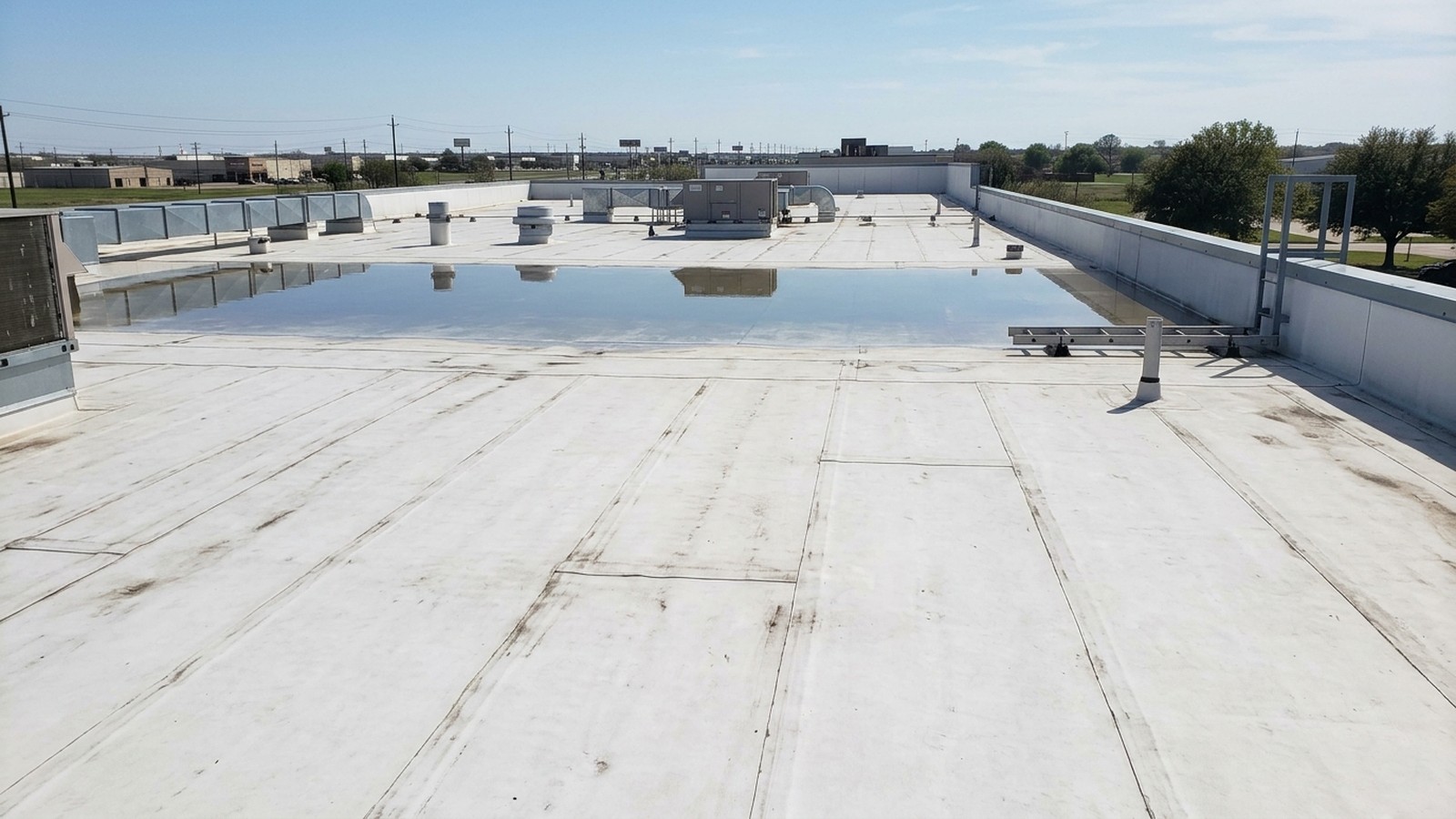
Water that is still sitting on a low-slope roof 48 hours after the rain stopped is ponding, and that is the line the industry draws between normal drainage and a defect. Anything that clears inside that window under drying conditions is what a flat roof is supposed to do. Anything still there on day three is telling you something about slope, drains or the deck underneath.
Fall is when this shows up in west Houston. A Katy commercial roof has just taken a full storm season, the drains have collected five months of debris, and the building owner is starting to build next year's capital budget. This guide covers what causes ponding, what it actually costs you, and what the fix looks like.
What counts as ponding water on a flat roof?
Ponding is water that remains on the roof 48 hours or longer after rainfall, under conditions where it should have drained or evaporated. The Asphalt Roofing Manufacturers Association uses exactly that definition, describing ponding water as water which remains on a roof 48 hours or longer.
The National Roofing Contractors Association frames it as a slope test rather than a water test. Writing in Professional Roofing, NRCA's position is that the criterion for judging proper slope for drainage is that there be no ponding water on the roof 48 hours after a rain during conditions conducive to drying, with short-duration ponding treated as acceptable and unavoidable.
So a puddle the morning after a storm is not a problem. A puddle that is still there on Thursday after Monday's rain, and that reappears in the same place every time, is a drainage defect with a location you can point at.
Why does water pond on a flat roof in the first place?
Flat roofs are not flat. They are low-slope roofs built to move water to a drain, and ponding means something in that path is not working. There are usually four candidates.
| Cause | What it looks like | Typical fix |
|---|---|---|
| Not enough slope as built | Broad, shallow ponds across large areas, present since day one | Tapered insulation, crickets and saddles to rebuild positive drainage |
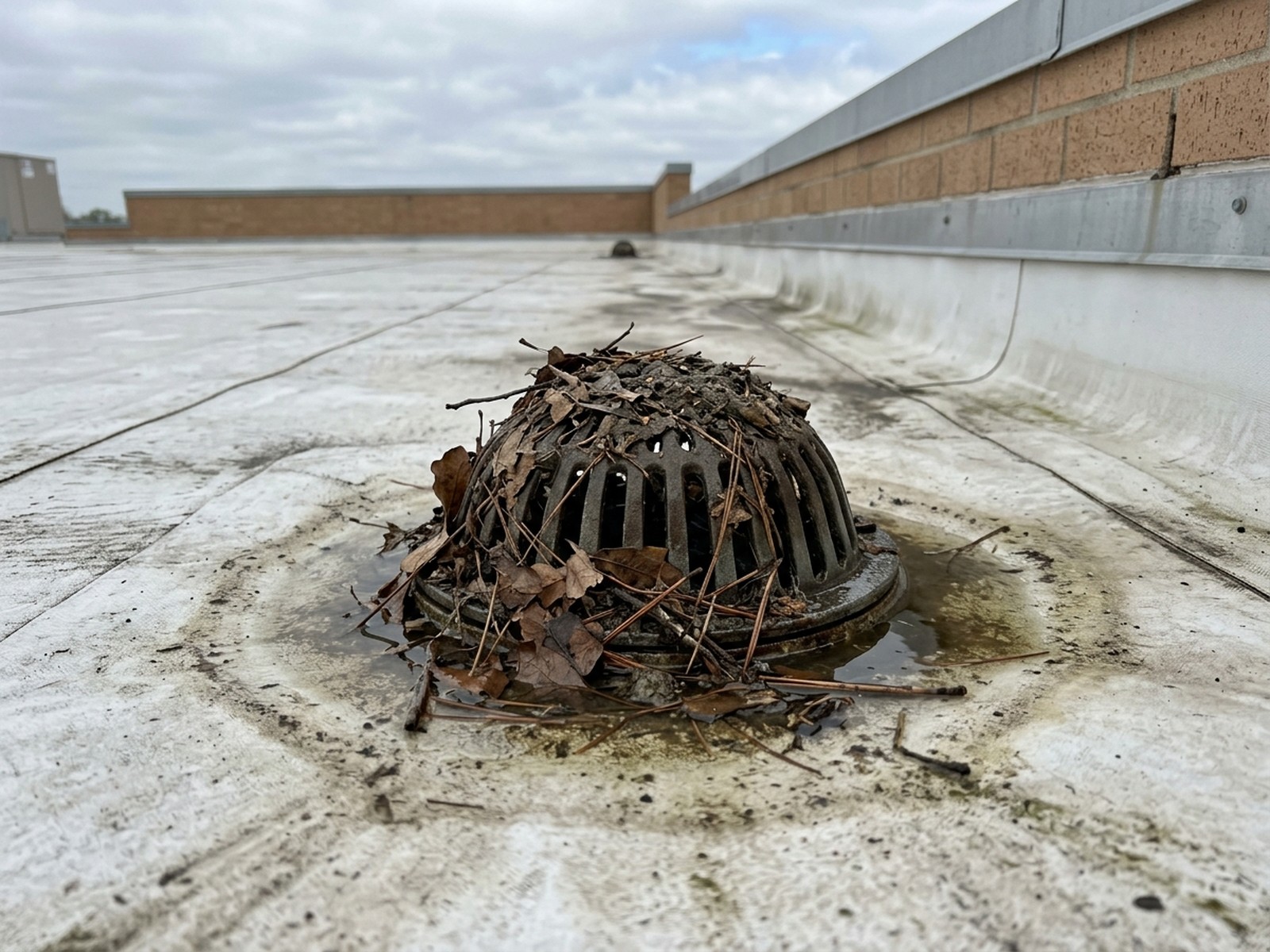
| Blocked or undersized drains | Ponds centered on a drain or scupper, worse after leaf fall | Clear and service the drains, add secondary drainage if the code path requires it |
| Deck deflection | A defined low spot between structural members, often worsening over time | Structural assessment first, then tapered insulation over the depression |
| Rooftop equipment and additions | Ponds upslope of a curb, a duct run or a new unit that interrupted the drainage path | Crickets and saddles to divert water around the obstruction |
The code and industry baseline for new work is a quarter inch of fall per foot. ARMA points out that model building codes and ARMA call for a minimum quarter inch per foot slope on new construction and positive drainage on reroof projects, with tapered insulation, drains, scuppers, secondary emergency drainage and crickets as the tools that get you there.
In Katy the two causes that dominate are blocked drains and equipment. Gulf Coast storms fill drains with debris in a single afternoon, and buildings accumulate rooftop units over the years without anyone rebuilding the drainage around them.
Why is ponding water actually bad?
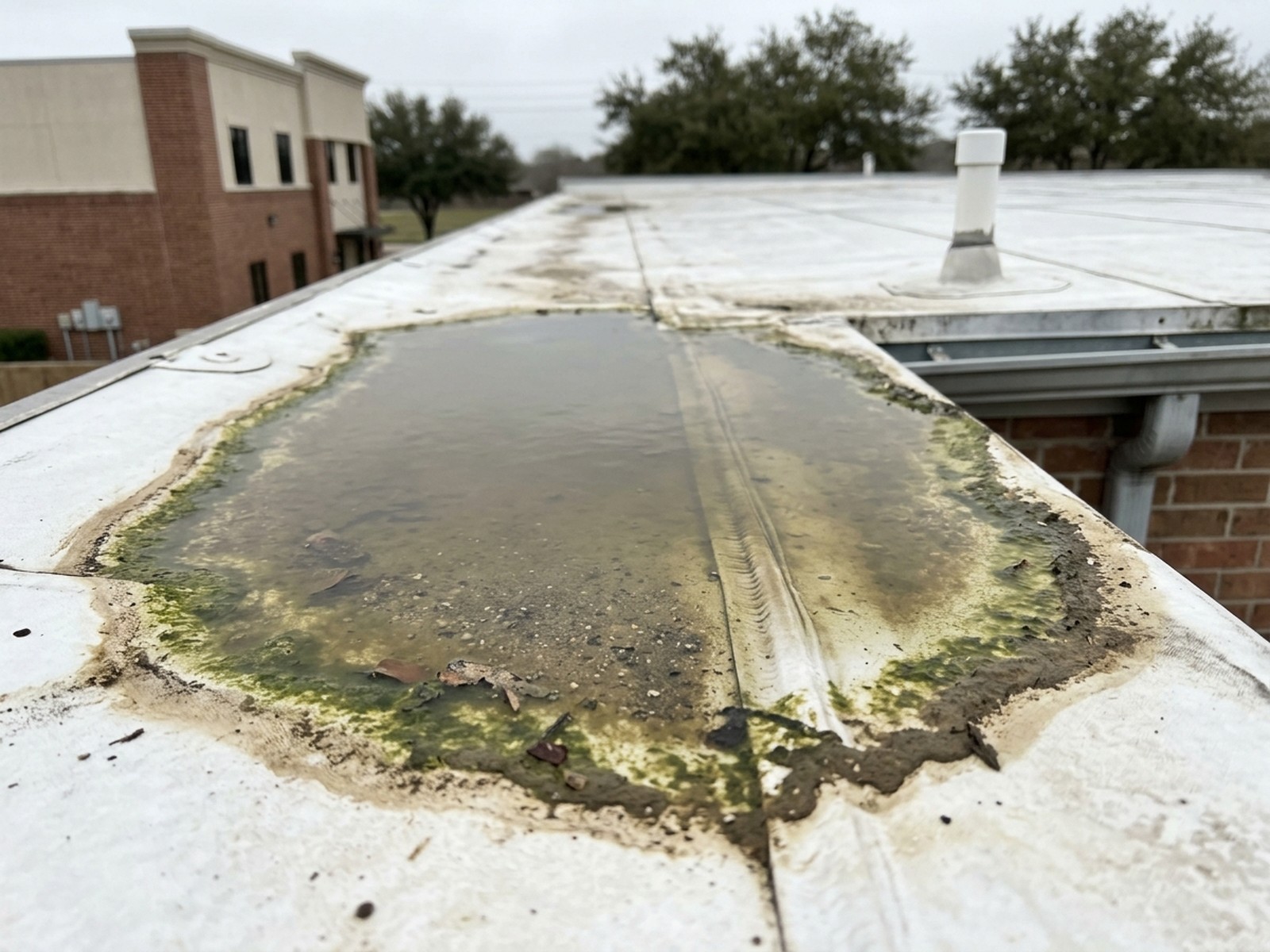
Ponding is a problem for four separate reasons, and they compound. ARMA lists structural damage, membrane deterioration, biological growth and contaminant accumulation as the consequences, noting that ponding can compromise deck integrity, reduce insulation efficiency and let moisture reach interior building components.
Weight. Water weighs about 62.4 pounds per cubic foot, which works out to roughly 5.2 pounds per square foot for every inch of depth. Two inches of standing water across a 40 by 50 foot area is around 20,000 pounds sitting on a structure that may not have been designed for it. Worse, deflection makes the pond deeper, which adds load, which increases deflection.
Membrane life. Constant immersion plus Texas UV ages a membrane faster than the same membrane on a well-drained section of the same roof. Seams sitting under water are the ones that fail first.
Biological growth and debris. Standing water grows algae and collects silt, which holds more water, which makes the pond more permanent. Debris mats also hide the seam or flashing that is about to fail.
Warranty exposure. Many manufacturer warranties limit or exclude coverage where ponding is present. That is a document-by-document question and worth checking your own warranty language before you assume you are covered, but it is a common enough term that ponding can quietly convert a warrantied roof into an uninsured one.
How do you tell a drainage problem from a structural problem?
The difference is whether the low spot is in the roof assembly or in the building holding it up, and it changes who needs to look at it first.
Signs it is a drainage and assembly issue:
- Ponds sit near drains, scuppers or equipment curbs
- The same ponds appear in the same places every rain and the pattern has not changed over the years
- The roof surface is otherwise firm underfoot
- Drains are visibly obstructed or set higher than the surrounding surface
Signs it may be structural and needs an engineer before roofing work:
- The low spot has grown or deepened noticeably over time
- The depression tracks a joist, beam or bay line
- The deck feels soft, springy or deflects underfoot
- Interior signs appear: sagging ceiling grid, deflected framing, cracked finishes below the area
- Ponding began after new rooftop equipment was installed
A roofing contractor should say plainly when the answer is an engineer. Putting tapered insulation over a deflecting deck treats the symptom on top of a problem that is still moving.
How is ponding water fixed on a commercial roof?
Fixing ponding means restoring positive drainage, which is a design problem more than a patching problem. The realistic options, cheapest first:
- Service the drainage. Clear drains, strainers, scuppers and gutters, and confirm each drain sits at the low point rather than proud of the membrane. On a lot of Katy roofs this alone solves it.
- Add crickets and saddles. Small tapered sections that divert water around curbs, walls and equipment. Targeted and comparatively inexpensive.
- Add drainage capacity. Additional drains or scuppers where the roof area per drain is too high, plus secondary emergency drainage where the code path requires it.
- Tapered insulation. Rebuilding slope across a section or the whole roof with a tapered system. This is the real fix for a roof that never had enough fall, and it is usually done as part of a reroof.
- Structural correction. Where the deck is deflecting, the structure gets addressed first and the roof follows.
Whatever the route, the sequencing matters. Anything laid over trapped moisture will fail, so wet insulation gets found and removed before new material goes down. That is the difference between a roof that lasts its design life and one that is back on the maintenance list in two years.
What should a Katy building owner do each fall?
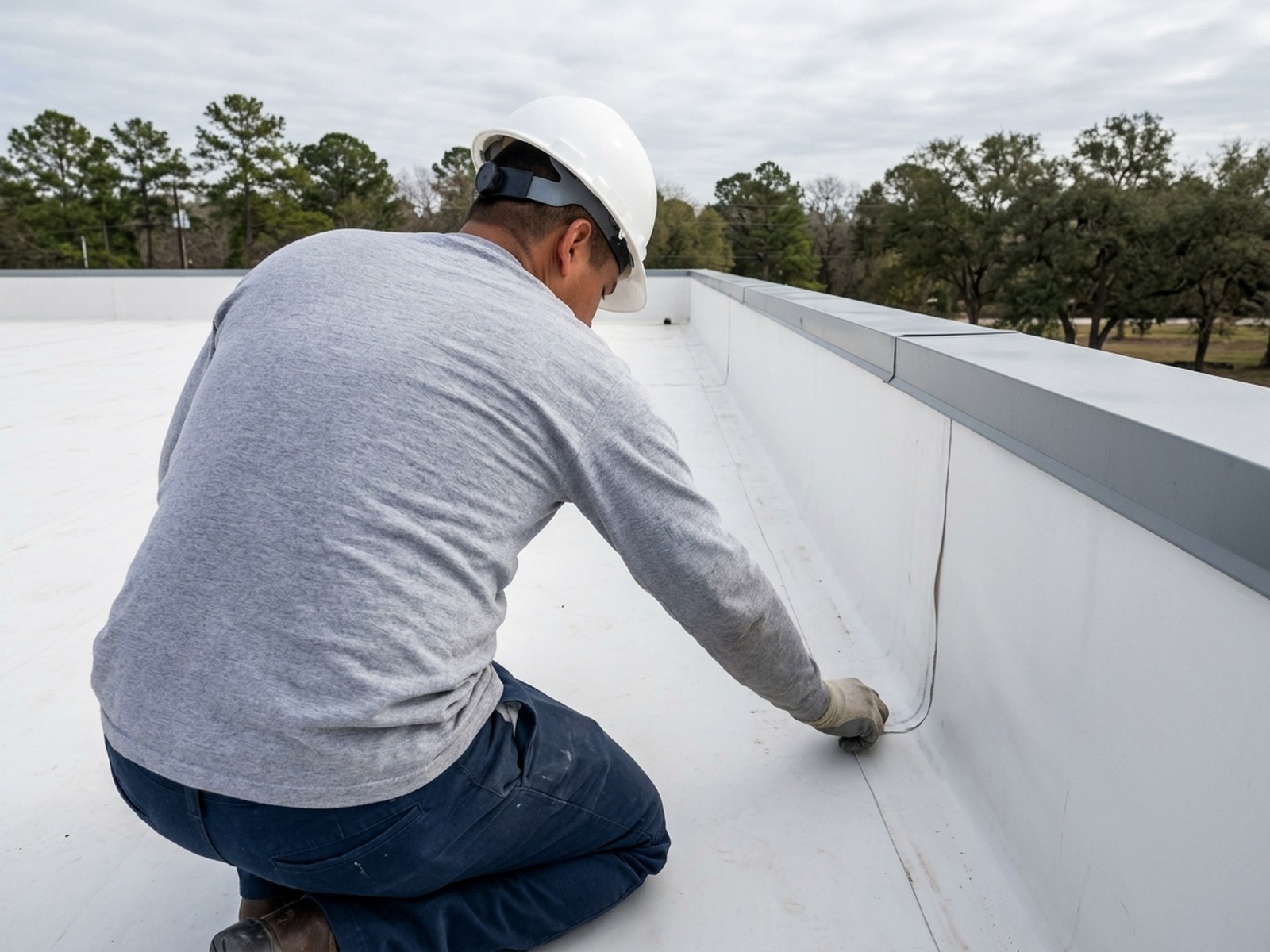
Put the roof on a schedule rather than waiting for the leak. A twice-yearly survey plus a post-storm check is the cadence that fits the Gulf Coast, and the fall survey is the one that matters most because it follows the season and lands before budget season.
A fall survey should cover the drains and strainers, the condition of every seam and lap, flashing at parapets, curbs and penetrations, the pitch pockets and sealant details, the state of the membrane surface, any punctures from foot traffic or service work, and a written record of where water is standing and how deep.
The Whole Building Design Guide's low-slope roofing guidance treats roof performance as a system problem across deck, insulation, membrane and drainage, which is the right way to read a survey report. A drain issue and a seam issue are not separate line items when the drain issue is what killed the seam.
Our commercial roof maintenance work is built around that cycle, and the point of it is that planned work is cheaper than emergency work by a wide margin.
Frequently asked questions
How long can water sit on a flat roof before it is a problem?
48 hours, under drying conditions. That is the threshold ARMA and NRCA both use. Water that clears within that window is normal drainage, and water still there afterward is ponding and should be investigated.
Is standing water on a flat roof normal after heavy rain?
Immediately after heavy rain, yes. Low-slope roofs drain over hours, not seconds, and a large storm will briefly leave water everywhere. The question is what the roof looks like two days later.
Does ponding water void a roof warranty?
It can, and it depends entirely on the warranty you hold. Many manufacturer warranties limit or exclude coverage in ponding areas. Pull your warranty document and read the exclusions before you assume the roof is covered.
Can ponding water cause a flat roof to collapse?
It is possible where the deck is already deflecting, because ponding is self-reinforcing: deflection deepens the pond, the deeper pond adds weight, and the added weight increases deflection. A low spot that is visibly getting worse is a structural question, not a roofing question, and it warrants an engineer.
How much does it cost to fix ponding water?
It ranges from a maintenance visit for blocked drains to a tapered reroof, so no honest number exists without a survey. What a contractor can give you before any money is spent is a written assessment of the cause, the area affected and the realistic options.
Do I need an engineer or a roofer?
Start with a roofer for the survey. If the assessment finds deck deflection, soft decking or a low spot that has deepened over time, a structural engineer should look at it before any roofing work is specified.
Get the roof surveyed before the budget closes
If water is standing on your building and you are not sure whether it is a maintenance item or a capital item, a survey answers that before the number goes into next year's budget. Blue Rhino Roofing handles commercial flat and low-slope roofing across Katy and the surrounding 50-mile area, and the survey comes back written and photographed with the ponding areas mapped.
Call (346) 733-8558 to schedule a survey.

Shawn Swearingen
Shawn Swearingen leads Blue Rhino Roofing, a BBB A+ accredited, Texas-licensed roofing company based in Katy. He's on the roof and on the phone, and known for telling homeowners the straight truth about whether they need a repair or a replacement.