
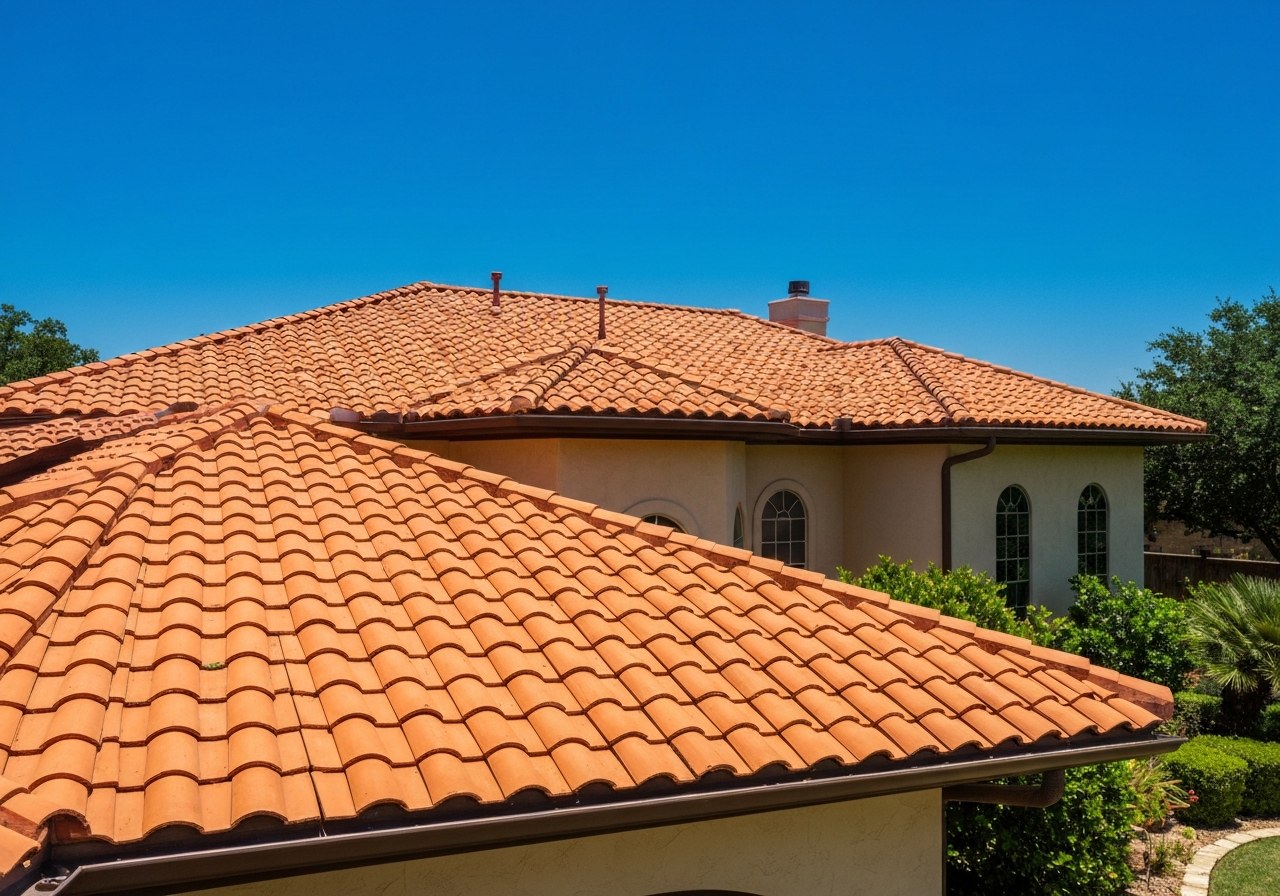
Many Houston-area homeowners must choose between clay and concrete tile because both offer long life and strong curb appeal but differ sharply in cost, weight, and storm performance.
These differences matter for budgets, roof framing and permit requirements, and insurance exposure in a hurricane-prone region. Selecting the wrong material or skipping a structural check can add thousands of dollars and delay recovery after a storm.
This guide compares installed costs and typical project totals, explains what to expect from contractor quotes and financing, contrasts concrete and clay pricing and styles, covers weight and framing implications, describes expected lifespan and maintenance on the Gulf Coast, reviews storm and hail performance, lists local pros and cons, provides a decision checklist and alternatives, and closes with practical local next steps and FAQs.
Read on for a clear cost breakdown that you can use during contractor estimates and inspections.
Overview: Tile roofing in the Gulf Coast climate
Quick summary
Tile roofs — clay and concrete — are widely used on Gulf Coast homes because they resist humidity, stand up to heat, and last decades. They weigh more than asphalt shingles and cost more up front, but their long life and low maintenance can offset that for many homeowners. Proper installation and underlayment are crucial in humid, coastal climates.
Local relevance
Blue Rhino Roofing serves Katy and the greater Houston area (within a 30-mile radius), so we frequently install and service tile roofs across neighborhoods that favor durable, long-lasting materials. If you’re considering tile for your home, start with our free inspection and see options tailored to Gulf Coast weather on our Tile roofing service page (/tile-roofing/).
Next, we’ll break down tile roof costs — per square foot, per square, and typical project totals.
Tile roof cost breakdown — per sq ft, per square, and typical project totals
Price quick reference — $4.50–$12.00 / sq ft, $450–$1,200 / square (typical Houston-area ranges; actual quote required)
- Cost per square foot: $4.50–$12.00 (typical Houston-area ranges; actual quote required)
- Cost per square (100 sq ft): $450–$1,200 (typical Houston-area ranges; actual quote required)
- Example project totals: see compact table below (typical Houston-area ranges; actual quote required)
Compact cost table (convertible for snippets)
| Measure | Low (typical) | High (typical) |
|---|---|---|
| Per sq ft | $4.50 | $12.00 |
| Per square (100 sq ft) | $450 | $1,200 |
| 1,500 sq ft home (roof area) | $6,750 | $18,000 |
| 2,200 sq ft home (roof area) | $9,900 | $26,400 |
| 4,000 sq ft home (roof area) | $18,000 | $48,000 |
| Tear-off (per square, if required) | $50 | $200 |
| Dumpster / disposal (project) | $300 | $1,200 |
(Amounts above are typical Houston-area ranges; actual quote required. For higher accuracy, add company-region data or a formal citation.)
Partial services — $2.50–$8.00 / sq ft (typical Houston-area ranges; actual quote required)
Short note: Partial repairs or tile “lift-and-reset” work costs less than full replacement but varies by access and damage.
- Lift-and-reset / spot tile replacement: $2.50–$8.00 per sq ft (typical)
- Common scenarios: small leak repair, limited valleys or hips, replacing broken tiles after wind/hail
- When partial makes sense: isolated damage, budget constraints, good remaining underlayment
Underlayment replacement — $1.00–$3.50 / sq ft (typical Houston-area ranges; actual quote required)
Short note: Underlayment often needs replacement when tiles are removed or when it shows age/damage; prices depend on material (felt vs. synthetic) and roof complexity.
- Typical underlayment cost: $1.00–$3.50 per sq ft (typical)
- Required when: full tear-off, significant water intrusion, code upgrades, or when installing modern synthetic underlayment
Hidden fees — common extra charges to watch for (typical; verify with contractor)
- Tear-off labor (if old roof removed) — often charged per square or per hour
- Dumpster / disposal fees — project-level charge
- Permit fees — local municipality charges
- Flashing repair or replacement — added if rusted or damaged
- Deck or structural repairs found during tear-off — quoted after inspection
- Crane or lift rental for steep or high roofs / hard access areas
- Code upgrades or required ventilation changes — added if building code demands
- Specialty tile matching or custom tile orders — extra material cost
Ask contractors for line-item quotes that show these charges. For the most accurate cost for your home, schedule a free inspection and request a written estimate from Blue Rhino Roofing (typical Houston-area ranges; actual quote required).
Quotes, contractor responsibilities, timelines and financing
What a good quote should show
A clear, professional quote should list all major costs separately so you can compare bids and avoid surprises. Ask for a written estimate that includes each of these line items:
- Materials (type, brand, color)
- Labor (hours or crew rate)
- Tear-off / disposal (number of roof layers removed, dumpster)
- Underlayment (type and brand; see /roof-repair/ for related deck/underlayment work)
- Flashing and metal (valleys, step flashing, ridge caps)
- Structural reinforcement (if applicable)
- Permits (itemized permit fee)
- Cleanup and haul-off
- Warranties / guarantees (manufacturer vs contractor coverage)
- Payment schedule and total price
Follow-up: if any item is described vaguely (for example, “underlayment” with no brand or class), ask the contractor to clarify in writing.
Structural reinforcement and when an engineer is needed
Structural issues add cost and require documentation. Local permit and code requirements vary — check the City of Houston permitting guidance before accepting structural work: https://www.houstonpermittingcenter.org/.
Engineered plans or an assessment by a structural engineer are usually needed when load or framing conditions change, or when signs indicate the roof structure may not meet current standards.
Checklist: ask whether any of these apply; if so, request an engineer evaluation or engineered plans
- Home age over 40 years or unknown framing history
- Rafter or truss spacing unusually wide (>24" O.C.) or inconsistent spacing
- Attic framing showing sagging, rot, or water damage
- Added loads (solar, heavy tile, equipment)
- Elevation/FEMA requirements or floodplain restrictions
Warranties and guarantees
Differentiate between two coverage types: manufacturer warranties (cover material defects) and contractor guarantees (cover workmanship). Typical exclusions: wind uplift beyond rated limits, improper ventilation, damage from hail or falling debris, and improper maintenance. Always get warranty terms in writing and confirm who handles claims — the manufacturer or the contractor.
Licensing, insurance, and subcontractors
Before work begins, request these documents and verify they’re current:
- Contractor’s state/local license and license number
- Certificate of insurance (COI) showing general liability and workers’ comp
- List of subcontractors who will work on the job (names and contact)
- Proof of bonding, if applicable
- Copies of manufacturer-certified installer credentials for special materials
- Lien waiver policy — who will provide waivers and when (interim and final)
Timeline and project stages
Expect the job to follow these stages; day ranges are typical but vary by crew size, weather, and permit speed.
- Inspection & written estimate — 1–3 days
- Permit application & approval — 3–14 days (may be longer if structural/engineered plans required)
- Material ordering & staging — 1–7 days (depends on availability)
- Tear-off and decking inspection/repairs — 1–3 days
- Underlayment, flashing, and tile/roof installation — 2–7 days
- Final inspection, cleanup, and punch list — 1–3 days
Give the contractor a phone number and email for updates and ask for a daily or milestone schedule in writing.
Financing and payment options
Common options include down payment plus progress payments, credit-card acceptance, and third-party financing (loan terms, APRs, and loan types vary). Ask for a written payment schedule tied to project milestones and verify specific loan terms directly with the lender before signing. See available financing options and resources here: https://bluerhinoroofing.net/financing/.
Final transition: Next, compare how material choices — clay vs. concrete tile — affect costs and long-term performance in the tile roof cost breakdown.
Cost comparison: concrete tiles vs clay (terracotta) tiles — installed prices
Concrete tiles — Typical Houston-area installed ranges: $5.50–$9.00 per sq ft ($550–$900 per square).
Concrete tiles are usually the lower-cost tile option to buy and install in the Houston market. Labor and roof complexity are the biggest cost drivers: steep slopes, multiple penetrations, and replacement of decking or underlayment can push installed costs toward the high end of the range. Concrete tiles are also heavier than most asphalt systems, so any required structural reinforcement will add to labor and permitting costs.
Clay / terracotta tiles — Typical Houston-area installed ranges: $6.50–$12.00 per sq ft ($650–$1,200 per square).
Clay (terracotta) tiles command a premium over concrete in many cases because they’re often hand-formed or finished, and sometimes imported. Manufacturing and finish quality affect both price and expected lifespan: properly manufactured clay tiles can last 50–100 years with correct installation and maintenance. For technical guidance on lifespan expectations and installation best practices, see the [NRCA tile roofing guide](https://nrca.net/roofingguidelines/Library/Detail?id=39ZX2HFf_iQ%3D).
Premium tiles (natural clay, slate-like) — Typical Houston-area installed ranges: $10.00–$20.00+ per sq ft ($1,000–$2,000+ per square).
Premium natural clay profiles or specialty tiles that mimic slate (or true natural slate) sit at the top of the price ladder. They offer superior aesthetics and longer service life but usually require the most careful installation and sometimes additional structural work because of higher weight. Expect longer lead times and higher labor rates from experienced crews for these installs.
Manufactured vs natural — quick cost and performance comparison
- Cost drivers
- Manufactured concrete: lower material cost, faster production — lower installed price.
- Natural clay / handmade: higher material cost, finishes and sourcing increase price.
- Availability & lead times
- Manufactured concrete: readily available, shorter lead times.
- Natural clay/premium: sometimes custom or imported — longer lead times.
- Lifespan & warranty
- Manufactured concrete: 40–60 years typical; many manufacturers offer 20–50 year limited warranties (check specifics).
- Natural clay / premium: 50–100+ years possible with good installation; warranties vary by product.
- For installation standards and longevity guidance, reference the [NRCA tile roofing guide](https://nrca.net/roofingguidelines/Library/Detail?id=39ZX2HFf_iQ%3D).
- Weight & structure
- Manufactured and natural tiles are heavy compared with asphalt — structural assessment can add cost.
- Maintenance
- Natural tiles may require more careful replacement of broken pieces; manufactured tiles can be easier to source but may vary in color match over time.
How tile style affects cost
Interlocking flat and S-curve — typical installed $6.50–$10.50 / sq ft (Houston-area)
These styles are among the most common and usually the least expensive tile options to install. Labor is moderate because tiles lay flat and interlock, speeding placement and reducing cutting. Expect typical installed ranges shown above for the Houston area; exact price depends on tile material (concrete vs. clay) and roof complexity. Waste is usually lower than carved tiles.
Spanish barrel tiles — typical installed $8.50–$14.00 / sq ft (Houston-area)
Spanish barrel (also called barrel or “S-pan”) tiles are heavier and more labor-intensive. Labor increases because installers must align convex/concave profiles and often use additional fasteners or underlayment techniques. These tiles also generate higher waste from broken or mismatched pieces and may require extra flashing detail at hips and ridges.
French / Mission-style — typical installed $9.00–$15.50 / sq ft (Houston-area)
French and Mission (also called Mission-style or low-profile curved tiles) are decorative and often require more cutting and custom fitting around penetrations, hips, and valleys. Labor and cutting time are higher, and installers may need specialty grout or ridge caps to finish the look. These factors push installed costs toward the higher end of the range.
| Style | Typical installed (Houston-area) | Labor impact | Typical waste estimate (approx.) |
|---|---|---|---|
| Interlocking flat / S-curve | $6.50–$10.50 / sq ft | Moderate — faster installs, fewer cuts | 5–10% (estimate) |
| Spanish barrel | $8.50–$14.00 / sq ft | Higher — alignment and fastening take longer | 10–20% (estimate) |
| French / Mission-style | $9.00–$15.50 / sq ft | Higher — more cutting/custom work | 10–20% (estimate) |
How complexity and waste affect cost
- Pitch/steep slopes: Steep roofs increase labor hours and safety requirements (fall protection). Estimate 10–25% higher labor cost on steep pitches compared with low slopes.
- Hips, valleys and ridges: Each hip/valley adds cutting, flashing, and special ridge tiles — plan for additional labor and materials. Complex rooflines can increase total project cost by 15–40% depending on frequency of intersections.
- Cuts, penetrations and detailing: Skylights, chimneys, and many penetrations increase cutting and finishing time — expect more tile breakage and waste.
- Recommended waste percentages (estimates):
- Simple, regular roof: 5–10% waste
- Moderate complexity (some hips/valleys/penetrations): 10–15% waste
- High complexity (many hips/valleys/steep pitch/multiple penetrations): 15–25% waste
- Note: These percentages are estimates for planning and vary by tile type and installer practices.
All the ranges above are typical Houston-area installed estimates and will vary by tile material (clay vs. concrete), local labor rates, and the specific contractor. Style choices that increase cuts, weight, or the need for special flashing will raise both labor time and the total installed cost.
Weight, framing needs, and structural considerations for tile on Gulf Coast homes
Typical weights: Concrete tile: 9–12 lb/sq ft (typical estimate). Clay tile: 6–10 lb/sq ft (typical estimate). Asphalt shingles (for comparison): 2.5–4.5 lb/sq ft (typical estimate).
Typical weights
| Material | Typical weight (lbs per sq ft) |
|---|---|
| Concrete tile | 9–12 (typical estimate) |
| Clay tile | 6–10 (typical estimate) |
| Asphalt shingles | 2.5–4.5 (typical estimate) |
(These are typical estimates—actual weights vary by profile, manufacturer, and underlayment. Use manufacturer specs for final engineering.)
When reinforcement is required
Checklist — consider reinforcement when any of the following apply:
- Existing framing age or condition: rafters/joists older than ~30 years or showing rot, decay, or termite damage.
- Rafter/joist spacing and size: wide spacing (e.g., 24" o.c. vs 16" o.c.) or undersized members may need sistering or replacement.
- Attic framing and connections: inadequate collar ties, weak ridge beams, or corroded fasteners require strengthening.
- Cumulative load: roof assembly weight (tile + underlayment + decking + live load) exceeds existing design capacity based on local code or manufacturer thresholds.
- Local wind and uplift requirements: Gulf Coast wind loads can demand stronger attachments and strapping.
- Flood elevation or coastal exposure concerns: if your home is in a coastal flood zone, elevation and flood-resistance measures may require structural changes—see FEMA coastal flood guidance for design considerations.
- Multiple existing roof layers: adding tile over multiple layers can push loads beyond acceptable limits.
If any checklist item applies, plan for framing reinforcement (sister rafters, add purlins, upgrade sheathing, or install engineered trusses) before tile installation.
Structural engineer inspections and costs
Have a licensed structural engineer evaluate framing when tile is heavier than the existing system was designed for, when significant reinforcement is planned, or when the home is in a high-risk coastal/flood zone. A typical inspection includes: site visit, roof framing measurements, load calculations, recommended reinforcement details (drawing or scope), and a signed report for permits.
Typical Houston-area fees for a structural inspection and written report: $300–$1,200 (typical Houston-area fees). Complex evaluations or engineered drawings for permit may cost more. When discussing elevation or flood-related structural requirements, follow FEMA guidance: FEMA coastal flood guidance. Provide the engineer’s report to your roofing contractor and the permitting authority before work begins.
Installing over existing roofing
Code limits and practical risks:
- Many local codes allow one existing layer of roofing to remain under a new roof; two layers is usually prohibited. Check local code and your permit office.
- Installing tile over existing roofing materials is generally not recommended because the extra layer(s) add weight and can hide deck/underlayment issues.
- Cost differences: removing existing roofing adds labor and disposal costs but gives a clean deck and avoids unexpected reinforcement. Leaving one layer in place can save on tear-off costs but may require additional framing checks and increase risk of premature failure.
- Risks: trapped moisture, hidden rot, insufficient decking attachment, and exceeding allowable framing loads.
Plan for a roof tear-off if framing capacity, decking condition, or local code requires it. Work with your contractor and an engineer to decide the safest, code-compliant approach.
Lifespan and maintenance: what to expect for tile roofs on the coast
Expected lifespans — concrete: 50–75 years | clay: 50–100+ years | asphalt (tile-look): 20–30 years | metal tile: 30–50 years
- Concrete tile: 50–75 years typical lifespan. Typical Houston/Gulf Coast estimate: lifecycle cost roughly $0.50–$1.50 per sq ft per year (estimate; depends on installation quality and local conditions).
- Clay tile: 50–100+ years when properly installed and maintained. Typical Houston/Gulf Coast estimate: lifecycle cost roughly $0.40–$1.20 per sq ft per year (estimate).
- Asphalt tile (tile-look products): 20–30 years — shorter than true tile but often lower upfront cost. Typical Houston/Gulf Coast estimate: lifecycle cost roughly $1.00–$2.50 per sq ft per year (estimate).
- Metal tile: 30–50 years depending on finish and maintenance. Typical Houston/Gulf Coast estimate: lifecycle cost roughly $0.60–$1.80 per sq ft per year (estimate).
Notes: These are typical Houston/Gulf Coast estimates and intended to show relative lifecycle cost, not a guaranteed quote. Actual costs vary with roof pitch, underlayment, local labor, and storm damage history.
Routine maintenance tasks
- Visual roof inspection — Frequency: twice a year (spring and fall) and after major storms. Typical cost range: $0–$250 (many contractors offer free inspection; paid inspections $100–$250).
- Clean gutters and downspouts — Frequency: 2–4 times per year (more often if many trees). Typical cost range: $75–$300 per visit.
- Remove debris from roof surface (leaves, branches) — Frequency: as-needed, minimum twice a year. Typical cost range: $75–$250 per visit.
- Moss, algae, and stain cleaning — Frequency: annually or when growth appears. Typical cost range: $150–$600 (depends on roof size and method).
- Check and repair flashings, ridge caps, and sealants — Frequency: annually and after storms. Typical cost range: $150–$1,200 depending on scope.
- Replace broken or slipped tiles — Frequency: as-needed (inspect after storms). Typical cost range: $50–$300 per tile replacement (labor and matching tile availability affect price).
- Inspect attic and underlayment for leaks/moisture — Frequency: annually. Typical cost range: $100–$400 for inspection; repairs extra.
Estimated annual maintenance budget: $150–$800 per year for routine upkeep on a typical single-family home in the Houston/Gulf Coast area (labelled as a typical Houston/Gulf Coast estimate; actual costs vary).
Coastal-specific maintenance
Coastal climates add three main challenges: high humidity, enhanced algae/moss growth, and salt spray. High humidity and warm temperatures accelerate organic growth (algae, moss, lichen), which can darken tiles, hold moisture against the roof, and shorten underlayment life. Salt exposure near the shoreline can accelerate corrosion of metal flashings, fasteners, and any metal tile components — increasing the frequency of flashing and fastener inspections and replacements.
Best practices on the Gulf Coast:
- Use alkaline-resistant underlayment and sealants rated for humid, saline conditions.
- Prefer stainless-steel or corrosion-resistant flashings and fasteners near the coast.
- Schedule more frequent cleaning for algae/moss (annually or biannually) and consider preventive treatments.
- After strong storms or high winds, have a professional inspect tile integrity and flashing.
These coastal-specific steps reduce long-term damage and keep lifecycle costs closer to the lower end of the estimates above. Next, we’ll break down tile roof costs by unit — per sq ft, per square, and typical project totals — so you can plan budget and financing.
Storm, hail and wind performance for Gulf Coast tile roofs
Wind performance
Typical tested ratings: many manufactured tile systems and assemblies are tested to resist winds in the 100–150+ mph range as part of product approvals and uplift testing (these are tested rating examples and vary by tile type, profile, installer method and building exposure). For site-specific design and required ratings, homeowners should confirm exact numbers with the manufacturer and their installer — and ask their insurer what rating they require.
Installation details that improve wind resistance:
- Strapping and continuous toe/heel straps that secure tiles to the roof deck (ask to see the type on the quote).
- Special fasteners and clips for hip/ridge and edge conditions where uplift is highest.
- Proper underlayment and adhesive application (bonded underlayment, plastic roof cement, or mechanical fastening where specified).
- Reinforced eaves and rake terminations and mechanically-secured ridge/hip systems.
Always ask your contractor to list specific wind-resistance measures (strapping type, fastener specs, underlayment brand/installation method) on the written quote so you can verify the assembly matches the product’s tested rating. For general design guidance and tools, see NRCA’s Roof Wind Designer: https://roofwinddesigner.nrca.net/ and NRCA roofing materials guidance: https://www.nrca.net/roofing-guidelines/roofing-materials.
Hail and impact
Tile roofs resist hail differently depending on material and profile. Concrete tiles are dense and often show scuffing or hairline cracks from large hail, while clay tiles can chip or break in focused impact zones. Unlike asphalt shingles, individual tiles can frequently be replaced locally without re-roofing the whole system, but damage to underlayment or secondary components (flashings, vents) may still require broader repairs.
Repair approach summary:
- Small surface dents/scuffs: often cosmetic — document for insurer, but may not require immediate replacement.
- Cracked or fractured tiles: replace individual tiles and inspect underlayment beneath those tiles.
- Widespread impact (broken tiles across multiple areas): may require larger sections or complete replacement; check flashing and accessories for hidden damage.
When in doubt, get a professional inspection and photographic documentation for insurance.
Hurricane/coastal considerations
Best practices for Gulf Coast / hurricane-prone homes:
- Continuous strapping tying tiles to the roof deck and rafters.
- Mechanically fastened, corrosion-resistant clips/fasteners rated for coastal exposures.
- Sealed and counter-flashed penetrations (vents, skylights, chimneys) to resist wind-driven rain.
- Elevated eaves and scuppers or overflow paths to reduce water intrusion from surge/backflow.
- Reinforced, fully-lapped flashings at valleys, hip/ridge, and roof-to-wall transitions.
- Use of corrosion-resistant materials (stainless or hot-dipped galvanized) for coastal salt exposure.
- Designed drainage and secondary water barriers behind tiles for wind-driven rain protection.
Insurance and claims
Insurers often view tile roofs differently than asphalt: they may favor tile for durability and longevity, but can be concerned about hail damage, brittle tiles, and replacement costs for large-scale damage. Some insurers offer discounts for certified wind-rated installations; others may require specific tested ratings or installation methods to qualify.
What homeowners should do:
- Confirm with your insurance carrier what wind/impact ratings or installation features (strapping, clips, underlayment) they require for premium discounts or full coverage.
- Request and keep a detailed written scope and photos from your installer showing materials, fastener/strapping specs and any tested rating labels — include these with claims.
- For claims, gather: before/after photos, the installer’s quote/spec sheet, manufacturer product data sheets, and any third-party test/certification documents.
- Expect insurers to ask for proof that installation meets their stated requirements; have your contractor note those measures on the invoice/guarantee.
Always verify policy specifics with your carrier and confirm installation details with your contractor before work begins. Next, we’ll break down how tile roof pricing typically looks so you can compare costs and quotes.
Pros and cons of tile roofing for Houston/Katy-area homes
Pros
- Durability: Tile resists rot and insect damage better than many materials, so it often lasts longer in local conditions.
- Curb appeal: Distinctive look (clay or concrete) can improve exterior aesthetics.
- Energy performance: Thermal mass and airflow under tiles can lower attic temperatures and reduce cooling load.
- Long lifespan: Tile roofs commonly last 50+ years with proper installation and maintenance.
Cons
- Higher upfront cost: Tile is more expensive to buy and install than standard asphalt shingles.
- Weight and structural needs: Tile is heavy and may require roof framing reinforcement.
- Maintenance in humid climate: Humidity and algae growth in the Houston area can mean periodic cleaning and inspections.
- Storm vulnerability: Individual tiles can crack or chip from large hail or flying debris and may need targeted repairs after storms.
Resale and neighborhood fit
Tile roofs can be a selling point in neighborhoods where tile is common, but the resale benefit is typical rather than guaranteed — local buyer preferences and comparable home styles matter. Also check HOA rules: many Houston/Katy subdivisions have design guidelines or color restrictions that affect tile choices. If you’re unsure how tile will perform for your property or whether your home’s structure and HOA allow it, consider a professional assessment and local market check. For a consultation or installation details, see Blue Rhino’s tile roofing service page: Tile Roofing (Concrete & Clay) in Katy, TX.
When you’re ready to compare costs and budgets, next we'll break down tile roof pricing per square foot, per square, and typical project totals.
When tile roofing is recommended for Houston-area homes
Tile roofing is recommended when a home’s roof structure can handle the extra weight and the homeowner wants long-term durability, low maintenance, and a specific aesthetic. Use the checklist below to decide whether tile is a good fit for your Houston-area house.
Decision checklist — numbered YES/NO style prompts
- Structural capacity: Does your roof framing and foundation support heavier roofing materials (ask a structural inspection)?
- YES → Schedule a structural or roof framing assessment and get weight/load confirmation from a qualified contractor.
- NO → Tile is not recommended without reinforcement; consider structural upgrades or lighter alternatives.
- Long-term ownership plans: Do you plan to keep the house 10+ years?
- YES → Tile’s 50+ year lifespan makes it a strong choice; get multiple installer estimates.
- NO → If selling in the short term, tile may not offer the best near-term ROI—compare costs with lighter options.
- Budget for upfront cost: Can you afford the higher initial cost for materials and labor?
- YES → Proceed to detailed cost estimates and financing options. Tile pays back over time in longevity and lower maintenance.
- NO → Consider budget-friendly alternatives (see Alternatives below) or plan phased upgrades and financing.
- Aesthetic and resale priorities: Is Mediterranean/Spanish/Mission or premium architectural look a priority for you or required by the neighborhood?
- YES → Tile delivers distinctive curb appeal that can boost resale value in the right market.
- NO → If aesthetics are flexible, lower-cost roofing may meet your needs equally well.
- HOA or historic district rules: Do HOA or local historic-district guidelines allow tile (and any specific colors/styles)?
- YES → Confirm approved colors and profiles, then move forward with samples and HOA paperwork.
- NO → You’ll need HOA approval before installation or choose a compliant material.
- Storm and wind priorities: Are resistance to wind, hail, and sun longevity top priorities for this property?
- YES → Tile performs well for sun and wind when properly installed; confirm wind-rating and underlayment choices.
- NO → If hail resistance is the primary concern, some tile types can be vulnerable—discuss impact-rated options or alternatives.
Printable checklist:
Alternatives to consider
If any of the checklist prompts point away from tile, consider these common alternatives:
- Asphalt shingles: Lower upfront cost, easier to install and replace, wide color/styles; best if budget or short-term ownership is the main concern.
- Metal roofing: Lightweight, very durable, excellent wind resistance, often recyclable; good when structural capacity is limited but you still want longevity.
- Synthetic tile (composite): Mimics clay/concrete tile appearance at lower weight and cost, easier to install, and often better impact resistance; a strong middle ground when you want the look of tile without the weight or price.
For a Houston-area recommendation tailored to your roof’s structure, budget, and neighborhood rules, contact Blue Rhino Roofing for a free inspection and personalized estimate. The next section breaks down tile roof cost — per sq ft, per square, and typical project totals.
How tile roofing fits within residential roofing choices
Comparative context
Tile roofing is a durable, long-lived option that sits between common asphalt shingles and metal roofing in cost, weight, and longevity. Compared with asphalt shingles (see our guide on asphalt shingle roofing), tiles typically last much longer—often 50+ years versus 20–30 years for asphalt—but have a higher upfront cost and require a stronger roof structure because of their greater weight. Versus metal, tile is usually heavier and less flexible for complex roof shapes, but it offers superior fire resistance and a distinct architectural look. In practice, choose tiles when long-term durability, curb appeal, and fire resistance are priorities; choose asphalt when budget and lighter load are deciding factors; choose metal when you want a lighter, low-profile, long-lasting solution for complex slopes.
Maintenance and integrated services
Tile roofs reduce routine maintenance compared with asphalt but still require periodic checks to protect the roof system as a whole. Common services that often accompany a tile project include:
- Underlayment and deck preparation — Because tiles are a long-term covering, installing a high-quality underlayment and confirming the roof deck condition is critical. If the deck needs repair or flashing replacement, coordinate with a licensed roof repair team (see roof repair).
- Flashing and penetration sealing — Properly integrated flashing at chimneys, valleys, and roof penetrations keeps water out and extends the life of both tiles and the underlying structure.
- Gutters and drainage — Tile roofs can direct more concentrated runoff at valleys and downspouts; upgrading gutters or adding leaf protection during a tile replacement avoids pooling and foundation risks.
- Attic ventilation — Tile systems perform best with balanced attic ventilation to prevent heat buildup and moisture problems that can degrade underlayment over time.
- Inspection and maintenance schedule — Plan for periodic inspections every 2–5 years and after severe storms to replace cracked tiles, reseal flashings, and clear gutters.
Tile work often intersects with these trades, so bundle inspections and repairs in the same project to avoid costly callbacks and ensure warranty compliance. For a local assessment and coordinated service plan, contact Blue Rhino Roofing to schedule a free inspection and estimate in the greater Houston area.
Local next steps: inspections, financing, and scheduling in Katy/Houston
Free inspection
We offer a complimentary, no-pressure roof evaluation for homeowners within our 30-mile service area across Katy and the greater Houston area. Our process includes a thorough visual roof assessment, high-resolution photos of problem areas, and a transparent written estimate for your project. Visit our tile roofing section to learn more about our local services and request your free assessment.
Financing options
Investing in a new roof should fit comfortably within your budget, which is why we offer tailored payment solutions. Homeowners can take advantage of competitive interest rates, low monthly payments, and flexible short- or long-term loan plans. Explore our flexible financing solutions to find the best option for your upcoming project.
How to schedule
Schedule your appointment today through our tile roofing page—our team will walk you through clear next steps and back all completed work with our trustworthy quality guarantee.
Frequently Asked Questions
How much does a tile roof cost per square foot in Houston, TX?
Typical estimate: $8–$15 per sq ft installed in the Houston area, depending on tile type, roof complexity, and underlayment—local jobs often fall in this range.
Can a tile roof be installed over existing shingles in Texas?
Short answer: Usually no — most tile roofs require removing old shingles. In rare cases a single overlay is allowed if framing and weight limits are verified; local building codes and wind-load rules may restrict overlays.
Will a tile roof require structural reinforcement for an older Houston home?
Short answer: Possibly — if the attic framing can’t handle the extra 10–15 psf weight of tile. Have a contractor check: attic framing, roof sheathing, load-bearing walls, and permit requirements (consider a structural engineer if any item fails).
How long does a tile roof typically last on the Gulf Coast?
Typical estimate: Clay tile — 40–60 years; concrete tile — 25–40 years, though coastal humidity and salt can shorten lifecycle; proper underlayment and ventilation help maximize life.
Does homeowner insurance usually cover tile roof damage from storms?
Short answer: Many policies cover storm damage to tile roofs, but coverage and deductibles vary. Get photos, keep maintenance records, and schedule a free inspection — then contact your insurer to confirm specifics.
Schedule a free inspection with Blue Rhino Roofing for documentation and claim support.
Frequently Asked Questions About Tile Roofing
How much does a tile roof cost per square foot in Houston, TX?
Installed tile roof pricing in the Houston area typically ranges from about $8 to $18 per square foot for most concrete and standard clay tiles. Lower-end concrete tile jobs with straightforward layouts and minimal deck repairs land near the bottom of that range, while natural clay, premium profiles, complex roofs, or significant structural and underlayment work can push installed costs toward $20 to $25 per square foot. Per-square (100 sq ft) and total project costs vary with roof complexity, tear-off needs, and access, so get a line-item estimate for material, labor, underlayment, flashing, permits, and disposal to understand the full price.
Can a tile roof be installed over existing shingles in Texas?
In most Texas jurisdictions local code allows only one existing roofing layer before a full tear-off is required, and tile over shingles is possible but uncommon. Installing tile over shingles increases dead load, hides the deck for inspection, and often voids manufacturer warranties and insurer expectations. Many contractors prefer a full tear-off to verify decking and install the proper underlayment and battens for a long-lasting tile system. If you are considering an overlay, have a qualified contractor inspect the framing and decking and document whether a permitted overlay meets both code and warranty requirements.
Will a tile roof require structural reinforcement for an older Houston home?
Tile is substantially heavier than asphalt shingle and older framing may need reinforcement. Typical concrete tiles weigh roughly 9 to 12 pounds per square foot and clay tiles can range from about 9 to 15 pounds per square foot, compared with 2 to 4 pounds per square foot for asphalt shingles. Reinforcement is more likely when the house is older than about 30 years, rafters or trusses are undersized or widely spaced, roof decking shows rot or damage, or framing was not designed for heavier materials. A structural engineer or licensed roofer can evaluate the attic framing and provide a stamped report when required; engineering inspections commonly cost $300 to $1,200 and structural work can range from a few thousand dollars for localized sistering to $5,000 to $15,000 for broader upgrades depending on scope.
How long does a tile roof typically last on the Gulf Coast?
On the Gulf Coast, concrete tile roofs commonly reach 40 to 60 years and clay tile roofs often last 50 to 100 years when installed and maintained properly. Coastal humidity, salt exposure, and storm impact increase the importance of regular inspections and prompt repairs, but tiles themselves are durable against UV and rot. Expect periodic maintenance such as replacing broken tiles, maintaining flashings and underlayment, and cleaning algae or moss; attentive care keeps the system functioning across multiple decades.
Does homeowner insurance usually cover tile roof damage from storms?
Most homeowner policies cover sudden storm damage from wind, hail, or falling debris subject to your policy limits, deductible, and specific exclusions. Insurers sometimes treat tile roofs differently: they may require documented maintenance, offer limited actual cash value on older tile, or require higher deductibles for wind/hurricane zones. Damage from wear, poor maintenance, or improperly permitted modifications is commonly excluded. Before work begins, document the roof condition and verify with your insurer whether a tile replacement or specific repair will be covered, and ask how coverage affects premiums and claims handling. If you want a definitive assessment and photos to support an insurance claim, schedule a free inspection with a written report and estimate to clarify next steps.
Schedule your free Katy/Houston tile roof inspection
Book a complimentary visual roof assessment for Katy and greater Houston that includes photos and a written estimate, and ask about available financing options to help manage costs. Our inspection will identify decking or framing concerns, document damage for insurance, and give clear next-step recommendations so you can decide with confidence. Tile roofing service page.

Shawn Swearingen
Shawn Swearingen leads Blue Rhino Roofing, a BBB A+ accredited, Texas-licensed roofing company based in Katy. He's on the roof and on the phone, and known for telling homeowners the straight truth about whether they need a repair or a replacement.