
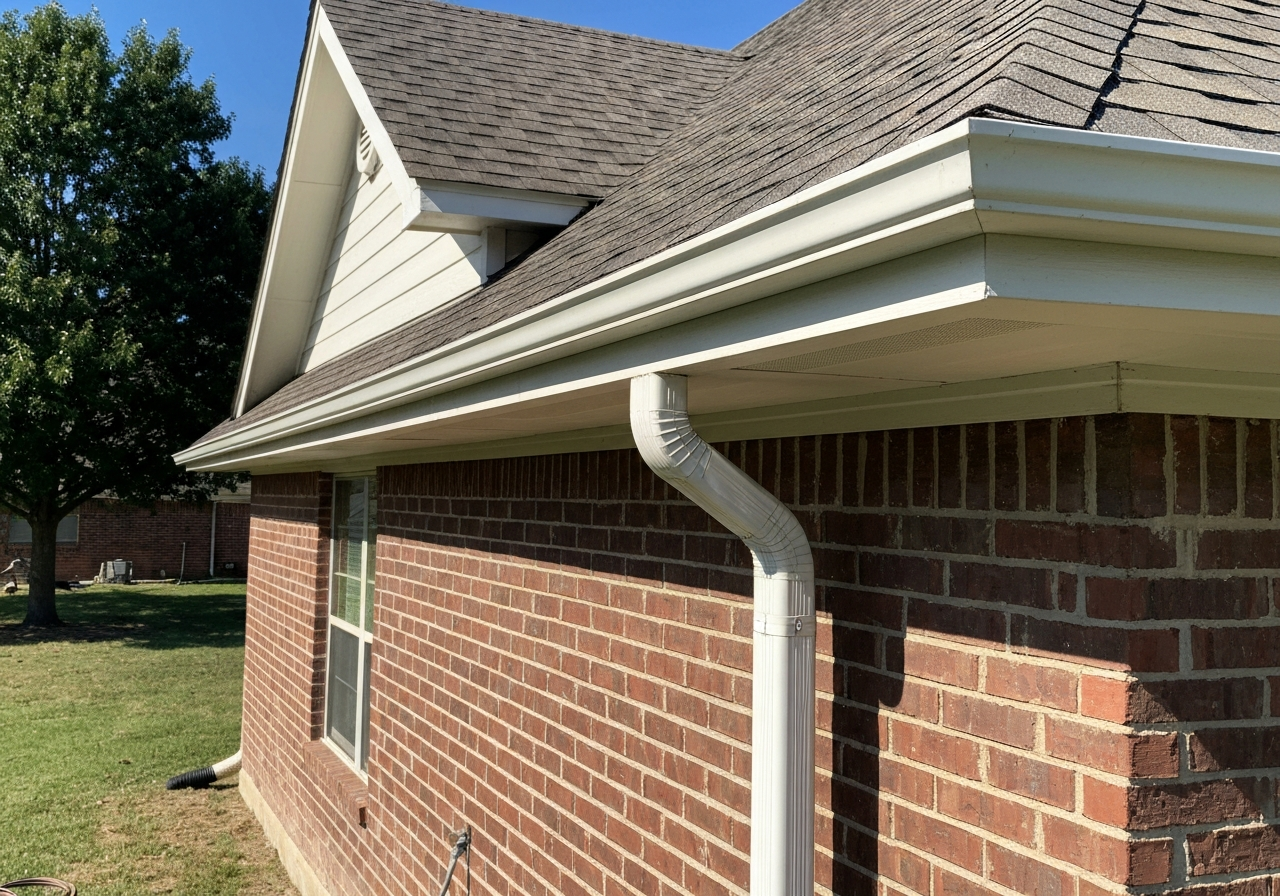
Many homeowners assume gutter guards remove the chore of gutter cleaning, but in practice guards reduce how often you clean rather than eliminate the work. The key decision is whether the guards you choose will meaningfully reduce maintenance and prevent storm-related overflow given Gulf Coast rainfall and the heavy oak and pine debris common in the area.
This matters because clogged gutters concentrate water at roof edges and fascia, increasing the risk of interior water damage, rot, and accelerated shingle wear during frequent heavy rain and tropical storms. For homeowners near large trees, missed downspout clogs and wind-driven debris after storms are the most common failure modes.
This guide compares guard mechanisms and seven common product types, evaluates how each performs with Gulf Coast rain and local debris, lays out realistic maintenance expectations and inspection timing for Houston and Katy, provides installed cost and ROI guidance (including an example for a 200 linear-foot home), and finishes with practical recommendations for when to buy, what to avoid, and how to inspect installation quality. The next paragraph explains how gutter guards manage water and debris so you can judge performance claims.
Quick summary — are gutter guards worth it in Houston and Katy
Summary verdict
Yes — gutter guards are usually worth it in Houston and Katy. They cut frequent clogs and maintenance time here, though cost, roof type, and heavy storm events affect how much benefit you get.
Local factors that change the answer
- Heavy Gulf Coast rain: very high short-term rainfall rates increase the need for guards to keep downspouts flowing — see NOAA Atlas 14 for Texas rainfall intensity data: Houston rainfall intensity data.
- Predominant trees: lots of oak, pine, or Spanish moss near your house raises debris load and makes guards more valuable.
- Roof pitch and material: steep or textured roofs shed debris and water differently; some guard types work better with asphalt shingles than with other materials.
- Home age / gutter condition: older gutters with sagging, holes, or poor slope may need repair or replacement before guards will perform properly.
- Hurricane exposure: frequent high-wind storm debris and heavy rains can overwhelm some guards and increase repair risk.
Next: how gutter guards work (basic mechanisms)
How gutter guards work (basic mechanisms)
Gutter guards work by keeping debris out of gutters while allowing water to flow into the gutter and downspouts, typically using a physical barrier or design that separates leaves and solids from flowing water (see EPA guidance on stormwater and roof runoff: Urbanization and Stormwater Runoff).
Core mechanisms
Gutter guards use a few basic approaches to block debris and move water:
- Screening: a solid or slotted cover with openings that let water pass while stopping larger debris.
- Micro-mesh: a fine stainless-steel or polymer mesh that filters tiny particles; micro-mesh is defined as a very fine woven or perforated material with openings small enough to block small debris and pine needles.
- Surface-tension (reverse-curve) designs: rely on surface tension—the tendency of water molecules to stick together and to surfaces—so water follows the guard’s curve into the gutter while leaves slide off; surface tension is the cohesive force at a liquid’s surface that makes water cling and form droplets.
- Fill (brush/foam) methods: place material inside the gutter to block solids while letting water flow through or over the filler.
These options trade off filtration, maintenance, and capacity; all must still align with good roof runoff management principles described by the EPA for effective water control.
Urbanization and Stormwater Runoff — EPA
Common failure points
- Edge leaks (where the guard meets the roof or gutter lip)
- End caps that aren’t sealed properly
- Seams between guard sections that allow debris or water bypass
- Downspouts that become clogged or are undersized for redirected flow
- Improper slope of the gutter or guard preventing proper drainage
- Poor fastening or fastener corrosion that lets guards shift or detach
Next, we’ll break down how each guard type performs in real-world conditions and which problems are most common for each.
Gutter guard types — features, pros and cons
Mesh
Mesh guards are metal or plastic sheets with perforations (holes) that sit on top of the gutter or attach to the fascia. They block large debris while allowing water through; hole size and material determine how well they keep out small particles and resist corrosion.
- Pros: Good debris exclusion for leaves; durable if metal; low profile and widely available.
- Cons: Small debris (pine needles, shingle grit) can pass through depending on hole size; metal mesh can corrode if low-grade; may require occasional cleaning of surface.
- Best-for: Homes with medium-to-large leaf debris and moderate rainfall.
- Typical lifespan / warranty note: 5–15 years depending on material (aluminum/steel longer), warranties vary—many manufacturers offer 5–10 year limited warranties.
- Installed cost per ft: Low: $3 | Mid: $6 | High: $10
Micro-mesh
Micro-mesh uses very fine stainless-steel or aluminum mesh that filters out small particles (pine needles, shingle grit) while letting water pass. It’s often framed and installed over the gutter opening.
- Pros: Excellent filtration of fine debris; durable stainless options resist corrosion; very low maintenance.
- Cons: Higher cost; can clog with heavy fine debris and require occasional rinsing; some high-flow rainfall may pond on the surface if not sized correctly.
- Best-for: Areas with pine needles, shingle grit, or fine debris and homeowners wanting minimal maintenance.
- Typical lifespan / warranty note: 10–20 years for stainless micro-mesh; many manufacturers offer 10+ year warranties.
- Installed cost per ft: Low: $6 | Mid: $12 | High: $20
Screen
Screen guards are rigid or flexible grids (plastic or metal) that sit across the gutter mouth. They block larger debris but have bigger openings than micro-mesh.
- Pros: Inexpensive; easy to install and replace; effective against leaves and large debris.
- Cons: Less effective against small debris and seeds; plastic screens can sag or warp; metal screens may corrode if not aluminum or stainless.
- Best-for: Budget-conscious homeowners with mostly large-leaf debris.
- Typical lifespan / warranty note: 3–10 years depending on material; limited warranties common (1–5 years).
- Installed cost per ft: Low: $2 | Mid: $4 | High: $8
Reverse-curve (surface tension)
Reverse-curve guards (often marketed as surface-tension systems) guide water over a curved shield so it flows into the gutter while leaves and debris fall off the edge. They attach to the gutter front and depend on surface tension and flow dynamics.
- Pros: Low-profile, keeps large debris off the gutter, minimal visible change to roofline.
- Cons: Performance varies widely with roof pitch and rainfall intensity; can cause water to overshoot gutters in heavy rain; may require precise installation; some models performed poorly in testing. See Consumer Reports' gutter guard performance testing for independent results.
- Best-for: Homeowners prioritizing appearance and large-debris protection on moderate-rainfall roofs.
- Typical lifespan / warranty note: 5–15 years; warranties vary—check for water-handling guarantees.
- Installed cost per ft: Low: $5 | Mid: $9 | High: $18
(Independent testing reference: gutter guard performance testing)
Foam / insert
Foam or gutter inserts are porous blocks cut to fit inside the gutter channel. They sit below the roofline and allow water to pass through while trapping leaves on top of the foam.
- Pros: Inexpensive, DIY-friendly, simple to install and replace.
- Cons: Foam can compress, mold, or degrade; surface debris accumulates on top and can cause clogging or overflow; not recommended for heavy foliage or high-sediment environments.
- Best-for: Short-term budget solutions or low-debris, low-rainfall locations.
- Typical lifespan / warranty note: 2–7 years; often minimal warranty from manufacturers.
- Installed cost per ft: Low: $1 | Mid: $3 | High: $6
Brush
Brush guards are long, cylindrical brushes that sit inside the gutter or across the opening; bristles trap leaves while water flows between them.
- Pros: Very low upfront cost; easy DIY installation and removal for cleaning.
- Cons: Bristles trap debris and can become a substrate for mold or nesting; less effective with small debris; may require frequent pulling and cleaning.
- Best-for: Homeowners needing a temporary, low-cost solution and willing to perform regular maintenance.
- Typical lifespan / warranty note: 2–6 years depending on material and sun exposure; warranties are generally limited or absent.
- Installed cost per ft: Low: $1 | Mid: $2 | High: $5
Surface-tension panels
Surface-tension panels are small ledges or panels that use surface tension to pull water into the gutter while shedding solid debris; these are often aftermarket panels that fit under the roof edge or on top of the gutter.
- Pros: Low profile, can be visually unobtrusive; effective for many types of debris when properly installed.
- Cons: Performance is sensitive to installation angle and roof edge condition; can fail in heavy storms or with certain roof materials; some systems are similar to reverse-curve and share the same downsides.
- Best-for: Homeowners wanting a discreet solution and professional installation for reliable performance.
- Typical lifespan / warranty note: 5–15 years; warranties vary—look for water-handling and material guarantees.
- Installed cost per ft: Low: $4 | Mid: $8 | High: $16
Comparison table
| Type | Pros | Cons | Best for | Typical lifespan (yrs) | Installed cost per ft (low/mid/high) |
|---|---|---|---|---|---|
| Mesh | Blocks large debris; durable if metal | Small debris may pass; possible corrosion | Medium-to-large leaf debris | 5–15 | $3 / $6 / $10 |
| Micro-mesh | Filters fine debris; durable (stainless) | Higher cost; occasional rinsing needed | Pine needles, fine grit | 10–20 | $6 / $12 / $20 |
| Screen | Inexpensive; easy install | Less effective on small debris; potential sagging | Budget installs, large leaves | 3–10 | $2 / $4 / $8 |
| Reverse-curve (surface tension) | Low-profile; keeps large debris off | Variable performance; can overshoot in heavy rain | Appearance-focused homes | 5–15 | $5 / $9 / $18 |
| Foam / insert | Cheap; DIY-friendly | Can compress, mold, trap debris on top | Low-debris, budget solutions | 2–7 | $1 / $3 / $6 |
| Brush | Very low cost; easy to fit | Traps debris/mold; frequent cleaning | Temporary or DIY maintenance | 2–6 | $1 / $2 / $5 |
| Surface-tension panels | Discreet; effective when installed well | Sensitive to angle; can fail in heavy storms | Discreet, professionally installed systems | 5–15 | $4 / $8 / $16 |
Short transition paragraph:
Use the table and type-level pros/cons above to weigh which system fits your roof, foliage and budget—next, we'll explain how the main gutter-guard mechanisms work so you can match performance to your local conditions.
Performance in Gulf Coast weather, storms and debris
Heavy and hurricane-level rainfall
Short answer: Mesh and micro-mesh screens can manage heavy flow better than coarse screens, but no gutter guard guarantees overflow-free performance in hurricane-level events. In extreme short-duration storms common to the Houston area, high-intensity rainfall can exceed a guard’s ability to pass water quickly enough, creating overflow risk. For local intensity and frequency figures, see NOAA’s Houston/Texas precipitation data: Houston rainfall intensity data (NOAA Atlas 14).
- What handles high flow best: continuous micro-mesh and some reverse-curve (overflow-optimized) designs tend to allow higher flow rates because they combine many small openings with a near-level surface that directs water into the gutter quickly.
- Overflow risk: coarse surface-shelf and some foam/insert guards can slow inflow or trap surface tension, increasing overflow risk during very intense bursts.
Note: specific numeric capacity claims (e.g., “handles X inches/hour”) need testing for each product and rainfall duration — flagging any unsourced capacity claims as potentially inaccurate. Use the NOAA link above when comparing product specs to local design storms.
Oak leaves, pine needles, and small seeds
Gulf Coast yards vary: large oak leaves, long pine needles, and many small seeds behave differently on guard types. Summary first: needles and small seeds are most likely to pass through coarse guards or lie flat across mesh; large leaves are either trapped on top or shed depending on slope and design.
- Trapped (likely to accumulate on top of or inside the guard):
- Large oak leaves — often trap on top of flat or low-angle screens and can form a mat that blocks flow.
- Wet, matted leaves — more likely to clump and block openings.
- Likely to shed or pass through (depending on opening size):
- Pine needles — tend to lay across or pass through wider openings; micro-mesh may trap them.
- Small seeds and samaras (helicopter seeds) — often pass through coarse screens; micro-mesh may trap them on the surface.
- Design notes: sloped, ribbed, or curved surfaces encourage shedding; micro-mesh traps small debris but requires more frequent surface cleaning to avoid clogging.
Pests and nesting
Short conclusion: some guard types deter nesting better than others, but no guard makes gutters pest-proof.
- Mesh and micro-mesh present fewer sheltered cavities, reducing bird and rodent nesting chances compared with wide-open or loosely fitted foam inserts.
- Foam inserts and oversized trough-style guards can create cavities where wasps, rodents, and birds may nest.
- Recommended post-storm check: inspect for nests and animal damage after any major storm and seasonally in spring/fall.
Effect on mosquito breeding
Front-loaded point: Gutter guards can reduce standing water but do not eliminate mosquito breeding risk.
If debris accumulates on top of a guard or the guard creates pockets where water pools, those pockets can become breeding habitat. Guards that allow rapid drainage and are kept clear lower mosquito risk; regular inspection and cleaning remain necessary.
Callout: Wind-driven debris and post-storm inspections
- Wind-driven branches, roofing granules, and shredded storm debris can quickly overwhelm guards that trap matter on the surface.
- After strong winds or hurricanes, schedule a visual inspection within 24–72 hours and a hands-on cleaning or professional check within 1–2 weeks as needed.
For practical storm prep and post-storm maintenance steps, see our local guidance: Storm preparation.
Next, we’ll explain how gutter guards work and the basic mechanisms that affect these performance differences.
Maintenance and cleaning — myths and reality
Are gutter guards truly maintenance-free?
No. Gutter guards greatly reduce routine clogging but do not remove the need for periodic inspection and cleaning. Even the best systems collect fine debris, shingle grit, or seeds that can degrade performance over time.
Do gutter guards still need cleaning?
Yes. Guards cut down major clogs but require recurring care to stay effective.
- Inspect: Lift or view guards to check for debris, sagging, or animal nests — monthly during heavy leaf season; quarterly otherwise (flag for sourcing).
- Remove debris: Brush or blow off leaves and pine needles from guard tops and inlet areas — seasonal and after large storms.
- Clear downspouts: Run water or use a plumber’s snake to confirm downspouts flow freely — check after every major storm and seasonally.
- Check seals & fasteners: Tighten screws, reseal gaps, and repair any clips or foam where needed — annually or after high winds.
Safety note: Use a stable ladder, ladder stabilizer, and non-slip shoes; consider a helper. If you’re uncomfortable on ladders or the home is multi-story, hire a pro.
Is it harder to clean gutters with guards?
Not necessarily. Difficulty depends on guard type—some simplify cleaning, others require more steps.
- Mesh: Remove fasteners or lift edge, brush mesh surface, vacuum or hose off trapped grit, then reseat.
- Micro-mesh: Same as mesh but expect finer debris removal; use a soft brush and low-pressure water to avoid damaging the fine weave.
- Screen (tubular/reticulated): Pry up one section, scoop debris beneath, brush screen, and re-secure — panels are usually lightweight to handle.
- Reverse-curve (surface-tension): Clear leaf buildup at the lip, check the deflector for blockages, and test runoff with water; these can be trickier because debris sits on the deflector.
- Foam: Pull foam inserts out, rinse the gutter trough, replace foam (inspect for compression or mildew) — foam often needs full replacement more often than other types.
- Brush (gutter brushes): Pull brush out in sections, shake or hose debris off, and push back in; brushes can trap small matter and may need more frequent cleaning.
- Panels (solid top): Lift panels where accessible, remove accumulated debris under seams, clear downspouts, and re-secure panels.
Safety note: Always work with gloves and eye protection; avoid forcing or bending guards—damaged guards reduce effectiveness and often need replacement.
Recommended inspection schedule and signs of failure
- Inspection intervals (Houston/Katy):
- Inspect seasonally (spring, fall) and after major storms; during heavy pollen/leaf months check monthly (flag for sourcing).
- For high-debris trees, move to quarterly or monthly checks.
- Quick chart — guard type vs. typical cleaning frequency
| Guard type | Typical cleaning frequency |
|---|---|
| Mesh / Micro-mesh | Quarterly |
| Screen / Panels | Quarterly |
| Reverse-curve | Twice yearly |
| Foam | Twice yearly to annual |
| Brush | Quarterly |
| No guard (baseline) | Monthly during leaf season |
- Clear signs a guard is failing:
- Overflow during light rain or at specific roof sections.
- Plants or moss growing in the gutter.
- Water stains on fascia or soffit, indicating backups.
- Sagging gutters or detached fasteners.
- Frequent pests or nesting in the system.
When to call a pro: hire a qualified gutter or roofing contractor if you see structural damage, repeated overflows after cleaning, or if the home is multi-story/unsafe to access. For most homeowners, routine inspections and simple cleaning are DIY-friendly; for ladders, complex guard types, or warranty-covered systems, professional service is recommended.
Should homeowners install gutter guards themselves or hire a pro?
DIY: pros, cons and typical tasks
Installing gutter guards yourself can be a good option for homeowners with single-story houses, simple rooflines and basic DIY experience. DIY saves labor costs and lets you control product choice and timing. Downsides: working on ladders is risky, improper installation can cause water to bypass or pool, and some installations may void roofing workmanship warranties if shingles are penetrated.
Checklist — tools & skills
- Tools: ladder with stabilizer, tape measure, tin snips or circular saw with metal blade (for some systems), drill/driver, screws and rivets, caulking gun, safety harness (for 2+ story), work gloves, safety glasses.
- Skills: comfortable with ladders, basic measuring and cutting, fastening metal to gutters, sealing joints, and reading product instructions.
- Safety note: if you’re uncomfortable on ladders or working at height, hire a pro.
DIY tasks — clear step list
- Measure gutter lengths and roof eaves to order correct guard sizes.
- Remove debris and clean gutters and downspouts before starting.
- Cut guards to length and shape (if required) using appropriate tools.
- Fit guards to the gutter lip or under the first row of shingles per product instructions.
- Fasten using screws, rivets or clips specified by the manufacturer.
- Seal end caps, seams and screw penetrations with appropriate roof-rated sealant if required.
- Test by running water across the roof/gutter line to confirm flow into gutters and downspouts.
Pro installation: pros, cons and what to expect
Hiring a professional guarantees trained technicians, proper flashing and secure attachment, plus safer work at height. Pros: faster, cleaner, often comes with workmanship warranty and correct integration with the roof. Cons: higher upfront cost and need to vet contractors for experience with your guard type and local roofing codes.
What a professional installer typically does:
- Inspection: full roof and gutter inspection to assess slope, fascia condition, sagging gutters, and downspout capacity.
- Custom fit & layout: measure and fabricate or select guards to match your seamless gutters and roofline for optimal performance.
- Flashing & integration: install or adjust flashing to direct water and prevent leaks where guards meet roof shingles.
- Sealing & fastening: use manufacturer-recommended fasteners and roof-rated sealants where needed to prevent water intrusion.
- Warranty registration & paperwork: explain product and workmanship warranties and, if applicable, register the warranty with the manufacturer.
- Labor time (typical estimate): small single-story home: 2–4 hours; medium home with multiple runs: 4–8 hours; complex or multi-story: 8+ hours. Typical estimates — actual times vary by house and guard type.
When to strongly consider a pro
- Roofs taller than two stories or steep pitches.
- Complex rooflines, multiple roof-to-gutter connections, or hidden valleys.
- Existing roofing or gutter damage, loose fascia, or sagging gutters.
- If you want warranty-backed workmanship and product registration.
Does installation affect roof/shingle warranty or roofing services?
Installing gutter guards can affect roof or shingle warranties in some cases — especially if installation requires penetrating shingles or removing/altering factory-installed components. Homeowners should check their shingle and roof system warranty documents and ask the shingle manufacturer or original roofer before proceeding. Avoid unnecessary shingle penetrations whenever possible and prefer attachment methods recommended by both the gutter guard manufacturer and your roofing manufacturer.
Best practices to protect warranties and roofing services:
- Document roof condition before work with dated photos (close-ups of shingles, flashing, and fascia).
- Ask the installer to use non-penetrating or manufacturer-approved fastening methods when available.
- Request written confirmation from the installer about whether their method could affect any roofing warranties and retain any warranty registration paperwork.
Next, we’ll look at how gutter guards work and the basic mechanisms behind different guard types to help evaluate cost and ROI.
Cost ranges, ROI and whether expensive systems are worth it
Installed cost ranges per linear foot (low / mid / high)
- Low: $4–$6 per linear foot (basic mesh or plastic guards; estimate for Houston area)
- Mid: $8–$12 per linear foot (aluminum or vinyl with better screening; estimate)
- High: $15–$25 per linear foot (premium metal/continuous systems, micro-mesh; estimate)
Example project: 200 linear feet — low / mid / high total
For a 200-linear-foot home, expected installed totals (estimates):
- Low: $800–$1,200
- Mid: $1,600–$2,400
- High: $3,000–$5,000
Spreadsheet-style ROI example (assumptions are clearly marked below):
- Assumptions (estimates):
- Cleaning cost saved per year: $200/year (typical single annual service; adjust for regional rates or frequency)
- Avoided repair estimate: $1,500 every 10 years (repairs from clogged gutters, fascia/soffit rot; estimate)
- Annualized avoided repair value: $1,500 / 10 = $150/year
- Annual net savings: $200 + $150 = $350/year
- Payback (years) = Installed cost ÷ Annual net savings
- Low ( $800–$1,200 ) → 800 / 350 ≈ 2.3 years to 1,200 / 350 ≈ 3.4 years
- Mid ( $1,600–$2,400 ) → ≈ 4.6 to 6.9 years
- High ( $3,000–$5,000 ) → ≈ 8.6 to 14.3 years
- Notes: these are example numbers to illustrate the math. Swap in your local cleaning/repair estimates and expected system life to get a personalized result.
How to evaluate ROI
- Formula (simple payback): Payback years = Installed cost ÷ Annual net savings
- Where Annual net savings = (Savings from avoided cleanings per year) + (Avoided repair costs ÷ years between repairs) + (annualized insurance/energy benefits, if any)
- Steps to calculate for your home:
- Estimate installed cost (use per-foot range × linear feet).
- Estimate how much you pay for gutter cleaning per visit and how often you’d get it without guards.
- Estimate likely avoided repair costs and frequency (e.g., fascia/soffit repairs every X years).
- Add any insurance discounts or reduced water damage risk value.
- Compute annual net savings and divide the installed cost by that number to get payback years.
- Other ROI factors to include:
- Financing cost: interest increases effective installed cost — include monthly finance payments in savings calculation.
- Warranty length and coverage: a longer warranty reduces long-term repair risk (treat as additional value).
- Lifespan: divide total cost by expected lifespan to compare against annual benefit.
- Maintenance still required: some systems reduce but don’t eliminate maintenance — reduce assumed savings accordingly.
Are expensive systems worth it?
- Pros of higher-end systems:
- Better long-term debris rejection (micro-mesh keeps fine debris out)
- Longer lifespan and stronger materials
- Less maintenance and lower risk of clog-related damage
- Stronger warranties and sometimes transferable coverage
- Cons:
- Higher upfront cost and longer payback period
- May be overkill for homes with few trees or low debris
- Some premium systems still require occasional maintenance
- Decision checklist — consider installing a higher-priced system if most of the following are true:
- You have many trees or frequent heavy debris.
- You pay $150–$300+ per cleaning or need multiple cleanings per year.
- Your home has sensitive roof/wall/fascia details where water backups would cause expensive damage.
- You want low-maintenance and plan to own the home long enough to recoup cost (compare payback years to your ownership horizon).
- You value long warranties (10–25 years) and stronger materials.
- If you rent out the home short-term or have low debris, a mid or low-cost system may be more cost-effective.
Typical lifespans vary by material and quality — expect 10–25 years for most systems; always weigh warranty duration and coverage when calculating ROI.
Lifespan, maintenance expectations and typical warranties
Typical lifespan by type
- Mesh (standard metal mesh): About 10–20 years, depending on material (aluminum lasts longer than thin steel).
- Micro-mesh: About 15–25 years when made from quality stainless or aluminum micro-mesh; longer if paired with a durable frame.
- Screen (plastic or metal screen): About 8–15 years — plastic screens tend to age faster in sun-exposed climates.
- Reverse-curve (surface deflection/type): About 5–15 years — lifespan varies with design and how well they resist wind uplift and debris buildup.
- Foam/insert: About 5–10 years — foam can compress, degrade, or trap debris sooner, especially in hot/sunny climates.
- Brush: About 5–10 years — bristles fray and collect debris; lifespan depends on bristle material and debris load.
- Surface-tension panels (cover-style): About 10–20 years when constructed from high-quality metals or plastics.
Note: these ranges are general industry estimates. If your draft earlier listed different figures, reconcile them to match the types above or cite manufacturer/industry sources. For homes on the Gulf Coast (high UV and salt exposure), expect the lower end of these ranges unless the product is rated for coastal environments.
Common warranty types and what they cover
- Material warranties (manufacturer): Cover defects in the product itself — corrosion, premature cracking, or material failure. These warranties commonly specify a duration (e.g., 10 or 20 years) and may prorate coverage over time.
- Workmanship / installation warranties (contractor): Cover improper installation that causes failure (detachment, leaks where guards were improperly secured). These are issued by the installer (e.g., Blue Rhino Roofing) and often have different terms and lengths than manufacturer warranties.
- Performance claims / clogging guarantees (rare): Some manufacturers or contractors offer limited guarantees against clogging or overflow, but these are uncommon and usually come with strict maintenance requirements and narrow conditions.
Always read the fine print: warranties differ in what they exclude (damage from storms, improper maintenance, animal activity, salt corrosion, paint fade, etc.). Avoid assuming every warranty covers all types of failure.
If the warranty mentions transferability, verify how to transfer (some require registration and a transfer fee or have time limits). To confirm transferability: ask the manufacturer/installer for the specific steps and request warranty documents in writing.
Tips to protect warranties
- Keep installation receipts and the contractor’s contact information.
- Take photos of the gutter condition before and after installation and keep them with your records.
- Register the warranty with the manufacturer within the required time frame (if registration is required).
- Use certified or recommended installers — many manufacturer warranties require professional installation.
- Follow the maintenance schedule listed in the warranty (cleaning intervals, inspection guidance).
- Report issues promptly in writing to the installer and manufacturer — delays can jeopardize claims.
Checklist (quick actions):
- Document condition: receipts + before/after photos
- Register warranty: complete manufacturer form now
- Use pro installers: keep certificates/contract
- Follow maintenance schedule: log dates and actions
When in doubt, ask the manufacturer or your installer for written clarification of coverage and exclusions — do not rely on verbal assurances.
Next up: risks and downsides of gutter guards, then a closer look at how gutter guards work (basic mechanisms).
Risks and downsides homeowners should know
Overflow and performance failures
Gutter guards can reduce certain types of clogging, but they do not always prevent overflows or drainage problems. Performance depends on the guard design, roof slope, local debris types, and installation quality.
- Example scenarios where overflow still occurs:
- Heavy pine-needle fall during a storm — mesh or screen guards that rely on surface tension can let needles wash into the gutter and build up.
- Roofs with very heavy leaf load (e.g., mature oaks) — top-mounted covers that divert water can get surface-smothered and cause water to run over the front edge.
- Sudden downpours on shallow-slope roofs — micro-mesh fine filters may not move the volume fast enough and water can back up and overflow.
- Types of guards more likely to overflow in real conditions:
- Flat-top covers and some surface-tension systems in areas with fine debris or pine needles.
- Basic mesh screens with wide openings in neighborhoods with small debris that slips through.
- Any guard that’s poorly installed or mounted too high above the gutter lip.
Debris accumulation and hidden clogs
Some guards make the gutter appear clean while letting debris accumulate in places you can’t see. Guards can trap leaves, organic matter, and small particles under the cover or at seam points; trapped moisture increases the time debris stays wet.
- Why hidden clogs matter:
- Trapped debris can compress into dense packings that reduce flow or create periodic blockages.
- Moisture retained under a guard promotes faster wood and fascia deterioration and can support mold growth.
- Health and safety note: mold in damp building materials can cause respiratory symptoms in some people. For general guidance on mold health effects, see the CDC: https://www.cdc.gov/mold-health/about/index.html
Installation risks and roof impacts
Improper installation can damage roofing materials, reduce roof life, or create leaks. Common installation mistakes to avoid:
- Fastening into shingles or nailing through the roof surface instead of using proper hangers or fascia-mounted brackets.
- Cutting or routing flashing incorrectly, allowing water to run behind the roofing system.
- Using long screws or nails that penetrate roof decking or create gaps in underlayment.
- Improper pitch or spacing that prevents gutters from draining to downspouts.
- Leaving gutters partially blocked during the install (debris left in place or not flushing lines), which hides an immediate flow problem after work completes.
- Failing to integrate guards with existing roof features (ridge vents, eaves, or drip edges), which can change how water sheds off the roof.
When gutter guards are likely a waste of money
Use this checklist to decide whether guards are a sensible investment for your house:
- No significant overhanging trees or minimal leaf/needle fall.
- Roof is very low-slope or nearly flat (guards may not handle high-volume runoff).
- You plan frequent roof work or replacement in the near term (guards add cost and complexity).
- Historic or older homes where venting or roof detail could be affected by attaching guards.
- Tight budget where basic gutter cleaning every year is cheaper than an expensive system.
- Gutters are already oversized and rarely fill; little water or debris reaches them.
Example payback scenario: a homeowner spends several thousand dollars on a premium guard system for a house with no overhanging trees and minimal debris; because cleaning was already infrequent and inexpensive, the system never recoups its cost.
If you decide to move forward (or to skip guards), schedule a roof and gutter inspection every 6–12 months so a pro can check for overflow signs, hidden debris, flashing condition, and any installation-related issues before they become bigger problems.
Inspection and maintenance checklist for Houston/Katy homes
Seasonal inspection checklist
- Spring (March–May)
- Clear leaves and sediment from gutters and downspouts.
- Check for sagging gutters or loose hangers; tighten or mark for repair.
- Look for splits, rust, or holes in gutters and seams.
- Verify downspouts direct water at least 3–4 feet from foundation.
- Inspect fascia and soffit for water stains or rot.
- Fall (September–November)
- Remove heavy leaf build-up before storms.
- Check gutter slope toward downspouts; adjust if water pools.
- Test gutter connections and end caps for leaks.
- Trim overhanging branches to reduce debris and prevent roof damage.
- Inspect for animal nests or signs of pests.
- Post-storm (after heavy rain, hail, or wind)
- Walk property and note new gutter damage or detached sections.
- Check for overflow or pooling during a follow-up rain (see flow test below).
- Look for roof granules in gutters — heavy loss may signal shingle damage.
- Photograph all damage for records and insurance if needed.
(Printable: cut here)
Date: ______
Observed problems: ___________
Action taken / Next steps: ___________
How to inspect safely
- Wear slip-resistant shoes and eye protection. Always use gloves.
- Use a sturdy ladder on level ground; have a helper hold the base.
- Stay off the roof if it’s wet, windy, or steep. Do not climb in storms.
- Use a telescoping gutter scoop or lightweight tools—avoid leaning over the edge.
- Keep one hand on the ladder and maintain three points of contact.
- If you feel unsure about height, structural damage, or electrical hazards, call a pro.
- Call a professional when you see: major sagging, rotten fascia, large roof leaks, bent gutters, or damage after hail/wind.
What a free inspection should include
Contractor checklist (what you should get in writing or photos)
- Full roof edge and gutter photos (wide and close-up).
- Measurements of gutter length, downspout count, and slope where needed.
- Gutter capacity check: note signs of overflow and estimate debris volume.
- Downspout flow test: run water and record flow rate and discharge distance.
- Notes on attachments, hangers, end caps, and seal conditions.
- Evidence of shingle wear: missing granules, lifted edges, or broken tabs.
- Written recommendations: repair vs. replace, materials suggested, and cost estimate.
- Timeline estimate and warranty/guarantee details.
- Clear next steps and contact info for scheduling repairs.
(Call to action: request a free inspection and full photo report from Blue Rhino Roofing)
Request a free inspection — Blue Rhino Roofing
(Printable: contractor response space)
Inspector name: ______
Date: ______
Photos taken: Yes / No
Key findings: ____________
Recommended action: ___________
Final note: For a local, professional evaluation in the Houston/Katy area, schedule a free roof and gutter inspection with Blue Rhino Roofing — it’s the fastest way to protect your home and learn whether gutter guards are right for you. Learn more about coordinating roof checks at:
https://bluerhinoroofing.net/roof-inspections/
How gutter guard choices connect to overall residential roofing care
Why roofing and gutters are a system
Roofs and gutters work together to protect your home: the roof directs water off the shingles, and gutters carry that water safely away from siding, fascia, and foundation. Treating them separately can miss problems that affect the whole system.
How guard choices affect shingle and soffit health
- Water diversion: Poorly chosen or installed guards can change how water flows off the roof, causing overspray or concentrated flows that wear shingles or overwhelm downspouts.
- Trapped moisture → rot: Some guards trap leaves or debris against the gutter or roof edge, holding moisture against shingles, fascia, and soffits. In the Gulf Coast climate this trapped moisture speeds wood rot and accelerates shingle breakdown.
- Algae and growth: Standing moisture from blocked or poorly draining guards encourages algae and moss growth, which can stain and degrade shingles.
- Fascia and fascia board damage: When gutters clog or guards misroute water, water can back up under the roof edge and damage the fascia — the board behind the gutter that supports the roofline.
Coordinating gutter and roof inspections
- Schedule inspections together — book gutter and roof inspections the same day when possible so both specialists see conditions at the same time.
- Share inspection scopes — tell each inspector what the other will check (e.g., guard performance, shingle wear, soffit ventilation).
- Document findings clearly — have each inspector record photos and a short written list of issues (clogs, guard gaps, loose shingles, rot) so nothing gets missed.
- Communicate priorities — decide together which repairs are urgent (leaks, structural rot) and which can wait (minor gutter cleaning).
- Plan combined work — when fixes overlap (gutter replacement that affects fascia or roof edge), coordinate timing so one crew doesn’t undo another’s work.
Make sure to document any gutter issues and share those notes and photos with the roof inspector. For more on gutter options and maintenance, see our gutter guide at https://bluerhinoroofing.net/gutters/ — then read on to learn how gutter guards work and whether they’re worth it.
Conclusion: practical recommendation for Houston/Katy homeowners
Quick decision guide
- Overhanging oaks or pines + heavy storms/large debris → consider micro-mesh or high-quality stainless-steel mesh (best for needle and shingle buildup; helps reduce clogging in heavy tree cover).
- Mostly pine needles or fine debris → micro-mesh or fine stainless screen (better at stopping needles than coarse screens).
- Little to no tree cover / minimal debris → low-cost solid or basic screened guards — or none (routine cleaning may be sufficient).
- If gutters are already frequently clogged or you’ve had water damage, standing water, or overflow after storms → get a free inspection to evaluate guard type and gutter health.
(Recommendations are region-specific for Houston/Katy conditions but not absolute guarantees — results vary by roof pitch, gutter condition, and local tree types.)
Next steps
- Check gutters & nearby trees — note clogs, overflow spots, and which trees overhang your roof.
- Get a free inspection — schedule when you notice repeated clogs, after a major storm, or if it’s been 12+ months since the last check.
- Choose an installer and warranty — compare local pros, materials, and guarantees before deciding.
Ready for a no-pressure, free inspection from a local Katy/Houston roofer? Schedule your free inspection with Blue Rhino Roofing today.
Schedule a free gutter and roof inspection
What the free inspection includes
- Gutter capacity/flow test — we check how well gutters handle heavy runoff to identify overflow risks.
- Debris assessment — inspection for leaves, nests, and buildup that reduce performance.
- Downspout flow test — verify downspouts are clear and discharging properly.
- Photos — clear images of problem areas to show you what we find.
- Written recommendations — a concise, written summary of observations and suggested next steps (no obligation).
How to schedule
You can schedule an inspection using our online scheduling form or by calling our office. After you request an inspection we’ll confirm a convenient time and typically perform the inspection within a few days or on the next available visit.
We provide a straightforward, no-pressure evaluation of your gutters and roof.
Frequently Asked Questions
Are gutter guards truly maintenance-free?
IT DEPENDS. Some high-quality systems (like micro-mesh) greatly reduce cleaning frequency, but no gutter guard is 100% maintenance-free — debris can still accumulate and occasional checks are recommended.
Will gutter guards stop pine needles and tiny seeds?
NO / IT DEPENDS. Most basic screens and foam inserts do not block fine pine needles and tiny seeds; micro-mesh and some specialty designs perform much better. See the Types section and the comparison table below for which systems work best against fine debris.
How much should I expect to pay per linear foot for installed gutter guards in the Houston area?
IT DEPENDS. A typical installed range is about $5–$20 per linear foot, depending on material, roof access, and labor — higher-end micro-mesh and professional installations sit at the top of that range.
FLAG: Confirm this numeric range matches the figures used in the Costs and ROI section.
Do gutter guards increase the lifespan of gutters and reduce replacement frequency?
YES. By preventing clogs and standing water, gutter guards can reduce corrosion and damage, lowering the chance of premature gutter failure and delaying replacement — but they don’t eliminate all risks, especially if the system is poorly installed or not inspected periodically.
Frequently Asked Questions About Gutter Guards
Are gutter guards truly maintenance-free?
No. Gutter guards significantly reduce the volume of debris that reaches the gutter channel, but they do not eliminate maintenance. Fine dust, shingle granules, pine pollen and decomposed leaf material can accumulate on top of or behind many guard types and eventually restrict flow. Occasional inspections and targeted cleaning are needed to verify downspouts and end caps are clear, and to remove trapped wet debris that can invite rot or pests. In Houston and Katy you should plan for at least one visual check after heavy fall leaf drop and another after storm season to avoid surprises and protect roof edges.
Will gutter guards stop pine needles and tiny seeds from clogging gutters?
Micro-mesh screens block most pine needles and small seeds while maintaining good water flow, though they need periodic brushing to clear trapped dust and fine organic matter. Standard wire or plastic screens often let needles and seeds through, and foam inserts or coarse screens clog quickly with small material. If your yard has many pines or heavy seed drop, choose a proven micro-mesh product and budget for occasional maintenance.
How much should I expect to pay per linear foot for installed gutter guards in the Houston area?
Installed cost per linear foot varies with material, roof complexity, and installer quality, running from economy screen systems at the low end, to micro-mesh and higher-quality aluminum in the mid range, to premium stainless micro-mesh at the high end. Complex roofs and multiple stories add a premium on top of that. Ask for a written quote listing materials, labor, warranty, and any necessary flashing or fascia repair before deciding.
Do gutter guards increase the lifespan of gutters and reduce replacement frequency?
Yes, properly selected and maintained guards extend gutter life by reducing the standing debris and moisture that cause corrosion, rust, or rot at fasteners and fascia, and by cutting the frequent cleaning that bends gutters or pulls them from their hangers. Poor installation, incompatible products, or ignored maintenance can trap wet debris and accelerate damage instead. The net effect is positive when the system matches your trees, roof pitch, and local storm patterns and you inspect it periodically.
Get a free, no‑pressure gutter and roof inspection
Schedule a free inspection that includes photos, a downspout flow test, and a written recommendation tailored to your trees, roof type and storm exposure. Choose online scheduling or call us to book a convenient time; our report gives clear next steps so you can protect your home with confidence. Learn more about our Gutters and gutter services.

Shawn Swearingen
Shawn Swearingen leads Blue Rhino Roofing, a BBB A+ accredited, Texas-licensed roofing company based in Katy. He's on the roof and on the phone, and known for telling homeowners the straight truth about whether they need a repair or a replacement.