
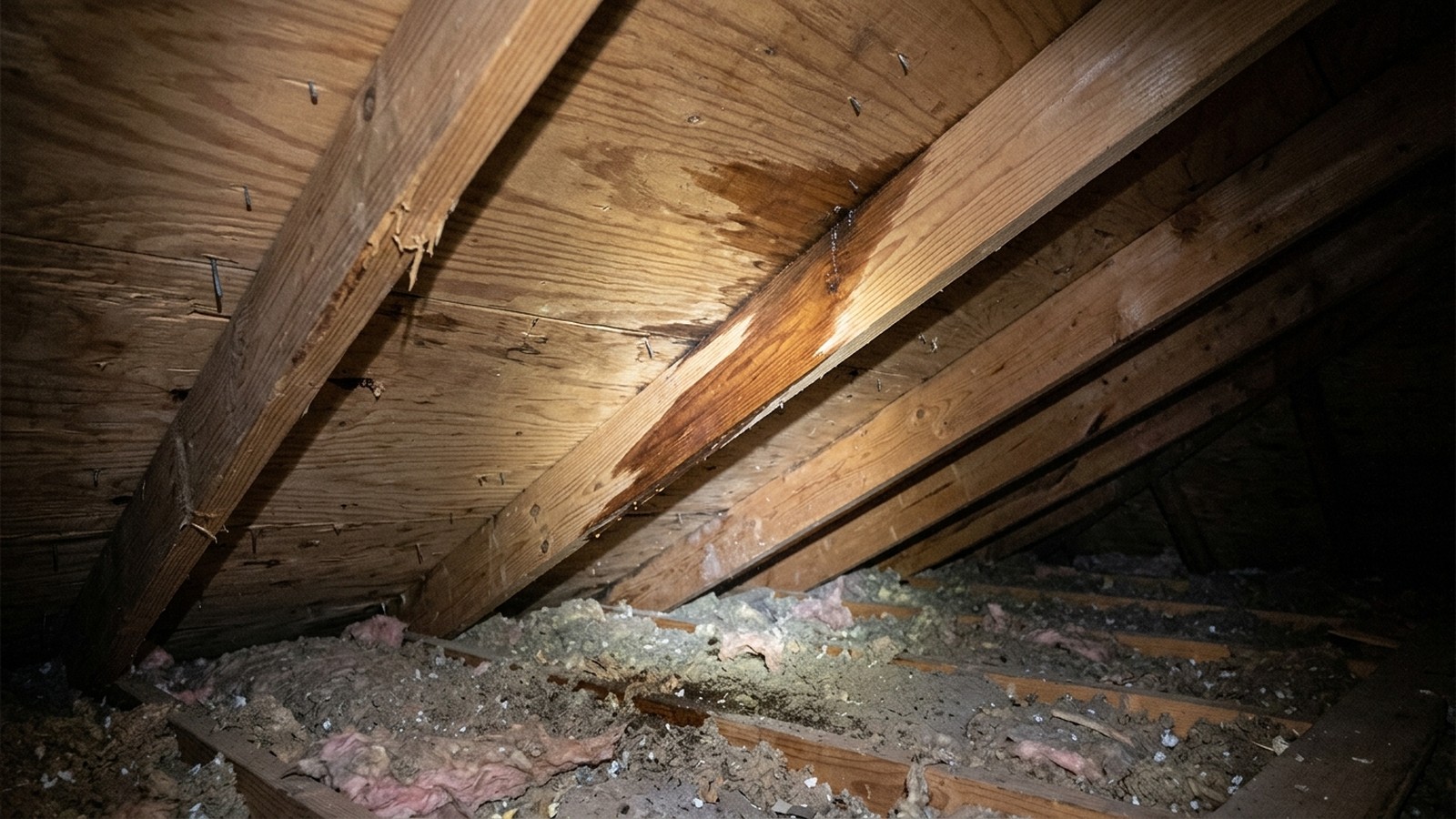
The stain on your ceiling is almost never directly beneath the place where water is getting in. Water enters the roof at a failed detail, then runs along the underside of the deck, down a rafter or a truss chord, across the top of the ceiling, and drops through at the first low point or seam it finds. By the time you see it, it may be fifteen feet from the entry.
That is the single most useful thing to know about roof leaks, and it is why chasing a leak from inside the house rarely works. This guide covers where Katy roof leaks actually start, what the pattern of the stain tells you, what is safe to check yourself, and what a real leak repair involves.
Why is the ceiling stain not under the leak?
Water follows the path of least resistance, and on a roof that path is almost always sideways before it is down. A roof deck is a continuous sloped plane with framing underneath, and a drop of water that gets past the shingles will travel that plane until something stops it.
Three things commonly redirect it:
- The slope of the deck. Water runs downhill under the sheathing just as it does on top of it.
- Framing members. A rafter, a truss chord or a ridge board will catch water and carry it along its length.
- Insulation and the ceiling plane. Water that reaches the attic floor spreads through the insulation and drops wherever the drywall has a seam, a light fixture, a vent boot or a fastener.
This is also why one leak can produce two stains in different rooms, and why the stain can move after a repair that only partly solved it.
Where do roof leaks actually start?
Most roof leaks start at a penetration or a transition, not in the open field of shingles. The middle of a slope is the simplest part of the roof and the least likely place to fail. Everywhere the roof changes direction or something passes through it is a detail that had to be built correctly.
| Where the leak starts | What usually failed | How common |
|---|---|---|
| Pipe boots and vent stacks | The rubber collar cracked or pulled away from the pipe | Very common, and often the first thing to fail |
| Step and counter flashing at walls and chimneys | Sealant aged out, flashing lifted, or it was never stepped correctly | Very common |
| Valleys | Debris dammed the valley or the metal corroded through | Common |
| Skylight curbs and flashing kits | Seal failure at the head or sides | Common |
| Nail pops and exposed fasteners | Fasteners backed out and broke the shingle seal | Common on older roofs |
| Ridge and hip caps | Caps damaged by wind, or ridge vent fasteners loosened | Common after storms |
| Eaves and drip edge | Water backing up under the first courses, often from clogged gutters | Common in heavy rain |
| Open field of shingles | Impact damage, missing tabs, or a roof at end of life | Least common on its own |
The Insurance Institute for Business and Home Safety describes the shingle roof as a layered assembly where underlayment is fastened to the deck before the shingles go on, which is the reason a single missing shingle does not usually produce an instant leak. The underlayment buys you time. A failed flashing detail has no second layer behind it.
Our guide to roof flashing covers the detail types and where each one fails, because flashing is behind a large share of the leaks we get called out to in Katy.
Why does my roof only leak when it rains hard?
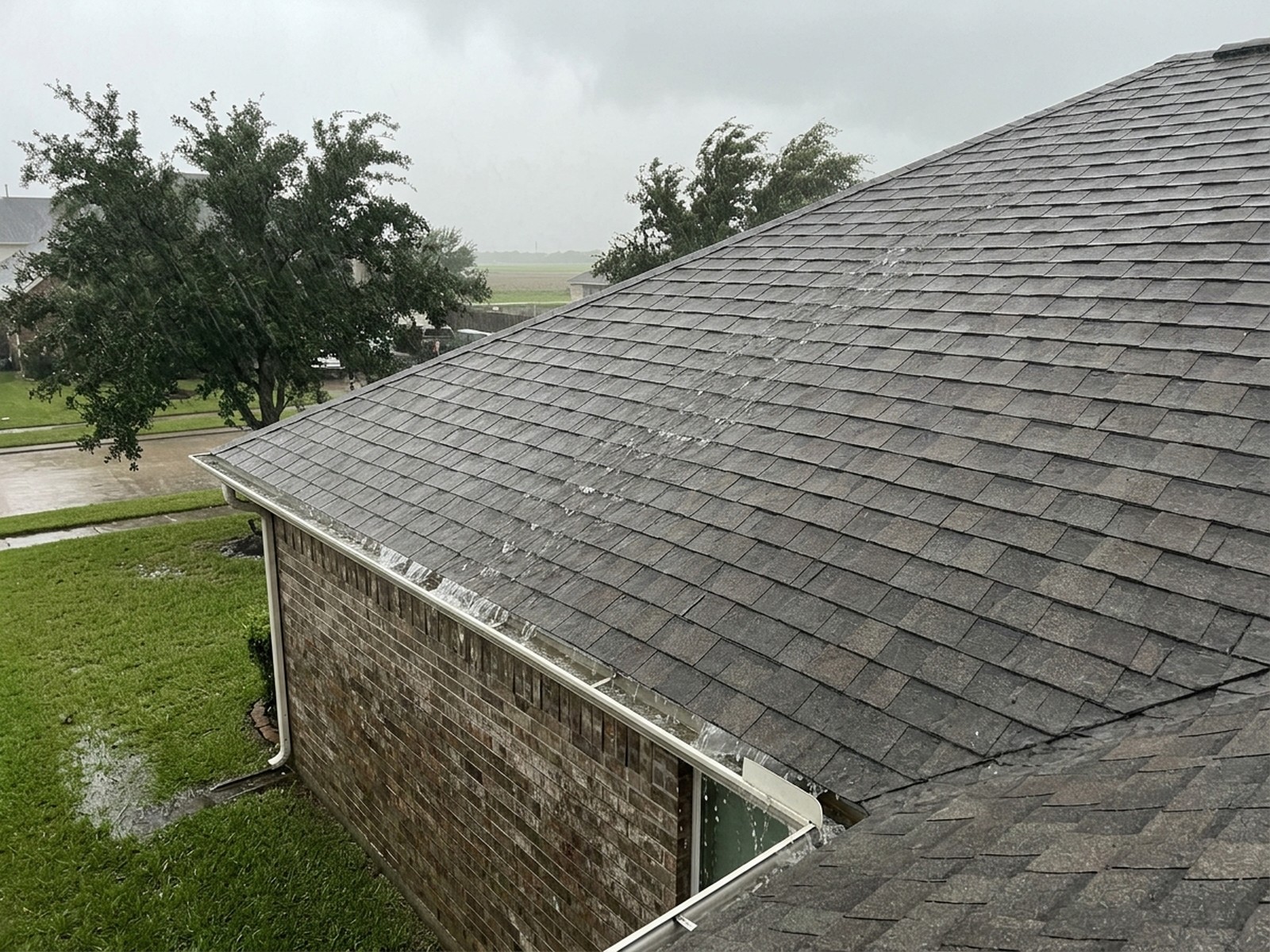
A roof that only leaks in heavy rain usually has a defect that needs volume, wind or both to push water where it should not go. Light rain runs off the way the roof was designed to shed it. Heavy rain changes three things at once.
Volume goes up, so valleys, gutters and drains run full and water backs up under the shingle course instead of over it. Wind drives rain horizontally and upward, which is a completely different load on every lap and flashing on the roof. And the two together find openings that gravity alone never reaches. IBHS research on how buildings let wind-driven rain in is built on exactly this point: the vulnerable openings are the ones that only matter when wind is pushing water through them.
Gulf Coast rain does this routinely. A Katy storm can drop more in an hour than a mild climate sees in a week, and it arrives sideways.
Is it a leak, or is it condensation?
Not every wet spot in an attic is a roof leak. Attic condensation produces very similar symptoms and has a completely different fix, so it is worth ruling out before anyone gets on the roof.
Condensation happens when moist indoor air reaches a cool surface in the attic and turns back into water. The Asphalt Roofing Manufacturers Association notes that a family of four generates roughly 2 to 4 gallons of water vapor a day through ordinary living, and that when that vapor is trapped in an attic it can condense and damage the roof deck and insulation.
The tells are different:
- A leak appears during or shortly after rain, is localized, and often has a defined stain with a ring.
- Condensation shows up as widespread dampness or frost-like moisture across the underside of the deck, is worst on cold mornings, and tracks with humidity rather than rainfall.
- Both can produce dark staining and mold on the sheathing over time.
ARMA's guidance is a balanced system, with intake at the eaves matched by exhaust at or near the ridge, sized to at least 1 square foot of net free ventilation area per 300 square feet of attic. Our post on roof and attic ventilation covers how that gets built and what happens in a Texas attic when it is not.
What can you safely check yourself?

Safe homeowner checks happen from the ground and from inside the attic. They stop at the ladder.
From the ground. Walk the perimeter and look for missing or lifted shingles, damaged pipe boots you can see from the yard, gutters that are full or pulling away, and staining on the soffit or fascia.
From inside the attic, on a dry day. Take a flashlight. Look for daylight at the deck, dark water tracks running down rafters, wet or compressed insulation, rusted nail points, and staining around penetrations. Trace any water track upslope, because the entry is always higher than the drip.
During rain, if you can do it safely. Water you can actually see moving tells you far more than a dry stain. Note where it enters, where it runs and where it drops.
Write down the pattern. Which rooms, how long after rain starts, whether it happens in every rain or only in storms, and whether wind direction seems to matter. That description shortens the diagnosis considerably.
Do not go up on the roof. A wet roof is slick, a leaking roof may have soft decking underneath, and a homeowner on a ladder with a caulk gun is the most common way a small leak becomes a large one. If water is coming in faster than you can contain it, that is an emergency call.
What does a real roof leak repair involve?
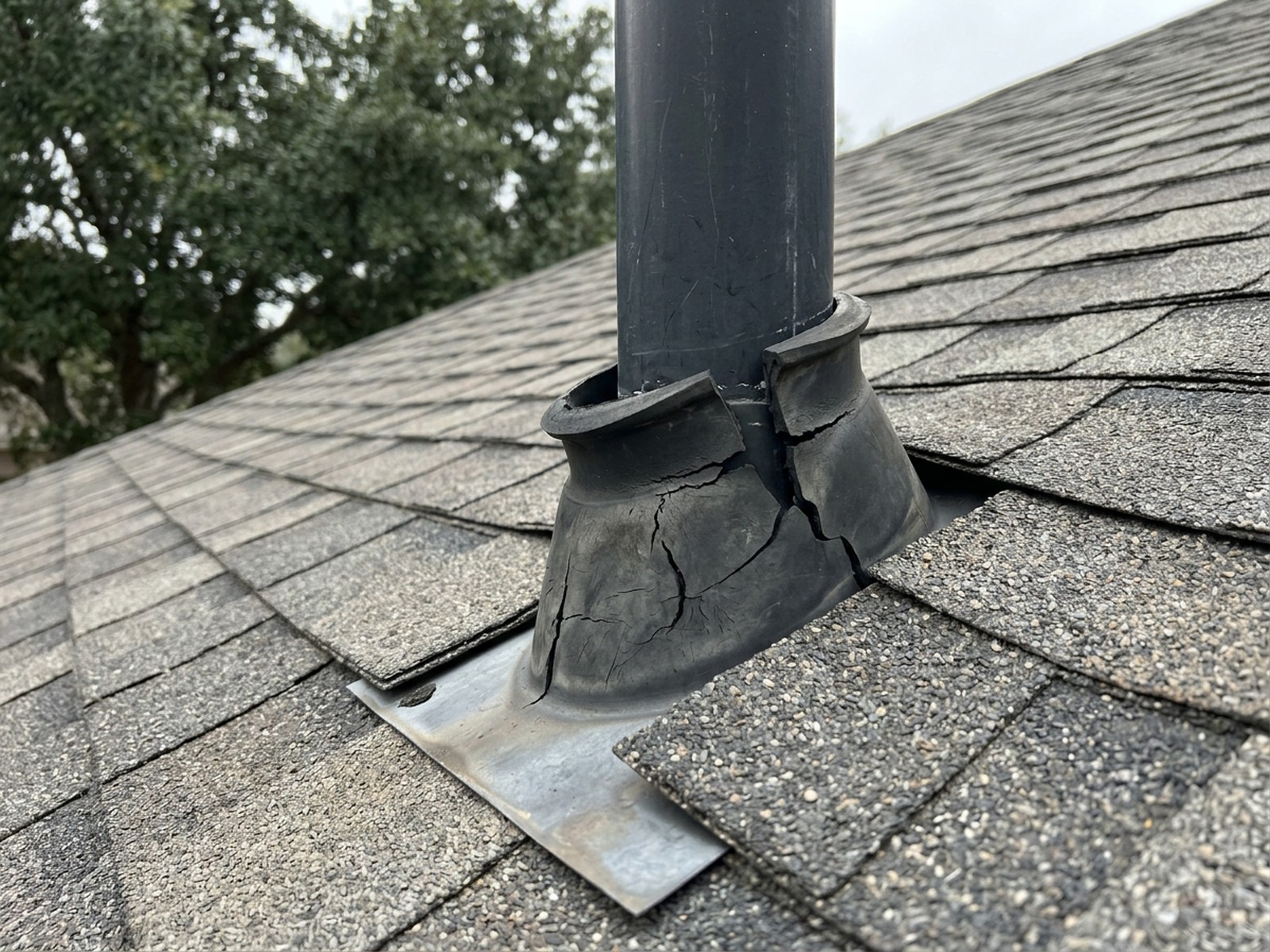
A real leak repair finds the entry point, opens enough of the roof to see what the water has already done, replaces the failed detail properly, and checks the decking underneath before anything goes back on.
The sequence usually runs:
- Diagnosis on the roof, starting upslope of the interior symptom and working through the penetrations and transitions in that water path.
- Water testing where the source is not obvious, isolating one area at a time rather than soaking the whole slope.
- Opening the area so the failure is visible rather than guessed at.
- Checking the deck. Wet sheathing does not dry out under new shingles. Soft or delaminated decking gets replaced.
- Rebuilding the detail to how it should have been built, which for flashing means correctly lapped metal rather than a bead of sealant over the top.
- A written record of what was found and what was done, with photographs.
That last one matters more than it sounds. If the leak turns out to be storm related, photographs taken during the repair are the documentation your claim needs. Sealant smeared over a flashing joint is not a repair, it is a delay, and it is one of the reasons a leak comes back in the same place a year later.
Frequently asked questions
How do I find a roof leak myself?
Start in the attic with a flashlight on a dry day and trace any water track upslope from the drip, because the entry is always higher than the symptom. Check penetrations first: pipe boots, vents, chimney and wall flashing, and skylights. Stay off the roof.
Why did my roof start leaking with no storm?
Most leaks are the result of a detail that has been slowly failing for months or years. A cracked pipe boot, aged flashing sealant or a backed-out nail will hold through light rain and finally fail in an ordinary one. Age is a cause, not just storms.
Can a roof leak without any visible damage?
Yes. Flashing failures, cracked boots and nail pops are frequently invisible from the ground and sometimes hard to see on the roof. A roof can look perfect and still have a leak at one penetration.
How urgent is a small roof leak?
More urgent than it looks. Water in an attic soaks insulation, reduces its performance, wets sheathing and framing, and in Gulf Coast humidity gives mold a place to establish. A small active leak is a short repair now and a decking and drywall job later.
Will my insurance cover a roof leak?
It depends on the cause and on your policy. Sudden damage from a covered event is treated differently from a leak caused by age, wear or deferred maintenance, and every policy is worded differently. Read your policy and ask your carrier. No roofer can tell you what is covered.
Should I put a bucket under it and wait?
Contain the water, yes, and get it looked at anyway. If the ceiling is bulging with trapped water, do not stand under it. Water spreading across a ceiling plane is doing damage you cannot see from underneath.
Let us find the real source
A ceiling stain rarely starts where it shows, and guessing at it costs more than diagnosing it. Blue Rhino Roofing is Katy based and owner led, and our roof leak repair work starts with finding the actual entry point and putting the findings in writing, with photographs, before anyone talks about a price.
Call (346) 733-8558 to get it looked at.

Shawn Swearingen
Shawn Swearingen leads Blue Rhino Roofing, a BBB A+ accredited, Texas-licensed roofing company based in Katy. He's on the roof and on the phone, and known for telling homeowners the straight truth about whether they need a repair or a replacement.