
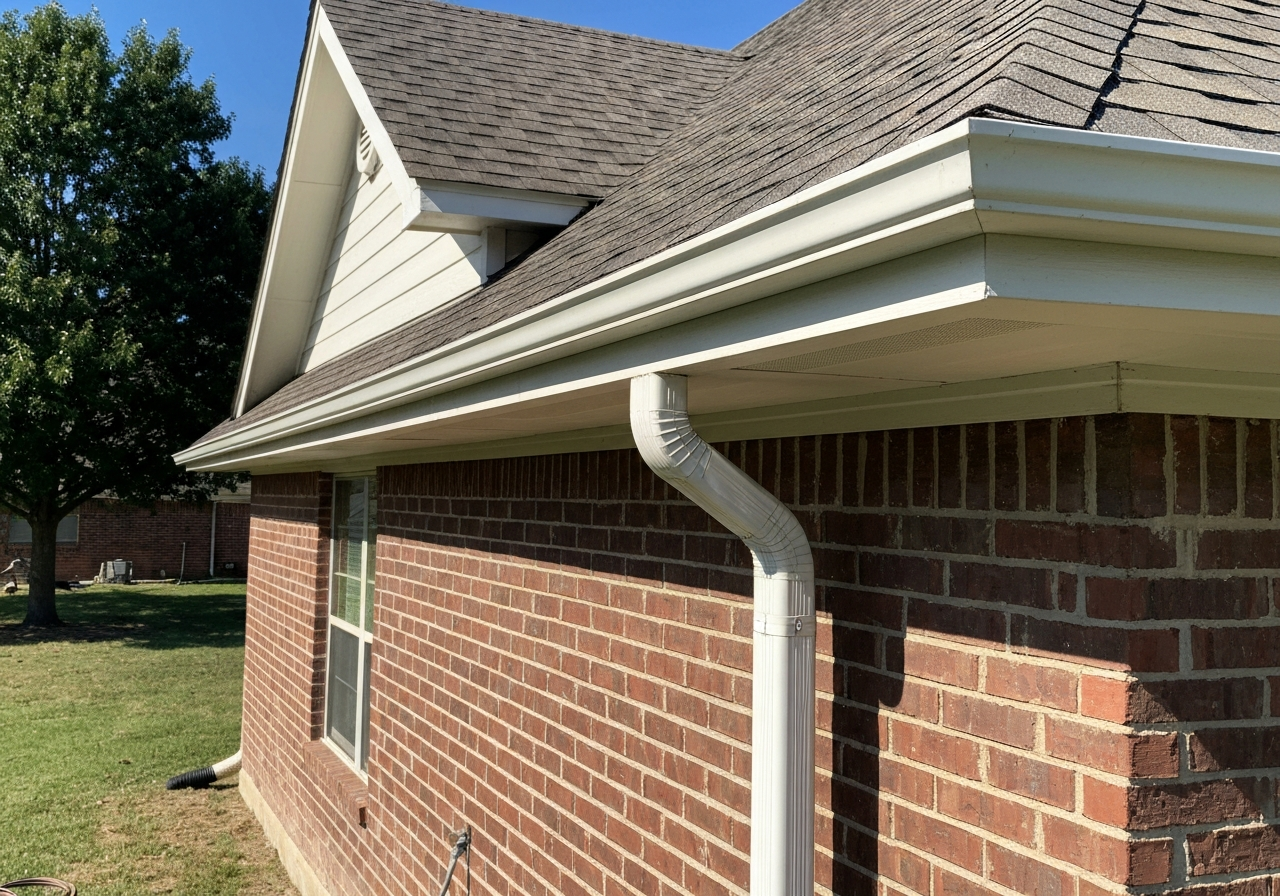
Many Katy homeowners contend with heavy tropical downpours, seasonal pollen and leaf drop, and occasional hurricane-driven rainfall that can overwhelm undersized or poorly maintained gutters. When gutters clog or overflow, your roof, fascia, siding, and foundation are exposed to accelerated water damage and higher repair costs.
Addressing gutter performance is a practical risk-management decision that protects property value and reduces maintenance cycles. A properly selected and installed seamless gutter system improves water shedding, lowers leak risk at joints, and decreases the frequency of emergency cleanouts during storm seasons.
This guide explains what seamless gutters are and why they are beneficial in Katy, describes local performance and sizing considerations, provides per-linear-foot and project pricing with a worked 40 ft example, covers materials and finish options, details installation logistics and timelines, explains contractor insurance and warranty expectations, and lists maintenance, neighborhood-specific factors, and next steps for requesting a free inspection and written estimate within a 30-mile service radius. It then moves into pricing details.
Introduction — Seamless Gutters in Katy, TX
What are seamless gutters?
Seamless gutters are continuous lengths of gutter custom-cut to fit a roofline without factory seams.
They reduce leaks and clogs compared with sectional gutters and are easier to maintain.
Why seamless gutters matter in Katy, TX
Katy experiences periods of heavy and tropical rainfall that can overwhelm poorly performing gutters (see NOAA for regional rainfall and hurricane guidance).
Seasonal pollen and falling leaves also increase clog risk, and durable gutters help protect roofs, siding, and foundations during storm season.
What this page covers
This page explains costs per foot and project pricing, a 40 ft example, sizing and material options, warranties, local FAQs, and installation details. It also notes our free inspections, financing options, a quality guarantee, and that we serve within a 30-mile radius of Katy. For broader gutter services and information, see /gutters/.
Cost and pricing: per-foot, project, and a 40 ft example
Price per linear foot
- Aluminum (0.027") — Low: $4/ft, Median: $7/ft, High: $10/ft. Typical inclusions: material, standard hangers, end caps, basic fasteners, standard labor. (Estimate range based on industry pricing sources: Fixr, HomeWyse.)
Fixr on aluminum gutters | HomeWyse
- Aluminum (0.032") — Low: $6/ft, Median: $9/ft, High: $13/ft. Thicker gauge increases durability and price; usually includes same basic components as above.
- Aluminum (0.040") / premium aluminum — Low: $8/ft, Median: $12/ft, High: $18/ft. Premium powder coat/hidden hangers may be included at higher bands.
- Galvanized steel — Low: $8/ft, Median: $10/ft, High: $15/ft. Stronger than standard aluminum; may include seam welding and heavier hangers.
- Copper — Low: $25/ft, Median: $32/ft, High: $40/ft. High-end material; includes soldered seams, copper downspouts, and more labor specialization.
HomeAdvisor on copper gutters | Fixr on copper
Note: All dollar amounts above are estimates/ranges compiled from multiple industry sources and reflect national market ranges; local pricing in Katy, TX, may vary. See listed sources for reference.
Cost table — price per linear foot (typical ranges and what's included)
| Material / Gauge | Low (per ft) | Median (per ft) | High (per ft) | Typical what's included |
|---|---|---|---|---|
| Aluminum 0.027" | $4 | $7 | $10 | Material, hangers, end caps, standard labor |
| Aluminum 0.032" | $6 | $9 | $13 | Better gauge material, standard installation hardware |
| Aluminum 0.040" (premium) | $8 | $12 | $18 | Premium gauge, powder coat, upgraded hangers |
| Galvanized steel | $8 | $10 | $15 | Heavier material, welded seams, stronger hangers |
| Copper | $25 | $32 | $40 | Soldered seams, copper downspouts, specialist labor |
(Price ranges compiled from Fixr, Angi, HomeAdvisor, EcoWatch, HomeWyse — figures are typical national ranges and should be treated as estimates. Examples: Fixr, Angi, HomeAdvisor.)
Are estimates free?
Yes — Blue Rhino Roofing offers free on-site inspections and written estimates for seamless gutter work in the Katy, TX area. Free estimates typically cover an inspection of roofline/run, recommended material and downspout placement, and a written price. Common exclusions from a free estimate: structural repairs (roof edge/soffit replacement), major fascia replacement, permit fees (if required), and remediation of severe rot — these are quoted separately if identified.
Is old gutter removal included?
- Many installations include basic removal of existing gutters in the project quote, especially when replacing with a new seamless system.
- If the old gutters are attached to rotted fascia, require major repair, or contain hazardous materials/large amounts of debris, removal may be billed as an extra line item. Blue Rhino will flag any extra-cost scenarios during the free inspection.
Total project cost — what affects price
- Material choice and gauge (aluminum vs. steel vs. copper).
- Home complexity (number of corners, stories, roof pitch, hard-to-reach areas).
- Number of downspouts and their length/location.
- Existing gutter removal and condition of fascia/soffit.
- Gutter guards or accessories (leaf guards, heat tape).
- Local labor rates and permits.
- Seasonal demand and lead time for materials.
Example: cost for a 40 ft seamless gutter
All figures below are estimates and intended as a worked example. Actual quote will come from an on-site inspection. Sources for per-foot ranges: Fixr, Angi, HomeAdvisor, EcoWatch (see links above).
Line-item breakdown (40 linear feet, typical single-story run):
- Materials (aluminum 0.032" at per-ft rates):
- Low: 40 ft × $6/ft = $240
- Median: 40 ft × $9/ft = $360
- High: 40 ft × $13/ft = $520
- Labor (installation):
- Low: $160 (≈ $4/ft)
- Median: $240 (≈ $6/ft)
- High: $480 (≈ $12/ft for complex/2-story work)
- Downspouts (2 standard downspouts):
- Low: $100 ($50 each)
- Median: $150 ($75 each)
- High: $300 (custom or longer downspouts)
- Old gutter removal and disposal:
- Low: $0–$150 (sometimes included) — use $0 if included, $150 if extra
- Median: $150
- High: $300 (difficult removal, heavy debris)
- Gutter guards (optional):
- Low: $0 (not included)
- Median: $200 (basic mesh)
- High: $600 (premium systems)
- Materials/fasteners/finish extras (endcaps, miters, paint touch-up):
- Low: $25
- Median: $50
- High: $100
Subtotal examples (40 ft, rolled up):
- Low estimate total (materials low + labor low + downspouts low + removal low + no guards):
$240 + $160 + $100 + $0 + $25 = $525 (estimate)
- Median estimate total (materials median + labor median + downspouts median + removal median + basic guards + extras):
$360 + $240 + $150 + $150 + $200 + $50 = $1,150 (estimate)
- High estimate total (materials high + labor high + downspouts high + removal high + premium guards + extras):
$520 + $480 + $300 + $300 + $600 + $100 = $2,300 (estimate)
Notes:
- These are example totals to show how components add up; they are estimates only. National sources show per-foot installed ranges roughly consistent with the per-foot ranges above (see Fixr, Angi, HomeAdvisor, EcoWatch). Local site conditions in Katy, TX (roof access, two-story homes, fascia condition) may push pricing toward the median or high end.
- For copper or premium aluminum, expect materially higher totals (copper example: 40 ft × $32/ft median = $1,280 material alone before labor).
Performance and weather: handling Katy rains and overflow
How seamless gutters handle heavy rain in Katy
Seamless gutters reduce the number of joints along the run, so water flows more smoothly to the downspouts and away from the house. That cut in seams means fewer leak points and less chance of water backing up at joints during heavy downpours.
Proper performance also depends on correct pitch, sufficient downspout capacity, and secure hangers. Pitch directs flow toward downspouts; undersized or clogged downspouts cause backup regardless of gutter type. If you need local rainfall intensity or design values for Katy/Houston, reference NOAA’s precipitation-frequency maps when sizing gutters and downspouts:
- NOAA Atlas 14 / Precipitation Frequency Data Server: https://hdsc.nws.noaa.gov/pfds/
Seamless vs sectional: overflow and foundation protection
Seamless and sectional systems differ in construction and therefore in overflow and foundation-protection performance. Summary comparison:
- Overflow risk
- Seamless: Lower — fewer joints to trap debris, smoother flow to downspouts.
- Sectional: Higher — joints every 10–12 feet can trap debris and create local overflow points.
- Leak points
- Seamless: Minimal — seams only at corners and downspouts.
- Sectional: Many — each joint is a potential leak that can let water drip near the foundation.
- Maintenance frequency
- Seamless: Typically less frequent — fewer seams means fewer trouble spots to inspect.
- Sectional: More frequent — check joints and sealants regularly.
- Lifespan and durability
- Seamless: Often longer — continuous lengths reduce stress at joints.
- Sectional: Can be shorter unless high-quality materials and installation are used.
For a reputable third-party comparison of seamless vs sectional gutters, see This Old House’s guide:
- This Old House — Seamless Gutters: https://www.thisoldhouse.com/gutters/seamless-gutters
Should gutters have guards?
Gutter guards cut down on leaves, pollen, and debris that clog gutters — and in Katy, where oak pollen and yard debris are common, they make sense for many homeowners.
Pros
- Reduce clogs and downspout blockages.
- Lower maintenance: fewer cleanings per year.
- Prevent overflow-related damage from backed-up gutters.
Cons
- Not maintenance-free: some debris still accumulates and guards require occasional cleaning.
- Added cost: upfront price varies by type and material.
- Compatibility: not every guard design works with every roof edge or gutter profile.
Recommendation for Katy: consider a high-quality micro-mesh or perforated top if you have lots of small debris (pine needles, pollen). For heavy leaf loads, choose a guard designed to handle large volumes while keeping water flowing to downspouts.
Where are seamless gutters made and roll-formed?
Seamless gutters are roll-formed on site from a continuous coil of material using a mobile roll-forming truck, with the installer measuring each run and cutting to length at your home so the gutter is a single continuous piece. Some gutters are instead pre-made in a factory and shipped as fixed-length sections that installers join on site. On-site roll-forming matters locally because it lets Katy contractors deliver longer continuous runs with fewer seams, so ask your installer which method they use.
Transition to sizing and downspout recommendations
Now that you know how seamless systems perform in Katy weather and how they compare to sectional gutters, next we’ll cover gutter sizing and downspout recommendations — including common sizes and an example for a 40 ft run.
Gutter sizes, downspouts, hangers, and corners
Recommended gutter and downspout sizes for Katy
- Small roof — up to 1,000 sq ft: 5" K-style gutter, one 2x3 downspout per 600–800 sq ft
- Medium roof — 1,000–2,000 sq ft: 5" or 6" K-style gutter, one 3x4 downspout per 800–1,200 sq ft
- Large roof — 2,000–3,000 sq ft: 6" K-style gutter, two 3x4 downspouts (or more)
- Very large roof — over 3,000 sq ft: 6" gutters, multiple 3x4 downspouts spaced to meet required capacity
Notes:
- Gutter profile (first use): the cross‑section shape of the gutter — “K‑style” is the most common residential profile.
- These are practical recommendations for Katy, TX (tropical downpours are possible). Final sizing should be verified on-site, accounting for roof shape and rainfall intensity.
How to size downspouts and place them for tropical downpours
- Use this simple formula (static snippet):
- Required downspouts = (roof area × rainfall intensity) ÷ downspout capacity
- Example: Roof area = 2,000 sq ft; rainfall intensity = 3 in/hr; downspout capacity = 600 sq ft per downspout → Required downspouts = (2,000 × 3) ÷ 600 = 10,000 ÷ 600 ≈ 5 downspouts.
- Guidance: cite NOAA or local design rainfall tables for accurate rainfall intensity (design storms). For Katy/Houston area, use NOAA or local municipal storm‑design values when calculating.
- Place downspouts where water naturally funnels from roof valleys and at low points on long gutter runs.
- Avoid long uninterrupted gutter runs without downspouts — aim to keep each downspout’s service area within its calculated capacity.
- Space downspouts so water has a short path to discharge; split flows from large roof areas into two smaller downspouts rather than one oversized discharge when possible.
Hanger spacing and fastening best practices
- Short intro: Use hangers to support gutters and prevent sagging. Pitch (first use): the roof’s slope — usually expressed as rise over run; affects how quickly water reaches the gutters.
- Standard hanger spacing: 18–24 inches apart for typical residential installations.
- Heavy-duty or high‑load spacing: 12–18 inches when you expect large water loads, ice, or when using lightweight gutter material.
- Fastening tips:
- Use hangers attached to fascia or rafter tails with corrosion‑resistant fasteners.
- Add extra hangers at corners, downspout locations, and long straight runs.
Corners and corner types
- Mitered corners
- Pros: lower cost; easier to install on variable fascia angles.
- Cons: rely on sealant; more potential leak points over time.
- Welded corners
- Pros: seamless at corner, much lower leak risk, cleaner appearance.
- Cons: higher cost and requires shop or on‑site welding/thermal seam work.
- Recommendation for Katy: welded corners when budget allows — they hold up better under tropical storms and heavy flow; use high-quality seam sealant for mitered corners if welding isn’t used.
Do installers use a level?
Yes — installers use levels and slope measurements to set gutters. Best-practice pitch is to slope gutters toward downspouts so water flows freely. A common guideline is about 1/4 inch of drop for every 10 feet of gutter run (0.25" per 10 ft); installers will fine‑tune on‑site to ensure consistent drainage and avoid standing water.
Note: Proper sizing, hanger spacing, corner choice, and downspout placement affect both performance and installation time. Correct installation reduces callbacks and safety risks (working at height, ladder setup).
Installation timeline, safety, and logistics
Typical installation time
- Single-story home: 4–8 hours (typical seamless-gutter run on one elevation; depends on roof complexity and downspout locations).
- Two-story home: 1–2 days (additional time for safe access, scaffolding or lifts, and extra seal/fastener work).
- Full replacement or multiple buildings: Multi-day (often 2–4+ days depending on number of rooflines, length of gutter runs, and demolition of old gutters).
Note: site conditions such as landscaping protection, driveway access, and the need for scaffold or lift permits can add time.
Site access, lifts, and safety near power lines
Work crews follow concrete safety measures to protect people and property:
- Utility locate before work (call 811 or local utility) to mark underground lines and confirm overhead line locations.
- Maintain safe distance from overhead power lines: keep at least 10 feet clearance for typical distribution lines; for higher-voltage lines, consult the utility for required clearances.
- Contact the utility if any work requires temporary de-energizing, line relocation, or a closer working distance.
- Trained crews and insulated equipment: use trained personnel, non-conductive ladders, and insulated tools when working near energized conductors.
- Use lifts or scaffolding when required and confirm ground access and load-bearing surfaces before placing equipment.
- Protect landscaping and hardscapes with plywood and drop cloths; use debris nets where needed.
Service area note: crews operate within a 30-mile radius of Katy, TX — confirm availability for your address when scheduling.
Permits and HOA coordination
- When permits are common: most municipalities require a building permit for new gutters if structural work, roofline changes, or large alterations are involved; some jurisdictions require a permit for full replacements.
- HOA approval: HOA or design-review approval is commonly required when gutters change visible exterior appearance (color, profile, or downspout placement).
- Who obtains permits: contractors typically pull local permits as part of the job, but confirm in writing who is responsible. For HOA approvals, homeowners usually submit applications; contractors can supply drawings and product specs to support approval requests.
Scheduling with other exterior projects
- Sequence exterior work to avoid rework: schedule roofing or fascia repairs before gutter installation, and complete major landscape grading or hardscape changes before crews arrive. If multiple contractors will work on site, set a single point of contact and agree on arrival windows to minimize delays and overlap.
Next: credentials and warranties — what to expect from installers and how guarantees are documented.
Insurance, warranties, written guarantees, and references
Are contractors insured and do they provide a COI?
Blue Rhino Roofing carries contractor insurance and a Certificate of Insurance (COI) is available on request. We recommend you verify that any contractor’s coverage includes general liability insurance (protects your property) and workers’ compensation (covers on-site injuries). Ask to see policy limits on the COI and confirm the policy is current before work begins.
Written workmanship warranties and quality guarantees
We back our work with written guarantees. Typical warranty ranges you should expect and what they cover:
- Labor / workmanship warranty: 1–10 years — covers installation errors, loose fasteners, or improper sealing that cause leaks or failure.
- Material manufacturer warranty: 20–50 years (varies by product) — covers defects in the gutter material such as corrosion, cracking, or finish failure.
- Finish / paint warranty: 5–25 years — covers peeling, blistering, or excessive chalking of factory-applied finishes.
- Leak-free or performance guarantee: 1–5 years — some contractors offer a short-term guarantee specifically promising no leaks from seams or connections.
- Transferability and claim process: Check whether warranties are transferable to a new homeowner and ask for a written claims process (who to contact, response time, and remediation steps).
Always get warranties in writing, read exclusions (storm damage, improper maintenance), and note any required maintenance to keep the warranty valid.
Are gutters seamless or sectional?
Blue Rhino installs seamless gutters by default — one continuous run custom-formed on-site to reduce leaks and improve curb appeal. Sectional gutters (pre-cut pieces joined at seams) are available on request for repairs or when seamless installation isn’t practical. If you prefer seamless, confirm the installed gutters are custom-formed and show the join locations (typically at corners and downspouts).
Local references and before-and-after photos
We provide local references and a before-and-after gallery showing recent Katy-area gutter projects. Ask for references in your ZIP code and request photos with captions that include the project ZIP code and a brief note of the scope (e.g., "142 ft seamless gutter install, 77449"). This helps verify local experience and similar scope.
Next, we’ll cover materials and profile options so you can compare colors, metals, and sizes before getting pricing and a per-foot estimate.
Materials: aluminum, steel, and copper — which is best for Katy?
Aluminum options and pros/cons
- .027" (lightweight, economy)
- Pros: lower material cost, easier to form on-site, lighter for eaves and fascia.
- Cons: less dent resistance; can sag on long runs if not supported frequently.
- Typical uses: budget-friendly residential seamless gutters and short runs.
- .032" (mid-range)
- Pros: good balance of cost and strength; common choice for residential seamless gutters.
- Cons: slightly higher cost than .027"; still not as impact-resistant as thicker options.
- Typical uses: most single-family homes in Katy for a good value/performance balance.
- .040" (heavier-duty)
- Pros: best dent resistance and rigidity among common aluminum gauges; holds shape on long runs.
- Cons: higher material and installation cost; heavier for ladder work.
- Typical uses: homes with long gutter runs or where durability vs. impact is a priority.
- Corrosion resistance
- Aluminum resists rust because it does not contain iron, but it can corrode in some coastal or chemically aggressive environments. In Katy (inland Houston area) aluminum is typically a highly corrosion-resistant choice compared with bare steel. If stating lifespan or corrosion expectations, use typical ranges (e.g., properly finished aluminum gutters often last 20+ years depending on finish and maintenance) or cite manufacturer guidance—actual life varies by finish and exposure.
- Paint/finish options
- Aluminum gutters are commonly coil-coated or factory-painted; premium finishes use PVDF (Kynar) for better color retention.
- Color-matched gutters are widely available (see the color/finish section below).
- Cost
- Aluminum is generally less expensive than copper and often less than high-gauge steel once installation factors are included. Thicker gauges (.040") increase material cost.
Steel and galvanized options
- Strength and rigidity
- Steel (painted or galvalume/aluminized) offers higher structural strength than equivalent-gauge aluminum — better where impact resistance or very long unsupported runs matter.
- Corrosion risk
- Galvanized steel resists rust initially but will corrode over time if the zinc layer is damaged or in coastal/aggressive environments; galvalume (aluminum-zinc alloy) improves corrosion resistance.
- Factory-applied coatings and finishes (including PVDF/Kynar on steel) extend life but steel remains more susceptible to rust than aluminum if the coating is compromised.
- Common uses
- Steel gutters are common on commercial buildings or residential jobs needing extra strength or where a painted steel profile is specified.
- Cost tradeoffs
- Steel material cost can be lower or comparable to aluminum depending on gauge; higher maintenance risk may affect total lifecycle cost.
Copper
- Copper gutters are chosen mainly for aesthetics and longevity:
- Pros: distinctive look that patinas over time; very long service life when properly installed (often decades).
- Cons: significantly higher material and installation costs; color and patina change over time (not color-matchable to painted systems).
- Lifespan/corrosion note: copper does not rust and can last many decades, but exact lifespan depends on installation and environment—presented here as typical expectations, not guarantees.
Color matching and finish options
- Kynar (PVDF) and polyester finishes
- Factory-applied PVDF (commonly marketed as Kynar 500) provides superior color retention, fade resistance, and weathering compared with standard polyester paints. See Manufacturer pages for aluminum and Kynar finishes for manufacturer guidance and specifications.
- Color matching availability
- Most manufacturers offer standard color palettes and limited custom color-matching. Exact availability depends on substrate (aluminum vs. steel), gauge, and whether the finish is coil-coated or post-painted.
- Warranty implications
- Color-matched, factory-applied PVDF finishes often carry longer color-fade warranties than standard polyester. Custom matches or field-painting can reduce or void manufacturer finish warranties—confirm warranty terms before selecting non-standard colors.
- Practical note
- If you plan to match gutters to a specific trim or roof color, ask for factory color samples and written warranty details tied to the chosen finish.
Choosing the best material affects upfront costs, expected lifespan, maintenance needs, and finish warranties — factor all of these when comparing quotes and selecting a gutter material for your Katy home.
Maintenance, common problems, and lifespan
Common problems to watch for
- Clogs — leaves, pine needles, and especially spring pollen can pack into gutters and downspouts, stopping flow.
- Sagging or pulling away — overloaded or improperly fastened gutters will bow or detach from the fascia.
- Leaks and seams — damaged joints, end caps, or corroded metal can drip at roof edges.
- Debris and pollen buildup — fine pollen and seed fluff common in Katy can create a muddy residue that traps more debris and accelerates clogs.
- Standing water / improper slope — when gutters aren’t pitched correctly water pools and can overflow or freeze in rare cold snaps.
- Downspout blockages — even if the gutter is clear, a blocked downspout will cause backups and localized overflow.
Maintenance schedule for Katy seasons
Follow this seasonal checklist to reduce problems and extend gutter life:
- Spring (March–May) — pollen cleanup
- Remove pollen, seed pods, and spring leaves from gutters and screens.
- Flush downspouts with a hose to clear pollen clogs.
- Inspect hangers and fasteners after any heavy storms.
- Summer (June–August) — storm readiness
- Check for loose or sagging sections before hurricane season ramps up.
- Trim back overhanging branches that drop debris during summer storms.
- Confirm downspout extensions direct water at least 4–6 ft from foundation.
- Hurricane season / late summer to fall (June–November) — heavy-rain prep
- Secure all hangers and replace any damaged sections.
- Clear gutters immediately after major storms to prevent secondary damage.
- Consider installing or checking splash blocks/underground drains to manage high runoff.
- Fall (October–December) — leaf season
- Remove accumulated leaves and check screens/guards for blockages.
- Tighten fasteners and reseal joints if you see leaks forming.
- Schedule a professional inspection if you notice sagging or repeated overflow.
- Winter / cold snaps (as needed) — freeze prevention
- Remove standing water where possible; inspect for ice dams after freezes (rare but possible).
- Check gutters after any freeze-thaw cycle for new cracks or separations.
Lifespan by material
- Aluminum (typical range: 20–30 years) — lightweight and rust-resistant, but can dent from impacts.
- Steel (typical range: 20–40 years with proper coating) — stronger than aluminum but can corrode if the finish is compromised.
- Copper (typical range: 50+ years) — long-lasting and low-maintenance; higher upfront cost.
- Vinyl (typical range: 10–20 years) — affordable and rust-free but can become brittle in prolonged heat or under heavy loads.
(These are typical ranges; actual lifespan depends on installation quality, local conditions, and maintenance.)
Are gutters worth it in Katy/Houston?
Yes. Well-installed gutters protect roofs, siding, foundations, and landscaping from heavy seasonal rains and pollen-related blockages common in the Katy/Houston area. The cost of routine maintenance and a proper system is generally far less than the cost of repairing water damage to your roof, walls, or foundation.
Next: cost and pricing — per-foot, project, and a 40 ft example (including financing and warranty options).
Warranties, financing, guarantees, and quality assurances
Typical local warranty lengths and coverage
- Labor (workmanship) warranty: commonly 1–10 years depending on the company and scope of work. Shorter ranges are typical for small repairs; longer terms are usually offered for full replacements or when backed by a contractor guarantee.
- Material (manufacturer) warranties: typically 10–50 years. Asphalt shingles often carry 20–30 year or longer warranties; metal and specialty materials may have longer manufacturer coverage.
- What these warranties generally cover:
- Labor warranty: defects in workmanship, improper installation, and repairs needed because of contractor error.
- Material warranty: failure or premature deterioration of the product itself (e.g., cracking, delamination). Manufacturer warranties rarely cover labor unless a specific program includes it.
- Notes: Many warranties have exclusions (storm damage, improper maintenance, deterioration from debris, or damage from other trades). Always read warranty terms for coverage limits, prorated vs. non-prorated terms, and any required maintenance to keep the warranty valid.
Company quality guarantee and what is included
Blue Rhino Roofing backs its work with a company quality guarantee that typically covers workmanship remediation when issues arise that are caused by installation. A company guarantee usually:
- Commits to repairing or correcting installation defects discovered within the stated labor-warranty period.
- Specifies the conditions that trigger remediation (e.g., leaks directly attributable to installation, loose fastening, improperly sealed seams).
- May require the homeowner to report problems within a set timeframe and allow inspection before corrective work begins.
Avoid absolute language like “guaranteed approval” — company guarantees cover contractor-controlled workmanship, not damage from storms, material failure covered under separate manufacturer warranties, or issues caused by third parties.
Financing options
Typical financing structures you can expect from local contractors and third-party lenders:
- Deferred-interest or 0% introductory offers for a set period (for example, 6–18 months) — read terms: missed payments can void the promotional rate.
- Low-interest installment loans with fixed monthly payments over 1–10 years, depending on loan size and lender.
- Home improvement loan or personal loan options through banks or credit unions with varying rates based on credit.
- Payment plans direct with the contractor (e.g., staged payments: deposit, mid-project, final) — amounts and milestones vary by job.
- Special programs (solar + roofing bundles or manufacturer-backed programs) that may offer unique terms.
What to expect during financing applications:
- Contractors or lenders will ask for basic financial information and run credit checks for many loan products.
- Approval is not guaranteed; terms depend on credit, income, and lender criteria. Always get the finance terms in writing and compare APR, fees, and prepayment penalties.
Deliverables: estimates, contracts, COI, warranty docs
Checklist to request and keep in writing:
- [ ] Written estimate with itemized costs (materials, labor, permits, disposal) and clear scope.
- [ ] Signed contract detailing scope of work, start and completion windows, payment schedule, change-order process, and cancellation terms.
- [ ] Certificate of Insurance (COI) showing contractor general liability and workers’ compensation coverage.
- [ ] Manufacturer warranty documents for all installed materials (shingles, gutters, flashing, etc.).
- [ ] Company workmanship warranty/quality guarantee in writing with duration and remediation process.
- [ ] Warranty transferability statement (if applicable) and any required maintenance to preserve coverage.
- [ ] Final inspection checklist and photographic record of completed work.
Before signing or paying final amounts, ask the contractor for references and evidence of recent similar work:
- Request local references (within your area) and call them.
- Ask for before-and-after photos of completed jobs or a portfolio link.
End note: always compare written warranties and financing offers side-by-side, and keep copies of all documents for future claims or resale disclosure.
How seamless gutters fit Katy neighborhoods and properties
Neighborhoods and ZIP coverage
- Neighborhoods: Cinco Ranch, Cross Creek, Grand Lakes
- Counties served: Fort Bend, Harris, Waller
- Key ZIPs: 77449, 77450, 77493, 77494
Common home types and how they affect gutter choices
Katy includes ranch-style homes on large lots, modern two-story houses on tighter infill lots, and patio-style homes in planned communities. Roof area and pitch determine gutter size (larger roofs need wider gutters); lot size and landscaping influence downspout placement and routing — homes on small lots often need carefully routed downspouts to avoid saturating neighboring yards, while larger lots allow more flexibility for daylighting or dry wells. Choose seamless gutters and downspouts sized and positioned for the roof geometry, lot constraints, and expected rainfall to reduce overflow and erosion.
Local environmental factors that affect gutters
- Tree cover and species: Live oaks, pecans, and Chinese tallow drop leaves and twigs that can clog gutters — consider gutter guards or larger-capacity systems.
- Proximity to bayous and drainage ditches: Homes near bayous may face faster runoff and require additional downspout capacity and well-planned discharge points.
- Soil and local drainage: Clay soils and low-percolation areas raise the risk of pooling; use extended downspouts, splash blocks, or routed drainage to protect foundations.
- Pollen and seasonal debris: Heavy spring pollen and seasonal seed pods increase maintenance frequency—material choice and slope help keep water flowing.
For examples, neighborhood-specific before-and-after photos and captions reference installations in ZIPs 77449, 77450, 77493, and 77494. Ready to see cost options? Next up: Cost and pricing — per-foot, project, and a 40 ft example.
Next steps: inspections, estimates, and scheduling
How to request a free inspection
- Call us — Phone: (enter local phone number) to speak with a scheduler and get same-week or next‑available dates.
- Fill the online form — Use the contact/inspection form on our site and select "Free inspection." Include the details below so we can prepare.
- Email — Send a short message to (enter email) with the same details if you prefer.
When you contact us, please provide:
- Property address (house number, street, city, ZIP)
- Preferred inspection dates and two alternate windows (mornings or afternoons)
- Best phone number and email for scheduling and estimates
- Gate or lockbox codes (if applicable) and any access notes
- Short description of the issue (leaks, visible sagging, clogged/downspout issues)
- Photos of the roof/gutters or problem area (optional but helpful)
What to prepare before the inspection
- Photos of the roof and gutters from ground level (phone photos are fine)
- Any recent repair records, invoices, or before/after photos
- Gate, yard, or dog access instructions and codes
- HOA rules or architectural restrictions that could affect work or materials
- Preferred days/times for follow-up and for work to be scheduled
- List of questions you want the inspector to answer (warranty, materials, timeline)
What to expect during the inspection and estimate timeline
- Arrival and safety check — The inspector will arrive at the scheduled time, check in with you, and confirm access, safety, and any hazards.
- Visual and close-up assessment — We inspect the roofline, gutter system, flashing, fascia, and any visible problem areas. If safe and necessary, the inspector may use ladders or a drone for close-up photos.
- Measurements and notes — We take measurements, record materials needed, and note any structural issues that could affect price or timeline.
- Documentation review — If you have HOA rules, prior repair records, or warranty documents, we’ll review them and note any constraints.
- Estimate preparation — We prepare a written estimate with scope, materials, timeline, and warranty information.
Typical turnaround for the written estimate:
- Same day to 24 hours for straightforward gutter-only repairs or simple replacements
- 24–72 hours for full replacement estimates or jobs that need supplier quotes or permit checks
(We aim to deliver estimates as quickly as possible; exact timing depends on job complexity and permit/HOA needs.)
Scheduling, coordination, and deposit/payment
Once you approve the estimate, we typically schedule work within a 1–3 week window depending on crew availability and material lead times. For larger projects, expect scheduling windows of 2–6 weeks. A deposit is usually required to hold materials and book the crew; deposit amounts vary by project size and will be stated clearly in the estimate. We accept common payment methods and will provide a written payment schedule before work begins.
Ready to schedule a free inspection? Contact us by phone, online form, or email with the details above and we’ll get you on the calendar.
Frequently Asked Questions
How much does a 40 ft run of seamless gutters cost?
Expect roughly $1,200–$2,400 as a conservative estimate for a standard 40 ft run (materials + installation).
This is an estimate — final price depends on gutter profile, material (aluminum vs. heavier gauges), number of endcaps/downspouts, fascia condition, and job access. We list a detailed 40 ft example in the Cost and pricing section; treat the figure above as a sample range, not a guaranteed final price.
Do seamless gutters perform better than sectional gutters?
Yes — seamless gutters generally perform better because they have fewer joints where leaks start.
Seamless systems reduce leaks and require less maintenance, especially on longer runs. Sectional gutters can be less expensive up-front but often need more repairs and sealing over time.
Can you safely work on ladders near power lines? What safety measures do you take?
Safety comes first, so we avoid any work that places crew or customers at risk near energized lines, and if gutters are within unsafe proximity we require the utility to de-energize or insulate the lines before work begins. Our crews are trained, use insulated tools, maintain OSHA-required clearances, and will not proceed on jobs we deem unsafe. We always discuss hazards and corrective actions in the estimate.
Do you provide Certificates of Insurance (COI) and written warranties?
Yes, COIs and written workmanship and material warranties are available on request. We carry liability and workers' comp insurance and will provide a COI before work starts, and all installations come with a written quality guarantee, with manufacturer warranties applying to materials where relevant. Ask your project manager for copies.
Are estimates and inspections free?
Yes — we offer free roof/gutter inspections and written estimates.
Our on-site inspections are free and include a clear, itemized estimate. We also explain financing options and any conditions that might change pricing so you can compare choices confidently.
Call to Action: Request a Free Seamless Gutter Inspection and Written Estimate
Schedule a free, no-pressure seamless gutter inspection and get a written estimate that includes COI and full warranty details.
- Service area: ZIPs 77449 / 77450 / 77493 / 77494 and within a 30‑mile radius of Katy, TX.
- To schedule: request online or call us at 346‑733‑8558.
- Online request: Request a Free Inspection — Blue Rhino Roofing Contact Page
We’ll include the Certificate of Insurance (COI) and warranty terms with your written estimate so you can review coverage before any work is scheduled.
To learn about pricing next, see the Cost and pricing section for per‑foot, project rates, and a 40 ft example.
Seamless Gutters Katy TX FAQs
How much does a 40 ft seamless gutter cost installed in Katy, TX?
A typical installed 40 ft seamless aluminum gutter runs between about $600 and $2,000 depending on material gauge, profile, number of downspouts, accessories, and whether old gutters are removed. Aluminum at 0.027 inch sits at the low end, heavier 0.032 or 0.040 gauges in the middle, and premium coatings or copper at the high end, with labor, standard downspouts, basic hangers, and disposal usually included. Extra downspouts, gutter guards, difficult access, roof repairs, or custom colors raise the price, so a site visit is the only way to lock in a firm number.
Do seamless gutters reduce overflow during heavy Katy rains better than sectional gutters?
Yes, seamless gutters eliminate most end and side joints where leaks and blockages begin, so they handle continuous heavy flow better than sectional systems with many seams. Properly sized gutters with correctly placed downspouts and the right pitch reduce overflow during the tropical downpours common to Katy, and larger downspouts or an extra outlet where runoff concentrates improve it further. Gutter guards help with debris-related overflow but do not replace correct sizing and slope.
Will installation require ladder work near power lines and what safety measures are used?
Installers commonly work from ladders and lift equipment near overhead service lines, following set safety protocols: assessing power line proximity, maintaining clearance distances, using insulated tools when required, securing ladders and lifts, and coordinating with the utility company when access falls inside the safety zone. If lines are closer than safety limits, crews request utility isolation or move to approved equipment such as non-conductive lift accessories. Any special precautions should be stated on your written estimate.
Do local installers provide written workmanship warranties and a Certificate of Insurance?
Reputable Katy installers supply a written workmanship warranty covering installation for a stated period and will provide a Certificate of Insurance showing general liability and workers compensation upon request. Typical labor warranties run from one year to ten years depending on installer policy, while manufacturer material warranties vary by product. Ask for the warranty document and COI during the estimate so coverage, claim procedures, and exclusions are clear before work begins.
Are estimates and inspections really free for Katy-area homes?
Yes, inspections and written estimates are free and carry no obligation within the service radius, including Katy ZIPs in the 30-mile coverage area. A free inspection includes a visual roof and gutter assessment, measurement for material takeoff, and a written proposal listing scope, exclusions, warranty terms, and insurance confirmation. Schedule one if you want a precise price or to compare options, since site-specific factors drive both cost and performance.
Request a free seamless gutter inspection and written estimate
Schedule a free inspection and written estimate for Katy ZIPs 77449, 77450, 77493, and 77494 online or by phone; the estimate includes a Certificate of Insurance and detailed warranty information and covers properties within a 30-mile service radius. Book your appointment now at Gutter services or call to reserve a convenient time.

Shawn Swearingen
Shawn Swearingen leads Blue Rhino Roofing, a BBB A+ accredited, Texas-licensed roofing company based in Katy. He's on the roof and on the phone, and known for telling homeowners the straight truth about whether they need a repair or a replacement.