
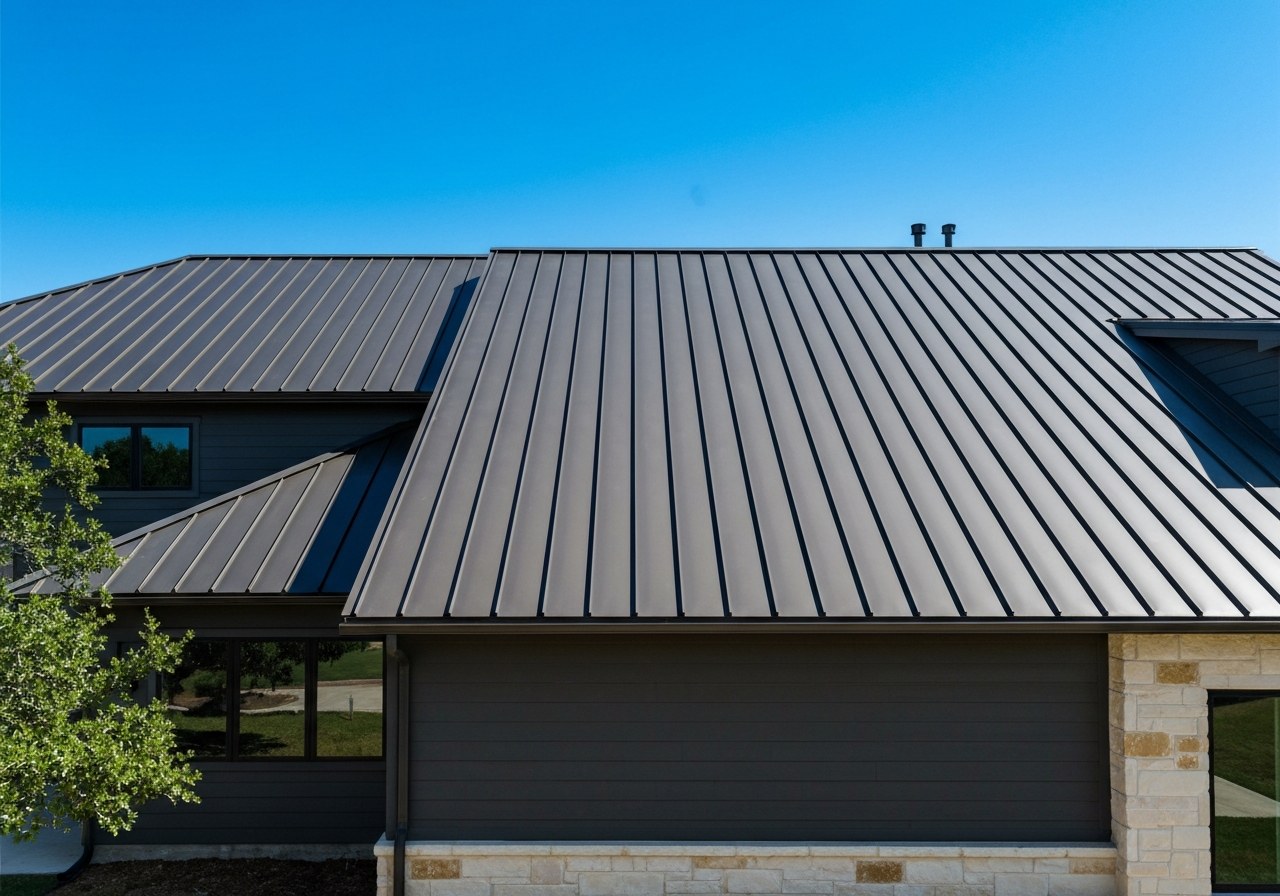
Houston homeowners face two clear roofing problems: prolonged summer heat that drives up cooling bills and frequent severe-weather exposure during hurricane season from June to November. Traditional shingles age faster under these conditions and often require earlier replacement or storm repairs.
Fixing those problems matters to your household budget and to the resilience of your home. A correctly specified metal roof can reduce attic temperatures, lower long-term replacement cycles, and provide higher wind and hail resistance, which affects insurance outcomes and repair risk.
This guide explains where we serve within the Katy area, how different metal systems perform in high winds and hail, corrosion and cool‑coating choices for coastal humidity, thermal movement and noise considerations tied to installation quality, material longevity and warranties, cost and energy savings with insurance implications, financing and a neutral free inspection option, permitting and HOA rules, contractor qualifications and the installation process, routine maintenance, how metal roofs integrate with residential solar, and concise local‑focused FAQs.
Begin by confirming service availability for your address and reviewing how metal roofs perform in Houston storms.
Service area, availability, and why metal roofing for Houston
Service area and availability
Blue Rhino Roofing serves the greater Houston metro from our base in Katy, including Katy, Sugar Land, Richmond, Cypress, Briar Forest, Spring, The Woodlands, Conroe, Pearland, Missouri City, Pasadena, Jersey Village, Houston Heights, and College Station. For our full metal roofing services and service hub details, see our metal roofing page.
- We serve addresses within 30 miles of Katy — check eligibility by entering your address at our service hub: /metal-roofing/.
Houston climate & storm facts
Houston’s summers are hot and humid. The National Weather Service climate summaries for Houston (IAH) show average summer high temperatures near the low 90s°F (see climate normals). Source: National Weather Service — Houston IAH climate normals: https://www.weather.gov/hgx/climateiahnormals_summary
Houston also experiences many hot days annually; climatology summaries note roughly 100–105 days per year with highs at or above 90°F on average. Source: City climate summaries and historical records (see summary at Wikipedia and NWS climate pages): https://en.wikipedia.org/wiki/ClimateofHouston and https://www.weather.gov/hgx/climateiahnormals_summary
Hurricane season in the Gulf runs June–November (officially observed by the National Hurricane Center). Houston’s coast has seen historically significant storms such as Hurricane Harvey (2017) and Hurricane Ike (2008), which brought major flooding and wind damage to the region. Source for season timing: National Hurricane Center — https://www.nhc.noaa.gov/
Why metal roofs are chosen locally
Homeowners across the Houston area pick metal roofing for local weather and long-term value. Key local advantages include:
- Durability against wind and hail — metal panels and interlocking systems resist uplift and impact better than many other materials.
- Energy savings with reflective coatings — cool-coat finishes reflect solar heat, lowering attic temperatures and reducing cooling costs.
- Long lifespan and low maintenance — metal roofs commonly last decades with less frequent repairs or replacements.
Transitioning next to how metal roofs perform in storms, wind, and hail — see the Storm & Wind Performance section.
Storm, hurricane, wind and hail performance
Wind resistance and uplift ratings
Metal roofs are commonly rated to resist high winds; typical commercial and residential wind-resistance ratings run from about 110–180+ mph, depending on the system, attachment method, and tested assembly. Common test standards used to qualify wind uplift resistance include UL 580, ASTM E1592, and FM 4473 — each evaluates slightly different assemblies and failure modes (deck, fasteners, clips, seams).
- UL 580 — comparative uplift resistance of roof assemblies (suits solid-substrate systems). UL guidance on roof wind resistance
- ASTM E1592 — structural performance and fastener/panel pull-through for standing-seam and through-fastened panels.
- FM 4473 — Factory Mutual test method used by manufacturers to document wind uplift performance of specific metal roof systems.
Uplift/impact-test examples:
- UL 580 — measures uplift resistance (psf) for an assembly.
- ASTM E1592 — measures ultimate load and fastener/panel pull-through on metal panels.
- FM 4473 — evaluates roof assembly uplift under specified cyclic loading for insurance qualification.
(Chart data ideas: columns for System Type — exposed panel, concealed-clip panel, metal shingle; Typical Attachment — through-fastened, clip-fastened; Common Test Used — ASTM E1592, UL 580, FM 4473; Typical Rated Wind Range (mph) — 110–140, 130–180, 110–150; Notes on fastener pattern and substrate.)
Hail resistance
Hail resistance is rated with standards that simulate stone/ice impacts. For flexible coverings the long-standing test is UL 2218 (steel-ball drop) with Class 1–4 (Class 4 = 2.00 in. ball, highest), and rigid materials often reference FM 4473 (ice-ball impacts for rigid coverings). See IBHS summary of UL 2218 test projectile sizes and classes. IBHS: Relative Impact Resistance
Short comparison — denting and surface damage:
- Metal shingles / heavier-profile metals — typically show less visible tearing and can be engineered to achieve high-impact performance; may flex and dent but keep watertightness.
- Exposed metal panels (thin, flat panels) — more prone to visible denting from larger hailstones unless heavier gauge or engineered with backing/support.
- Takeaway: specify UL 2218 Class or FM 4473 results from the manufacturer to compare hail performance rather than assuming one product class always outperforms another.
Real-world storm performance
Local and industry reports from major Texas storms show mixed but instructive results: for example, post-storm assessments after Hurricane Harvey (2017) and Hurricane Ike (2008) noted areas where metal roofs performed well for wind and water-tightness but also recorded instances of denting and fastener failures in vulnerable assemblies — outcomes varied by roof age, gauge, attachment, and installation quality. These observations are based on local reports and industry summaries and should be checked against manufacturer or insurer claims for specific products (should-cite).
How system choice affects storm performance
System selection—panel profile, metal gauge, clip vs. exposed fasteners, substrate, and coating—directly affects wind, uplift, and hail performance. That choice also leads into corrosion resistance and coating selection (how coatings hold up after impact and in humid coastal/southern climates), which is the next consideration when picking a metal roofing system.
Corrosion, coatings, heat and UV performance
Corrosion & coastal performance
Different metal substrates resist coastal corrosion differently. Galvalume (aluminum-zinc alloy) offers strong barrier protection and excellent corrosion resistance in many environments; G90 galvanized steel has a thick zinc layer that provides sacrificial protection but can corrode faster than Galvalume in aggressive coastal salt-spray environments; aluminum resists corrosion well but can be softer and dent more easily; copper resists corrosion and patinas over time but is costlier and behaves differently electrically and galvanically when paired with other metals.
Recommended coatings and substrate choices for Houston (coastal, humid, heavy sun):
- Preferred substrate: Galvalume (best balance of long-term corrosion resistance and cost in Houston).
- Topcoat: Kynar/PVDF (fluoropolymer) — best for UV durability and color retention in high-sun, high-humidity environments.
- Alternative/topcoat options: high-quality silicone-modified polyester (SMP) or polyurethane for lower budgets, but expect faster chalking and color fade than PVDF.
- Factory-finish vs field-paint: Choose factory-applied PVDF where possible for longest, most consistent performance.
- Maintenance tips: rinse salt and airborne debris annually or after major storms; inspect fasteners, flashings, and panel edges for coating wear and signs of corrosion; touch up exposed cut edges with approved corrosion-inhibiting primers and topcoat.
Heat, UV, and cool-coating benefits
Coatings affect how much solar energy a roof reflects (solar reflectance, SR) and how much heat transfers to the attic. Typical SR ranges for metal roofing finishes (approximate and labeled as typical estimates):
- Unpainted metals (bare Galvalume/galvanized): SR ~10–35% (estimate)
- Standard dark painted metal: SR ~10–25% (estimate)
- Light-colored painted metal / cool-painted finishes: SR ~35–70% (estimate)
- High-performance cool coatings (some PVDF or specially formulated solar-reflective paints): SR up to ~70–85% (estimate)
Expected attic temperature reductions when switching from a low-reflectance metal roof to a cool-coated or highly reflective metal roof are highly site-dependent; typical ranges are:
- Attic temp reduction (typical estimate): ~5–20°F lower peak attic temperatures under hot sunny conditions (estimate).
Note: the exact SR value and resulting temperature benefit depend on paint formulation, color, installation details, attic ventilation, insulation levels, and local climate. Flag: any exact °F or % SR numbers above are presented as estimates and should be verified against manufacturer data or program certification before specification.
Long-term performance of coatings
Long-term life expectancy varies by coating system and maintenance. Typical recoat/service-cycle guidance (generalized):
- PVDF/Kynar factory finish: expected long-term color and chalk resistance; many manufacturers advise recoat or major inspection at ~20–30 years depending on exposure and warranty terms (typical).
- SMP / polyurethane factory finishes: may need recoating every 10–15 years in high-UV, coastal environments (typical).
- Touch-up maintenance: spot repairs and touch-up after localized damage should be performed as needed to prevent substrate corrosion.
Manufacturer warranties and recoat intervals vary—always consult the product technical data sheet and warranty for exact guidance. The lifespans above are typical market expectations, not guarantees.
Lead into expansion & noise issues
Next, we’ll look at how metal roofing expansion/contraction and attachment methods affect noise, wind performance, and storm resistance.
Thermal movement, noise, and how installation affects performance
Expansion & contraction mechanics
Thermal movement is the way metal expands and contracts as temperatures change; if not accommodated, panels can warp, stress seams, or loosen fasteners.
- Use hidden-clip systems or floating clips that allow lateral movement while holding panels securely (prevents screw pull-through and seam stress).
- Install clips with the correct spacing and allow for end-lap/lengthwise movement — typical clip spacing is 12–24 inches on center and allow 1/4"–3/8" end movement per 10' panel (manufacturer guidance varies; treat these as typical ranges and follow your product spec).
Noise in rain & hail
Are metal roofs noisy? Not usually — perceived noise depends on the roof assembly, not the metal alone.
A bare metal panel over an open attic will sound louder; adding solid substrates and insulation dramatically reduces impact and airborne noise. Factors that affect noise include sheathing, underlayment, attic insulation, and whether panels are mounted as floating or fully fastened.
Noise-reduction options:
- Solid roof sheathing (OSB or plywood) under panels
- 30# felt or synthetic underlayment for damping
- Closed-cell foam or blown insulation in the attic cavity
- Sound-deadening underlayment specifically designed for metal roofs
Installation quality matters
Top installation practices that reduce leaks, movement issues, and noise (follow manufacturer specs for your system):
- Correct clip placement and orientation — locate clips per layout drawings and manufacturer spacing.
- Proper fastener selection and torque — use specified fasteners and tighten to torque ranges in the product manual (typical torque varies by fastener and substrate).
- Accurate seaming and locking of panels — ensure seams are fully engaged and mechanically seamed where required.
- Flashings and terminations installed to manufacturer detail — continuous flashings, kick-out details, and counter-flashing prevent water intrusion.
- Quality control and final inspection — check clip alignment, seam engagement, and perimeter flashings before project closeout.
Next: Storm, hurricane, wind and hail performance
Metal materials, expected lifespans, and warranties
Materials at a glance
| Material | Corrosion resistance | Expected lifespan (typical range) | Common uses | Typical warranty lengths (typical — verify with manufacturer) | Typical cost per 100 sq ft (per square) |
|---|---|---|---|---|---|
| Steel (Galvalume) | Good — steel coated with aluminum-zinc alloy; resists rust better than bare steel but can corrode in harsh coastal environments | 20–50 years (typical range; depends on paint system and environment) — citation needed for specific ranges | Standing seam, exposed-fastener panels, residential & commercial roofs | 20–40 years on paint finish common; substrate warranties often 20–30 years; workmanship warranties separate — verify with manufacturer | Moderate — mid-range (typically less than copper, comparable or slightly more than aluminum) |
| Aluminum | Very good — naturally corrosion resistant; excellent for coastal areas | 25–50 years (typical range; coastal salt exposure can shorten or require specific coatings) — citation needed for specific ranges | Coastal homes, metal shingles, lightweight standing seam systems | 20–40 years on paint finishes common; substrate/anti-corrosion warranties vary — verify with manufacturer | Moderate — mid-range (lighter than steel; price varies by gauge and finish) |
| Copper | Excellent — naturally corrosion-resistant and patinas over time | 60–100+ years (typical range for properly installed copper roofs) — citation needed for specific ranges | High-end roofs, architectural accents, historic restoration | Often limited on paint (patina is natural) — substrate life is long but paint warranties usually don’t apply; workmanship warranties still important — verify with manufacturer/installer | High — premium (significantly more than steel or aluminum) |
Notes:
- All numeric lifespan and warranty year ranges above are presented as typical ranges observed in the industry. Specific products and climates change these numbers — verify exact life expectancy and warranty terms with the manufacturer or product data sheet.
- Flag: Any specific warranty-year claims above should be confirmed with the actual manufacturer's warranty document before quoting to a homeowner.
Profile comparison
Choosing the right metal profile affects performance, cost, and appearance. Two common residential options are standing seam and metal shingles. In general:
- Standing seam offers a sleeker, more modern look with exposed panels and concealed fasteners; metal shingles mimic traditional shingle or tile styles.
Pros and cons
- Standing seam
- Pros:
- Excellent water shedding and fewer leak points due to concealed fasteners
- Higher wind resistance in many engineered systems when properly installed
- Cleaner, low-profile aesthetic — good for contemporary homes
- Often easier to install continuous panels for long roof runs
- Cons:
- Typically higher material and installation cost
- Visible seams may not suit all architectural styles
- Requires experienced installers to avoid oil-canning and fastening issues
- Metal shingles
- Pros:
- Aesthetically versatile — replicates asphalt, slate, or tile looks
- Usually lower cost than standing seam for comparable materials
- Easier to source matching accessories and trim for traditional homes
- Cons:
- More seams/fasteners than standing seam — more potential leak points
- Wind performance can vary by panel design and fastening pattern
- May require more maintenance in extreme climates
Warranties and coverage
Warranties for metal roofs come in a few categories and vary widely by manufacturer and installer. Key types and what they typically cover:
- Manufacturer paint/finish warranty
- Covers chalking, fading, and paint adhesion for the stated period under normal exposure.
- Does not cover damage from improper installation, physical impact, or extreme weather events unless the manufacturer explicitly states otherwise.
- Typical lengths are often marketed as 20–40 years for many painted metal products — this is a common range but confirm with the product's warranty. (Specific year claims require manufacturer citation.)
- Substrate or corrosion warranty
- Covers the metal substrate against perforation or premature rusting under normal atmospheric conditions.
- Coastal or industrial environments often require special coatings or alloys; standard substrate warranties may exclude salt-spray or acid-deposition damage.
- Typical durations vary — always read exclusions.
- Workmanship/installation warranty (contractor warranty)
- Issued by the roofing contractor and covers errors in installation (flashing, fasteners, sealing).
- Length and transferability depend on the contractor's policy — Blue Rhino Roofing backs its work with a quality guarantee, but customers should get the terms in writing.
Storms, hail, and wind
- Storm-related damage (hail dents, wind-driven debris, blown-off panels) is usually not covered by standard manufacturer paint or substrate warranties — these warranties focus on material defects and finish performance.
- Some manufacturers may offer limited protection against wind-driven metal loss if the product and installation meet their tested uplift rating; still, insurance or separate impact/wind endorsements are the usual path for storm-related claims.
- For storm claims, responsibility is often split:
- Manufacturer: defects in materials or finishes per warranty terms.
- Contractor: installation errors that cause failure.
- Insurance: physical damage from storms (file a homeowner claim; the insurer may coordinate with contractor/owner).
Transferability and exclusions
- Many manufacturer warranties are transferable, but often only once and with conditions (transfer fee, remaining warranty years, proof of maintenance). Always check the warranty language.
- Common exclusions: normal wear-and-tear, improper ventilation, chemical exposure (e.g., contact with dissimilar metals that cause galvanic corrosion), damage from foot traffic, and failure to follow maintenance recommendations.
Callouts / Red flags
- If a product page or salesperson cites a specific warranty year (for example, “50-year non-prorated”), request the exact warranty document. Any precise numeric claims should be backed by the manufacturer’s written warranty — otherwise flag as unverified.
- Ask for: product data sheet, paint warranty, substrate warranty, and the contractor’s workmanship guarantee before signing a contract.
Lead into costs and efficiency
Understanding materials, profiles, and warranties helps narrow choices — next we'll compare costs, energy efficiency, and return on investment so you can see which metal roofing option fits your budget and the Houston climate.
Costs, energy savings, insurance, and financial incentives
Installed cost comparison
- Standing seam (installed): $10–$18 per sq. ft. (per 1 roofing square = 100 sq. ft.: $1,000–$1,800 per square) — cost range flagged for sourcing.
- Metal shingles (installed): $7–$11 per sq. ft. (per square: $700–$1,100 per square) — cost range flagged for sourcing.
- Asphalt shingles (installed): $4.50–$8.50 per sq. ft. (per square: $450–$850 per square) — cost range flagged for sourcing.
Factors that drive price:
- Roof pitch, complexity (dormers, valleys), and number of penetrations (vents, skylights).
- Tear-off vs. overlay and underlying deck repairs.
- Material choice (gauge, coating, finish), seam type, and warranty length.
- Local labor rates and permit/inspection costs in the Houston area.
- Accessibility and required safety equipment (scaffolding, hoisting).
(Every numeric cost above should be verified with current local bids before budgeting — figures are typical ranges, not guarantees.)
Energy savings and SR metrics — bottom line first
- Bottom line: Expect modest but meaningful summer cooling savings from a lighter, high-reflectance metal roof — typically 5%–15% lower cooling energy use on conditioned space in hot climates like Houston (estimate — see assumptions below). Flag % savings for sourcing.
Key metrics and typical ranges (estimates):
- Solar reflectance (SR): dark asphalt shingles: ~0.05–0.25; painted metal or metal shingles (light colors/“cool” finishes): 0.25–0.65; specially rated cool roofs: 0.65+. Flag SR numbers for sourcing.
- Roof surface temperature drop: a cool metal roof can reduce surface temps by 30–50°F on a hot day vs. a dark roof (estimate; depends on SR and emittance) — flag for sourcing.
- Attic temperature reduction: typical reductions of 10–30°F in peak conditions when switching from dark asphalt to a high-SR metal roof (estimate; depends on attic ventilation and insulation). Flag for sourcing.
Assumptions behind the estimates above: single-family home in Houston climate, similar insulation and attic ventilation, comparing a dark asphalt shingle roof to a light/high-SR metal roof. Actual savings depend on roof color/finish, attic R-value, HVAC efficiency, home size, and local electricity rates. For authoritative guidance see ENERGY STAR and the Cool Roof Rating Council.
- ENERGY STAR cool roof guidance: https://www.energystar.gov/products/cool-roofs
- Cool Roof Rating Council resources: https://coolroofs.org/resources/home-and-building-owners
Payback and lifecycle cost
- Typical simple-payback scenarios: because metal roofing costs more up front but lasts much longer than asphalt shingles, simple payback from energy savings alone is often long (10+ years) — but lifecycle value is higher due to durability. Any specific payback-year claim should be flagged for the assumptions used (roof size, electricity rate, installation cost).
Sample assumptions to estimate payback:
- Roof size (square footage) — e.g., 2,000 sq. ft. roof (20 squares).
- Installed cost differential — e.g., metal shingles vs. asphalt: $700–$1,100 per square (metal shingles) minus $450–$850 per square (asphalt) → incremental installed cost per square. Flag numbers for sourcing.
- Annual cooling savings — assume 5%–15% of annual cooling energy spend (depends on SR, local climate, HVAC). Flag % for sourcing.
- Local electricity rate (cents/kWh).
- Expected roof life (asphalt: ~15–25 years; metal: 40+ years).
Payback calculator idea (for the page — add as an interactive widget or linked tool):
- Inputs: roof area (sq. ft.), current roof type, new roof type & installed cost per square (allow override), attic insulation R-value, HVAC type & annual cooling kWh or annual cooling $ spent, electricity rate ($/kWh), expected roof lifetimes, discount rate (optional).
- Outputs: incremental cost, annual energy $ savings, simple payback (years), net present value over 25–40 years, CO2 emissions avoided estimate (optional).
For a quick external calculation reference: Cool roof energy-savings calculators and methods (example): https://calcengineer.com/hvac/cool-roof-energy-savings-calculator/
Also useful for material cost benchmarks: https://roofingcalculator.com/
Insurance & incentives
- Possible insurance effects:
- Premium discounts for roofs with higher wind/hail resistance ratings or impact-resistant metal materials (verify with your insurer). Check policy details — effect varies by company.
- Storm mitigation credits (for impact-rated panels, Class 4 impact rating) can reduce homeowners insurance premiums in some cases.
- Replacement-cost coverage considerations: metal roofs typically increase the replacement cost line on your policy; confirm whether insurer requires a specific warranty or installer certification.
- Common incentives and programs to check:
- Federal/state/local rebates or tax credits for energy-efficient roofing or roofing that enables solar — check the current Database of State Incentives for Renewables & Efficiency (DSIRE) for Texas programs: https://www.dsireusa.org/
- Utility rebates for reflective roofing or attic upgrades — contact CenterPoint Energy or your local utility for programs in the Houston area.
- Manufacturer or dealer rebates and extended-warranty promotions (seasonal).
- Solar + roofing incentives: If installing solar later, some incentives depend on roof condition and orientation — plan accordingly.
Notes: Incentives and insurance discounts change frequently — verify current programs and insurer rules before making decisions.
Lead into financing & CTAs
If the up-front cost is a concern, we offer flexible financing — see our dedicated page for "Roofing financing options" in the financing section below. Ready to get a firm number for your home? Schedule a free roof inspection so we can measure your roof, confirm your options, and produce an itemized estimate.
Financing options, estimates, and free inspection CTA
Common financing options
- Personal loans — Typical terms: 2–7 years. Eligibility: credit-based; good option if you prefer unsecured financing and faster approval.
- Home equity loan / HELOC — Typical terms: 5–15 years (loans) or draw period + repayment (HELOC). Eligibility: requires sufficient home equity and lender approval; interest may be tax-deductible (consult a tax advisor).
- Contractor financing (third-party) — Typical terms: 6 months to 10 years depending on plan. Eligibility: varies by lender; may include promotional 0% APR offers for short terms. Ask for full terms and fees before signing.
- PACE (Property Assessed Clean Energy) where available — Terms: up to 20 years, repaid via property tax assessment. Eligibility: depends on local PACE program availability and property qualification.
- Solar + roof combo financing — Bundled financing for solar and roof upgrades can offer longer terms and lower monthly payments; eligibility depends on lender and project scope.
For more details and program comparisons, see our page: Roofing financing options.
Getting an estimate
A written estimate includes the scope of work, materials and product specifications, estimated timeline, and exclusions (what’s not included).
Prepare these documents and info before your estimate:
- Recent photos of the roof (if available) or note of visible issues (leaks, missing shingles).
- Property address and access notes (gates, dogs, best contact times).
- Any existing inspection reports, contractor proposals, or insurance adjuster notes.
- Desired materials or product preferences (metal panel style, underlayment, trim).
- Warranty expectations or questions about manufacturer vs. workmanship coverage.
A typical written estimate will list:
- Scope and description of the work (repair vs. replacement).
- Materials by brand/type and quantities.
- Labor and start/finish timeline.
- Permits, disposal, and other project-related fees.
- Clear exclusions or items that may change price (hidden rot, structural repairs).
Free inspection CTA
We offer a no-cost roof inspection that includes: photographs of the roof, a damage assessment, a basic cost range for repair or replacement, and guidance for insurance-claim support (documentation tips and meeting your adjuster if needed). Blue Rhino Roofing provides this free inspection for homes within 30 miles of Katy, TX.
If you’d like to schedule an inspection, you can schedule a free inspection. Inspections are informational and neutral — we’ll document what we see and answer your questions without pressure.
Next, we’ll cover permits & codes so you know what local rules affect roofing work.
Permits, local codes, HOA, and historic district rules
Local building codes & windstorm requirements
Harris County enforces adopted editions of the International Building Code (IBC/IRC) with local amendments — wind design and fastening details are governed by the IBC/IRC and the referenced wind standards (ASCE 7). Wind design speeds for specific addresses are shown on the Texas Department of Insurance (TDI) wind maps for Harris County and are used to determine required design wind speed, attachment schedules, and wind‑borne debris provisions. For example, TDI guidance lists typical Harris County design wind speeds used with the IBC/IRC (see TDI maps). Always verify the exact adopted code edition and the applicable wind speed at your property with the local building department before finalizing material selection or fastening schedules.
- Texas Dept. of Insurance — Adopted codes and wind guidance: https://www.tdi.texas.gov/wind/adopted-codes.html
- TDI Harris County wind maps: https://www.tdi.texas.gov/wind/maps/harris.html
- Harris County permits & standards (reference): https://oce.harriscountytx.gov/Services/Permits/Documents
Note: If you reference a specific wind speed or ordinance for a property, include the official map/ordinance citation and confirm with the county or city permitting office — code adoptions and maps can change.
Permits & inspections
Follow these common steps for a residential metal roof project. Timelines are typical but can vary by jurisdiction and workload.
- Submit permit application
- What to include: completed application, property plat/address, scope of work, contractor info, product data sheets, and any required structural calculations.
- Typical timeline: 1–3 business days to 2 weeks for review depending on county/city.
- Permit review
- County/city reviews plans for code compliance (wind, flashing, attachments).
- Typical timeline: 3–14 business days; expedited review may be available for a fee.
- Permit issuance
- Pay permit fees and receive permit placard/number before work begins.
- Typical timeline: same day to a few days after approval.
- Pre‑inspection (if required)
- Some jurisdictions require a pre‑construction or framing inspection before re‑roofing materials are installed.
- Contractor schedules with permitting office.
- Roofing inspections during work
- Common inspections: nail/attachment inspection, underlayment/flashings inspection, and final roofing inspection.
- Contractor is responsible for scheduling inspections; common requirement is to call 24–48 hours before the inspection window.
- Final inspection and sign‑off
- Inspector verifies installation meets codes and the permit is closed.
- Typical timeline to receive sign‑off: same day as inspection or within a few business days.
Contractors should confirm required inspections and scheduling rules with the local permitting office — requirements and lead times vary by city and unincorporated Harris County.
HOA & historic district considerations
HOAs and historic districts often set additional design controls independent of building permits. Start the approval process early — HOA/landmark reviews commonly add 2–8 weeks or more to project timelines.
Common restrictions and submittal items:
- Color and finish limits (e.g., approved palette or non‑reflective finishes)
- Panel profile and visible fastener rules (e.g., concealed fastener vs. exposed fastener)
- Roof slope and material type restrictions
- Trim, gutter, and downspout styles and colors
- Samples required: color swatches, profile photos, product cut sheets
- Photo/schematic submittal: existing roof photos, proposed roof elevation drawings, and installer info
- Application/fee and review meeting requirements (some historic commissions require in‑person review)
Tip: Provide the HOA/historic board a sample submittal packet (photos, product data, color swatch, contractor license, timeline) to speed approval. Always follow HOA or historic district procedures and timelines — denial or required revisions can delay permitting.
Required contractor documentation
Before work begins, confirm the contractor will provide all required documentation. Typical required items include:
- Current contractor license (local/state as applicable) and license number
- Certificate of Insurance (COI) showing general liability and workers’ compensation with the property owner and HOA listed as additional insured if requested
- Product data sheets for the metal panels, underlayment, fasteners, and trim (manufacturer cut sheets with model numbers)
- Test reports and approvals: UL/ASTM listings, FM approvals, or other third‑party test reports as required by permitting authority or insurance (wind uplift/test reports where applicable)
- Shop drawings or installation details when required by the permitting office (attachment schedule, flashing details)
- Permit paperwork: copy of the filed permit application, permit number, and any plan review comments/approvals
- Warranty documents: manufacturer warranty and contractor workmanship/installation warranty
- Storm‑specific paperwork (if applicable): Notice of assignment or post‑storm scope documents for insurance claims (if applicable to the project)
This list covers common requirements but may not be exhaustive for every jurisdiction. Avoid relying on online summaries for legal compliance — verify documentation requirements with the local permitting office or HOA before work starts.
Choosing a contractor and what to expect during installation
Contractor credentials and questions to ask
Checklist — must-review items before hiring
- License & insurance: Ask for the contractor’s license number and proof of general liability and workers’ compensation insurance. (If you need to confirm Texas-specific licensing rules, verify with the Texas Department of Licensing and Regulation — don’t rely on verbal claims alone.)
- References & recent local projects: Request 3–5 recent projects in the Houston area and contactable homeowner references.
- Written estimate & scope: Get a detailed, line-item estimate that lists materials, labor, start/end dates, and cleanup responsibilities.
- Employee vs. subcontractor: Ask whether crews are company employees or subcontractors and how background checks and training are handled.
- Sample warranty documents: Request copies of the manufacturer warranty and the contractor workmanship warranty you’ll receive after completion.
- Permits & inspections: Confirm who will obtain permits and coordinate municipal inspections (contractor should handle this — see below).
Questions to ask on the spot
- Do you carry active liability and workers’ comp insurance? Can you email proof?
- Can I see three recent Houston-area installations and homeowner contacts?
- Who will be on site each day, and are they employees?
- What are your start and completion dates? How will delays be handled?
- What exactly does your workmanship warranty cover and for how long?
- Will you obtain permits and schedule inspections with the city?
Installation methods & materials
Two common metal roofing attachment systems:
- Through-fastened (exposed fasteners): Panels are screwed directly through the panel into the deck. Pros: lower cost and faster install. Cons: exposed fasteners may need occasional tightening or replacement and can be less wind-resistant than some concealed systems.
- Hidden-clip standing seam (concealed fasteners): Panels lock together with clips that are fastened to the deck; fasteners are hidden under the seam. Pros: cleaner look, better thermal movement accommodation, superior wind and leak resistance. Cons: higher material and labor cost.
Recommended underlayment, ventilation & attic insulation
- Underlayment: Use a high-temperature synthetic underlayment or ice-and-water shield at eaves and valleys. For Houston, choose materials rated for high heat and humidity.
- Ventilation: Balanced intake (soffit) and exhaust (ridge or turbine vents) is critical to prevent attic heat buildup and condensation under metal panels. Provide at least 1:300 net free vent area, or follow manufacturer guidance.
- Attic insulation: Ensure adequate R-value for Texas climate (check current IECC recommendations for your area). Proper insulation reduces heat transfer and risk of condensation on the metal roof.
Project timeline & site protection
- Mobilization & site prep (1–2 days)
- Deliver materials, set up dumpsters, tarps, and staging area.
- Install roof protection at landscaping and HVAC units; lay down plywood or boards where needed.
- Tear-off (if replacing existing roof) (1–3 days depending on size & layers)
- Remove old roofing, inspect deck, replace any damaged sheathing.
- Protect gutters, siding, and windows with tarps and drop cloths.
- Deck repair & underlayment (0.5–1 day)
- Replace any rotten decking, install underlayment and ice-and-water shield where required.
- Panel installation (1–4 days depending on roof complexity)
- Install panels or standing seam system, flashing, and penetrations. Crews typically work from ridge to eave or in planned phases to maintain drainage.
- Flashing, gutters & accessory work (0.5–1 day)
- Fit and seal flashings around chimneys, vents, and valleys; install or reconnect gutters and downspouts.
- Final inspection & punch list (0.5 day)
- Walkthrough with homeowner to identify any touch-ups.
- Cleanup & final sign-off (0.5–1 day)
- Remove debris, perform magnet sweep for nails, restore landscaping, deliver warranty paperwork.
Protection measures during the project:
- Use magnetic nail sweeps daily.
- Protect grass, fences, and cars with tarps and plywood.
- Clearly mark work zone and coordinate daily schedules with occupants.
Flashing, gutters, penetrations & warranties
Flashing, gutters, and roof penetrations are critical leak points and are typically listed separately in the scope of work. A proper job includes:
- Continuous metal flashings at eaves, rakes, valleys, chimneys, skylights and wall transitions.
- Counter-flashing and sealed penetrations for vents, plumbing stacks, and HVAC curbs.
- Properly integrated gutters and downspouts that match the roof drainage pattern.
How scope affects warranty:
- Manufacturer warranty usually covers panel defects and paint performance but may exclude failures caused by improper flashing, bad installation, or incompatible accessories.
- Contractor workmanship warranty should cover installation errors (flashing, fastener placement, leaks from penetrations) for a defined period.
- Confirm which party is responsible for remedial work if leaks originate at flashings, gutters, or penetrations and get all warranty terms in writing.
Permits & inspections handled by contractor
Your contractor should obtain all required building permits and schedule municipal inspections. Confirm this in writing before work begins. If you want to verify permit status during the job, ask for the permit number and the inspection schedule — you can also check with the local city or county permitting office. (If you need specific Texas licensing or permit requirements verified, confirm with the Texas Department of Licensing and Regulation or your city’s permitting office.)
Maintenance, common problems, and signs you need repairs
Top issues and installation mistakes
- Loose or missing fasteners — Look for pop-up screws, exposed fastener heads, or panels that shift when you press them from the attic or ladder. Listen for rattling in high winds.
- Improper panel overlap or installation lapses — Visible gaps at seams or underlapped panels, plus water stains on the ceiling directly under lap areas, indicate poor overlap.
- Flashing failures — Rusted, bent, or poorly sealed flashings around chimneys, vents, and valleys; check for cracked sealant or gaps where flashing meets the roof.
- Poor edge or eave fastening — Edges that lift in wind or show buckling often mean under‑fastened eaves/rakes; inspect after strong gusts.
- Panel denting from hail or falling debris — Look for round dents or dings on panel surfaces; cluster patterns often point to hail, single deep dents can indicate impact from branches.
- Corrosion or finish failure — Check for chalking, flaking paint, or rust streaks, especially near roof penetrations and gutters; discoloration often precedes more serious metal degradation.
Inspection & maintenance schedule
Recommended frequency: have a professional inspection at least once per year and always after any major storm.
Checklist for each inspection:
- Walk the roof (professionally or visually from safe vantage) and scan for lifted panels, missing fasteners, or loose flashings.
- Inspect all flashings, sealants, and roof-to-penetration transitions for cracks or gaps.
- Check gutters and downspouts for metal shavings, granules, or signs of accelerated wear.
- Look inside attic for water stains, daylight through seams, or increased humidity/mold.
- Test roof edges and eaves for lift or separation after high wind events.
- Clear debris (branches, leaves) and trim overhanging trees to reduce impact and abrasion risk.
- Reapply or repair sealants and touch-up finish coatings as needed to prevent corrosion.
Repairability and dents
Most surface dents, small perforations, and localized seam/fastener issues on metal roofs are repairable without full replacement. Typical repairs include panel straightening, patching with matching metal, replacing damaged fasteners, and resealing flashings. Repairs can affect warranties — minor repairs done by an authorized contractor and documented usually preserve the manufacturer's finish and workmanship warranties, while DIY or incompatible repair materials may void portions of the warranty. Always check your specific manufacturer warranty and get repairs documented.
- Typical repair cost range: $100–$1,500 (typical range; actual costs vary by damage severity and access) — citation needed.
Signs you need repair or replacement
- Active leaks or water stains inside — Water marks, peeling paint, or mold in ceilings or attic.
- Multiple or spreading rust spots — Corrosion that penetrates coatings and expands across panels.
- Large or numerous dents from hail or impact — When denting compromises panel seams or coating integrity.
- Loose, missing, or backed‑out fasteners — Visible fasteners that are not seated correctly or have shed their washers.
- Flashing separation or failed seals — Water intrusion around roof penetrations despite intact panels.
- Persistent wind uplift or sagging panels — Panels that deflect in wind or show permanent deformation.
- Widespread finish failure or chalking — When protective coatings are failing across significant roof area.
- Age plus recurring problems — Older roofs with repeated patching needs may be better candidates for replacement than continued repairs.
How metal roofing choices fit long-term home planning
Longevity and lifecycle planning
Metal roofs typically offer longer service lives than conventional asphalt shingles—often 40–70 years depending on material and maintenance. That extended lifespan should be incorporated into replacement-cycle planning for the whole house (roof, flashing, vents, and any rooftop equipment) so homeowners can coordinate major investments and avoid repeated teardown and rework.
Solar integration & mounting
Standing seam metal roofing is compatible with clamp-mounted solar racking systems, which attach to seams rather than penetrating the roof deck—this reduces the number of roof penetrations and the associated leak risk. When planning solar, review roof material, seam spacing, and panel layout to confirm structural capacity and attachment locations.
Energy and home comfort
Reflective metal coatings and light-colored finishes can increase roof solar reflectance, lowering roof surface temperatures and reducing attic heat gain. That reduction in heat transfer often leads to lower HVAC loads and improved home comfort, which should be considered when estimating the net energy benefits of a roof upgrade.
If you are weighing a metal roof alongside other home upgrades, schedule an inspection so we can align service life, attachment details, and your long-term plans for the house.
Frequently Asked Questions
Will a metal roof rust, and what coatings prevent that?
Short answer: Properly finished metal roofs will not rust when the recommended coatings are used. Blue Rhino installs panels with factory or shop-applied corrosion-resistant finishes (for example, zinc or zinc-aluminum primers and topcoats such as acrylic or polyurethane) and we recommend specified touch-up coatings where flashings or cut edges are exposed. Regular inspections and prompt repair of damaged finish will prevent corrosion over the long term.
Will a metal roof be noisy in rain or hail?
Short answer: No — metal roofs are not inherently louder than other roofing types when installed over standard decking and insulation. Most perceived noise is eliminated by the roof’s underlayment, attic insulation, and solid deck attachment; adding insulation or foam-backed panels further reduces sound. For hail-prone areas, choose panels and underlayers rated for impact resistance (noted in our materials section) to minimize denting and noise.
Can a metal roof withstand hurricane-force winds?
Short answer: Yes — properly specified and installed metal roofing can meet high wind ratings when fasteners, clips, and seam details follow manufacturer and code requirements. Look for panels and attachment systems tested to recognized wind-load standards and installed per those manufacturer-tested details; our earlier section explains the recommended wind-rated assemblies and testing procedures we use. Proper fastening, continuous clips, and sealed seams are key to performance in severe winds.
How much will a metal roof save on cooling bills?
Short answer: Homeowners typically see a modest reduction in cooling costs — estimates commonly range from about 5% to 25% depending on roof color, insulation, and attic ventilation (citation needed). Reflective coatings, light colors, and improved attic ventilation provide the greatest savings; savings will vary widely by house orientation, insulation levels, and HVAC efficiency. — percent range above should be confirmed with a local energy study or manufacturer data.
Do you serve my neighborhood, and do you handle permits and insurance documentation?
Short answer: Yes — Blue Rhino Roofing serves homes and businesses within a 30-mile radius of Katy, TX, and our crews handle permit submission and insurance paperwork support. We work in Katy and surrounding communities across greater Houston and will assist with permit applications, provide documentation required by insurers, and can coordinate directly with adjusters as part of the project process.
Call to Action — Free inspection and written estimate
We offer a free, no-obligation roof inspection that includes an on-site review and a clear, written estimate of recommended work. The inspection is designed to give you the information you need to decide—no hard sell.
- Photos of visible damage and problem areas
- Damage assessment with recommended next steps
- Basic cost range for repair or replacement options
- Insurance-claim support information and documentation to help with filing
Service available within 30 miles of Katy. To schedule, call us or book online at Schedule a metal roofing inspection.
Metal Roofing FAQs for Houston Homeowners
Will a metal roof rust in Houston's humid, coastal environment and what coatings prevent it?
Properly specified metal resists rust in Houston when you choose the right substrate and finish, since Galvalume steel combines aluminum and zinc for better corrosion resistance than plain galvanized steel, and aluminum and copper are naturally corrosion resistant in coastal air. Long-term protection comes from a quality topcoat such as Kynar 500 or another PVDF paint that provides UV and chemical resistance and helps repel salt spray. For coastal properties consider thicker gauges or factory-applied coatings, and keep flashings and fasteners inspected with prompt touch-up of scratched areas.
How noisy is a metal roof during heavy rain or hail — will I hear it inside my house?
A properly installed metal roof is not noticeably louder inside than other roof types, because noise transmission depends on the roof deck, underlayment, attic insulation, and ventilation more than the metal itself. Solid sheathing over purlins, a heavy synthetic underlayment or felt, and attic insulation with sound-deadening properties all reduce impact noise, and standing seam with hidden clips performs quieter than thin exposed-fastener panels. If interior rooms directly under the roof still feel louder, adding or upgrading attic insulation and sealing air leaks will soften the sound.
Can a metal roof withstand hurricane-force winds common in the Houston area?
Yes, when configured and installed to rated standards. Standing seam systems with concealed clips and continuous seams achieve higher uplift resistance and are commonly tested to 110 to 180 plus miles per hour under standards such as ASTM E1592, UL 580, or FM approvals, while exposed-fastener panels can be engineered for high winds with closer attention to fastener type and spacing. Insist on products with third-party test reports and a contractor who follows local wind-load requirements.
Does a metal roof reduce my cooling bills and how much can I expect to save?
Metal roofs with reflective, high-SR coatings can reduce attic temperatures roughly 10 to 30 degrees Fahrenheit compared with dark asphalt shingles, and typical cooling bill reductions run 10 to 25 percent in a hot, sunny climate like Houston when paired with proper attic ventilation and insulation. Choosing a cool-color PVDF finish over an uncoated or dark finish has the largest impact. Exact savings still depend on your home, HVAC efficiency, shading, and energy prices.
Can you install a metal roof within 30 miles of Katy and will you handle permits and insurance claims?
Yes, we serve a 30-mile radius of Katy, Texas, and handle permits and documentation as part of the project scope. The inspection and estimate include photos, a damage assessment, and a cost range that supports insurance-claim submissions, and we pull required permits, provide product data and test reports to the building department, and coordinate inspections. We can document damage and help present an insurance claim, while you remain the policyholder making final decisions.
Schedule your free roof inspection and written estimate
Schedule a no-cost inspection that includes photos, a damage assessment, a basic cost range, and insurance-claim support. Service is available within 30 miles of Katy, TX. Book online or call to find an appointment that fits your schedule and get a clear plan for protection and energy savings.

Shawn Swearingen
Shawn Swearingen leads Blue Rhino Roofing, a BBB A+ accredited, Texas-licensed roofing company based in Katy. He's on the roof and on the phone, and known for telling homeowners the straight truth about whether they need a repair or a replacement.