
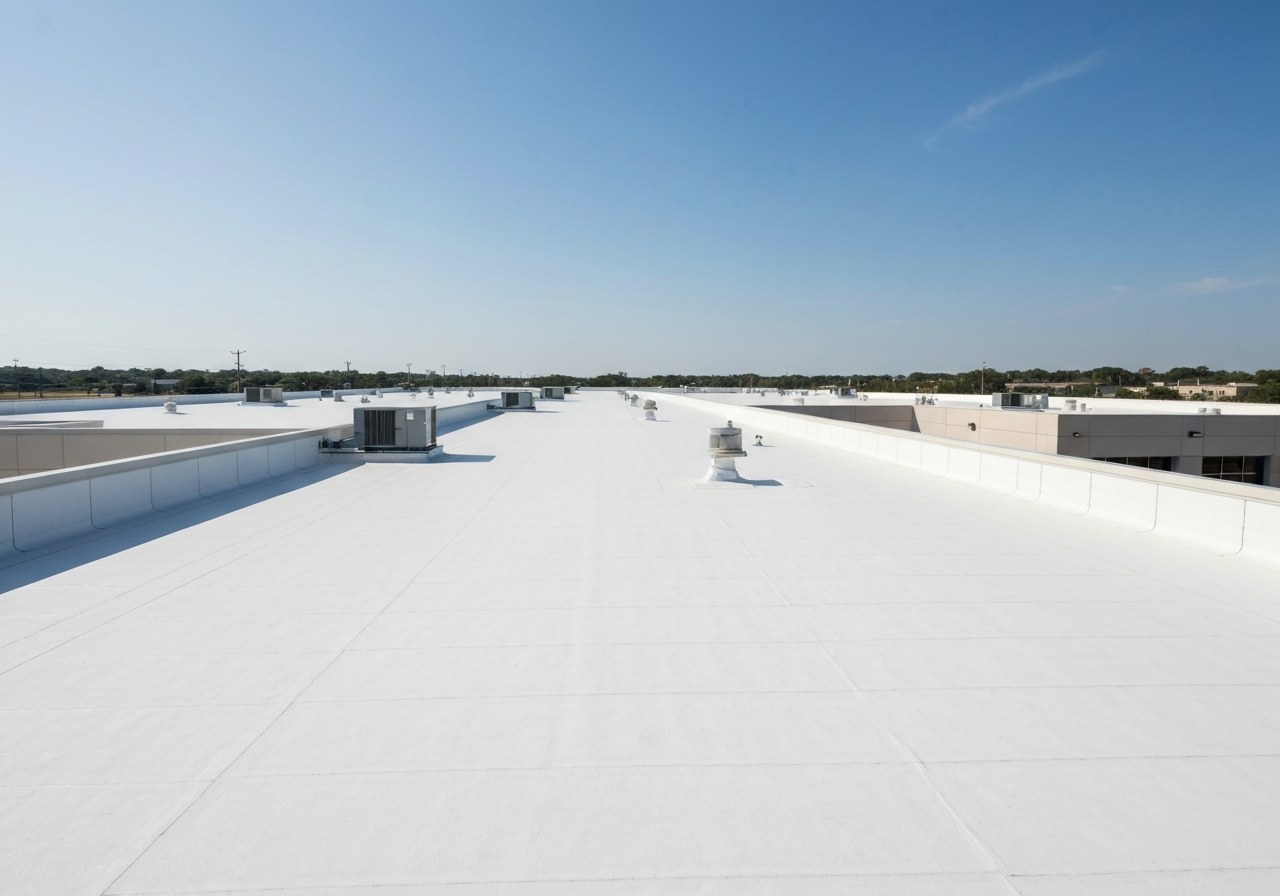
Facility roofs in Houston face accelerating stress from heat, humidity, and severe weather, and unmanaged roofing needs create recurring leaks, energy waste, and unplanned capital expenses. Property teams commonly struggle to get accurate local pricing, timely inspections, and reliable emergency repairs.
These issues matter because roof failures affect operations, tenant safety, insurance exposure, and building value. A clear cost picture and an inspection within 30 miles of Katy will reduce downtime and help you prioritize repairs versus replacement while preserving warranty and insurance recoveries.
This guide explains typical Houston pricing and how estimates are prepared, compares TPO, PVC, EPDM, and metal for local climate performance, summarizes permits and insurance interactions, lays out inspection and preventative maintenance programs, describes contractor verification and common failure diagnostics, and shows relevant system details and local projects to help you choose and schedule the right work. Use the pricing overview to decide whether to arrange a free inspection and a moisture scan for your building.
Commercial roofing services in Houston — overview
Quick snapshot
We provide commercial roofing services across the Houston metro with a free inspection within 30 miles of Katy/Houston to evaluate your roof and recommend the best solution. Our team handles everything from routine maintenance to emergency repairs with transparent estimates and backed workmanship.
Service area & coverage
- Katy
- Houston
- Sugar Land
- The Woodlands
- Pasadena
- Pearland
- Richmond, Cypress, Spring, Conroe, Missouri City, Jersey Village, Houston Heights, College Station (and surrounding communities)
- We serve properties within 30 miles of Katy, TX.
(Internal reference: Commercial Roofing — /commercial-roofing/)
Who we serve
We work with facility managers, property owners, and asset managers for retail centers, warehouses, office buildings, multi-tenant complexes, and municipal facilities—helping keep roofs safe, code-compliant, and long-lasting.
What we offer
- TPO, flat and low-slope systems & metal roofs — new installs, replacements, and upgrades for commercial roof types.
- Preventative maintenance & coatings to extend service life and improve energy performance.
- Emergency repairs, free inspections, and financing options to get properties protected quickly and affordably.
- Workmanship + materials quality guarantee backed by experienced crews and professional-grade equipment.
See Cost & Estimate below
Commercial roofing cost & pricing in Houston
Typical cost per square foot
Typical commercial roofing costs in Houston range by system. Below you'll find summarized per-square-foot ranges and lifespans; these figures are Approx. or Typical estimates based on local market conditions (local market as of Jul 2026). Use them for planning only — get an on-site estimate for exact pricing.
Use our Estimate My Roof calculator widget on the site to get a quick preliminary price for your building, or request a free inspection below.
Cost table (typical ranges)
| System | Low $/sqft | Typical $/sqft | High $/sqft | Typical lifespan | Typical minimum project price |
|---|---|---|---|---|---|
| TPO | Approx. $3.50 | Approx. $5.00 | Approx. $7.00 | 15–25 years | Approx. $5,000 (local market as of Jul 2026) |
| PVC | Approx. $4.00 | Approx. $6.00 | Approx. $8.00 | 20–30 years | Approx. $6,000 (local market as of Jul 2026) |
| EPDM | Approx. $3.00 | Approx. $4.50 | Approx. $6.00 | 15–25 years | Approx. $4,000 (local market as of Jul 2026) |
| Standing Seam Metal | Approx. $7.00 | Approx. $9.50 | Approx. $12.00 | 30–50+ years | Approx. $10,000 (local market as of Jul 2026) |
| BUR (Built-Up Roof) | Approx. $4.00 | Approx. $6.00 | Approx. $8.00 | 20–30 years | Approx. $6,000 (local market as of Jul 2026) |
Cost by system
- TPO: Typical $/sqft: Approx. $3.50–$7.00. TPO is popular for flat or low-slope commercial roofs — affordable, reflective, and relatively easy to install. Lifespan typically 15–25 years. Price varies with membrane thickness, insulation needs, and rooftop equipment penetrations.
- PVC: Typical $/sqft: Approx. $4.00–$8.00. PVC is more chemical- and heat-resistant than TPO and often lasts 20–30 years. Expect higher material costs and slightly more complex installation.
- EPDM: Typical $/sqft: Approx. $3.00–$6.00. EPDM (rubber) is one of the lower-cost membrane options with 15–25 years typical life. Costs change with single-ply thickness and whether seams are fully adhered or mechanically attached.
- Standing Seam Metal: Typical $/sqft: Approx. $7.00–$12.00. Metal roofs are durable and long-lasting (30–50+ years) but come with higher upfront cost. Complexity increases with roof pitch, curb transitions, and rooftop equipment.
- BUR (Built-Up Roof): Typical $/sqft: Approx. $4.00–$8.00. Traditional multi-layer systems offer solid protection and a 20–30 year life with regular maintenance. Labor and material layers drive cost.
(Each system paragraph above condenses the primary cost drivers: membrane type/thickness, insulation/cover board, tear-off or overlay, roof pitch, and rooftop equipment/access.)
Minimum project price & tear-off/deck repairs
Typical minimum project prices exist because crew mobilization, safety setup, and equipment add overhead on small jobs. Expect Approx. minimums in the ranges listed in the table (local market as of Jul 2026). Tear-off, hazardous material abatement, or rotten deck repairs will increase costs — we always inspect decking and provide separate line items for repairs so you know what’s included.
Repair cost per square foot
Minor commercial repairs commonly run Approx. $2.00–$8.00 per sqft depending on membrane and access; full patch/section replacements approach the lower end, while extensive flashing or curb work pushes higher. For example, a small EPDM patch may be near Approx. $2–$4/sqft, while metal flashing replacement is often more costly per sqft due to labor intensity.
Market changes affecting quotes
Roofing material and labor prices can move with supply chains, fuel costs, and local labor availability. Statements above are Approx. and reflect the local market as of Jul 2026; your written estimate will show current pricing. If you need references for industry-wide trends, ask and we’ll share recent supplier pricing or market bulletins.
Financing & payment options
- Short-term project financing through local lenders and credit partners
- Equipment-lease or capital-lease options for larger installations (solar + roof bundles)
- In-house payment plans or monthly installment options (subject to credit approval)
- Traditional bank or SBA lending for large commercial builds
Contact us for local partner details and current promotions.
How to get an accurate estimate
- Free inspection
- Rooftop measurement
- Moisture scan
- Written bid
For the fastest preliminary cost, try our Estimate My Roof calculator widget on the site, then schedule a free inspection so we can confirm conditions and provide a written bid. See Licensing & Trust for contractor credentials and warranty details.
Which roofing materials work best in Houston's climate
Heat & humidity performance
Summary comparison: In Houston’s hot, humid climate, single‑ply thermoplastic membranes (TPO/PVC), thermoset EPDM, built‑up roofing (BUR) and modified bitumen, metal, and spray polyurethane foam (SPF) each have tradeoffs — TPO/PVC offer good seams and moisture resistance, EPDM is durable but can retain heat unless coated, BUR/modified (BUR = Built‑Up Roof) provide excellent ponding tolerance and multi‑ply redundancy, metal sheds water and heats/cools quickly, and SPF gives seamless waterproofing but needs protective coatings to resist UV and humidity.
- TPO / PVC / EPDM: TPO and PVC are thermoplastic membranes with welded seams that resist ponding and hydrostatic pressure well; PVC also resists some chemical/grease exposures better than TPO. EPDM (a thermoset rubber) is very durable and tolerant of foot traffic but can be less reflective unless coated.
- BUR / Modified bitumen: BUR (Built‑Up Roof) and modified bitumen are multi‑layer systems that handle ponding and high humidity without rapid failure; they excel where water pooling and mass thermal inertia help performance. Modified bitumen refers to asphalt sheets reinforced with modifiers for flexibility and UV resistance.
- Metal: Metal performs well for quick shedding and long life; uninsulated metal can transfer heat rapidly into the building, so it needs proper insulation and thermal breaks to avoid heat gain and condensation issues.
- Spray polyurethane foam (SPF): SPF creates a seamless waterproof layer and good R‑value, but requires a durable, reflective topcoat and routine maintenance in Houston’s sun and humidity.
Energy efficiency & cool‑roof options
- Reflective single‑ply membranes (TPO/PVC coated EPDM): Best balance of low cost and reflectivity; welded seams reduce leak risk. Good choice where energy savings and low maintenance are priorities.
- Reflective metal (coated metal panels): High durability and recyclability; can be very reflective if factory‑coated, but thermal bridging and condensation control must be managed with insulation and vapor control.
- Spray foam with reflective coating: High R‑value and continuous air barrier; needs reflective protective coating to act as a true cool roof.
- Recommendation: For most Houston commercial buildings, reflective TPO or PVC (or coated SPF where continuous insulation is required) gives a strong mix of energy savings and moisture performance.
- For official guidance on cool‑roof selection and testing, see the EPA and DOE cool roofs guidance: EPA and DOE cool roofs guidance and https://www.energy.gov/eere/buildings/articles/cool-roofs
Wind, hail, and severe weather resistance
- Best performing systems: Mechanically fastened or fully adhered TPO/PVC with reinforced membranes, properly installed metal panels with secure clips, and BUR/modified systems with adequate ballast or adhesion perform best for wind uplift; SPF with good fastening of substrate and edge securement also performs well.
- Hail resistance: Thicker single‑ply membranes, coated metal with impact‑resistant profiles, and multi‑ply BUR/modified built‑up systems resist hail damage better than thin membranes.
- Required installation practices:
- Use manufacturer‑recommended fasteners, spacing, and seam welding/adhesion patterns.
- Follow code‑required edge metal and perimeter securement; use uplift calculations for local wind speeds.
- Inspect and reinforce flashings, roof drains, and rooftop equipment tie‑downs.
- Use impact‑rated materials in risk‑prone zones and replace damaged panels/membranes promptly.
Chemical/grease and special exposure
For roofs exposed to oils, restaurant grease, or chemical vapors, PVC membranes or factory‑coated metal are preferable because PVC resists many hydrocarbons and properly coated metal withstands splashes and exhaust exposure. If exposure is heavy, use specialized chemical‑resistant membranes and design for easy cleaning and inspection.
Insurance & warranty implications
Insurance and warranty outcomes can vary: some carriers offer better rates for Class‑A or impact‑resistant assemblies, and manufacturers may limit warranties when non‑recommended coatings or attachment methods are used. Frame this as a conditional factor — verify specific policy terms and warranty language before choosing a system, and document installed materials and fastening patterns for claims or warranty support.
Permits, building codes, and insurance for Houston commercial roofs
Local permits & inspections
Most commercial roofing projects in the Houston area require a permit and one or more inspections — especially reroofs, structural repairs, or changes to rooftop equipment. Check requirements before work starts because unpermitted work can delay occupancy, void warranties, or cause fines. Common permit triggers include: full roof replacement, structural repairs, new rooftop mechanical equipment, and changes to roof drainage.
Example municipalities: Houston, Katy, Sugar Land. For specific code language and permit applications, see the City of Houston building code and permitting information.
Wind codes & fastening requirements
- Edge securement: Perimeter and edge metal must be mechanically fastened and often require higher-density fastener spacing than field membrane to resist uplift at corners and eaves.
- Perimeter fastening: Fastener spacing along parapets and eave lines is reduced (closer spacing) and may require additional straps or blocking.
- Uplift resistance: Roof systems must meet design uplift values from the adopted wind code (typically tied to building exposure, height, and wind speed maps) — choose membranes, adhesives, and fasteners rated to those uplift pressures.
- Fastener schedules: Use manufacturer fastener schedules matched to the deck type (metal, concrete, steel deck, or wood) — fastener length, type, and pattern differ by substrate and wind zone.
- Wind-zone considerations: Buildings in higher wind zones (coastal or exposed sites) commonly require enhanced edge metal, storm straps, and increased fastener counts; consult the project’s wind-load calculations.
- Documentation: Keep manufacturer fastener schedules, wind-load calculations, and installation records on file for permitting and insurance verification.
Insurance & claims process
- Document damage — Take dated photos and video of the roof (wide and close-up), note the storm date, and keep any temporary repair receipts.
- File claim — Contact your insurer promptly and report the loss. Be aware of any wind/hail deductibles or percentage deductibles in your policy.
- Work with the adjuster — Schedule the adjuster to inspect with your contractor present if possible; provide documentation, contractor estimates, and photos. For guidance on filing, procedures, and what to expect with wind/hail claims, see the Texas Department of Insurance guidance on wind/hail claims.
- Get a written scope — Have your commercial roofer produce a detailed scope and materials list the insurer can use for the estimate.
- Approve repairs and retain paperwork — Keep all permits, invoices, warranties, and photos after repairs — insurers and future buyers often request them.
Warranties & previous modifications
Check any existing warranties and records of past roof modifications before you start work. Prior repairs, flashings, or added rooftop equipment can affect both permit needs and warranty coverage — and may be discoverable during inspection. If previous work is undocumented, a brief diagnostic inspection can uncover hidden issues that influence scope and costs.
Contact local building department or request our free inspection to confirm permit needs.
Inspections, preventative maintenance, coatings, and emergency repairs
Recommended inspection schedule
- New roofs (first 3 years) — Inspect at installation, 6 months after completion, then annually to confirm warranties and flashings are performing.
- Routine commercial roofs (3–15 years) — Inspect twice a year (spring and fall) and after any major weather event.
- Older roofs (15+ years) — Inspect quarterly plus after storms; consider more frequent checks if traffic or repairs have been common.
- Post-storm inspections — Inspect within 24–72 hours after hail, high wind, or heavy rain to identify immediate damage and prevent interior problems.
Inspection checklist
- Document roof type, age, and last work done
- Check flashings at penetrations, curbs, and parapets for gaps, rust, or sealant failure
- Inspect drains, scuppers, and gutters for clogs, standing water, or rust
- Look for membrane damage: blisters, tears, punctures, and seam separation
- Search for ponding water and note duration after rain (standing >48 hours is high risk)
- Examine roof-mounted equipment for rust, leaks, and unsecured mounts
- Check insulation signs inside for stains or mold that suggest leaks
- Note previous patch locations and verify integrity
- Photograph issues with date-stamped images for records and warranty claims
- Prioritize safety items: walkway conditions, fall protection presence, and roof access points
Commercial roof inspection checklist (print/download):
Moisture/infrared surveys & deck assessment
Before scheduling routine maintenance, consider a moisture/infrared survey to find hidden wet insulation or saturated roof deck areas. These surveys detect temperature differences that indicate trapped moisture long before visible symptoms appear.
A wet deck reduces insulation efficiency and accelerates membrane failure. An infrared or nuclear moisture scan plus targeted core sampling gives a clear picture of deck condition and helps prioritize repairs or reroofing.
Preventative maintenance plan
- Debris removal & drain clearing — Frequency: quarterly; Typical cost: $150–$400 per visit depending on roof size and access.
- Minor flashing and sealant repairs — Frequency: as-needed during inspections; Typical cost: $200–$800 per repair (small areas).
- Surface patches for membrane tears or blisters — Frequency: as-needed; Typical cost: $250–$1,200 depending on size/material.
- Rust treatment & metal seam re-seal — Frequency: annually for metal roofs; Typical cost: $300–$1,000.
- Walkway and protection re-installation — Frequency: as-needed based on wear; Typical cost: $200–$1,000.
- Detailed annual report & photo documentation — Frequency: annually; Typical cost: $150–$350.
All cost figures above are typical estimates; actual pricing varies by roof size, access, and local conditions. For an accurate quote, request a free roof inspection.
Coatings & life-extension options
A roof coating can extend service life and improve reflectivity. Choose based on roof type, condition, and budget.
- Acrylic coatings — Water-based, cost-effective, and good for reflective properties. Best for dry climates or roofs with good ponding control. They’re breathable but can soften under standing water. Typical lifespan: 5–10 years.
- Silicone coatings — Excellent for ponding water and long-term UV resistance. Silicone adheres well to many substrates and resists degradation. Typical lifespan: 10–15 years.
- Urethane coatings — High abrasion resistance and durable on areas with foot traffic or mechanical wear. Polyurethane can be more expensive but offers strong protection. Typical lifespan: 7–12 years.
Coating selection should follow a full roof assessment and moisture scan. Coatings are a cost-effective life-extension when the deck is dry and substrate is sound.
Emergency repairs & rapid response
- Initial contact & triage (within 1–4 hours) — We log the issue, ask for photos, and advise immediate temporary actions (tarps, moving equipment).
- Site visit & temporary repairs (within 24 hours) — Patch visible leaks, install temporary flashings, and secure loose materials to stop active damage.
- Damage assessment & estimate (24–72 hours) — Provide a written scope with options: emergency patch, targeted repair, or prioritized reroofing.
- Permanent repair or replacement scheduling (within days to weeks) — Depending on severity and permit requirements, schedule permanent work and coordinate downtime.
- Follow-up inspection (post-repair, within 7–30 days) — Verify repair integrity and document for warranties or claims.
These timelines are typical response goals; exact timing depends on workload, weather, and permit needs.
How to sign up
Ready to protect your commercial roof? Contact our team for a free inspection and to enroll in a preventative maintenance plan — see the Hiring & Contractor section for next steps and contractor selection tips.
Hiring a commercial roofing contractor in Houston — verification & expectations
License, insurance, bonding
- Yes: we provide a state contractor or trade license. Ask to see: state contractor license or trade license (copy).
- Yes: we carry commercial insurance. Ask to see: Certificate of Insurance (COI) showing General Liability and Workers’ Compensation (policy limits and effective dates visible).
- Yes (if applicable): we can provide a surety bond. Ask to see: bond document or bond number and surety company contact.
Always get copies of these documents before work begins and confirm the COI names you and the property as additional insured where required.
Certifications & manufacturer endorsements
- Firestone endorsement or applicator certification
- Carlisle certified contractor or installer credential
- GAF (or other shingle/membrane manufacturer) installer certification
- Recommended worker training: in-system membrane installation, hot-air welding (for TPO/EPDM where used), and fall protection training for crew leads
Ask for manufacturer endorsement letters or certificate numbers so you can verify coverage for material warranties if a leak later relates to installation.
Warranties & contracts
Typical warranty lengths vary by type: material warranties commonly run 10–20 years, while workmanship (labor) warranties typically range 1–10 years depending on the contractor and scope. Avoid anyone promising a lifetime, unconditional guarantee — warranties always have exclusions and maintenance requirements.
A proper contract should include:
- Clear scope of work (materials, roof penetrations, flashings, edge details)
- Start and projected finish dates and remedies for delays
- Detailed payment schedule (deposit, progress payments, final retainage)
- Who pulls permits and responsibility for inspections and corrections
- Warranty terms (material vs workmanship) and manufacturer's endorsement details
Get the contract in writing, read warranty fine print, and keep copies of ROIs, invoices, and permit receipts.
Project timeline & disruption
Most small-to-medium commercial roof repairs take 1–3 days; full re-roofs on medium-sized buildings commonly run 1–3 weeks depending on weather, decking repairs, and roof complexity. Expect noise, crews on the roof during daytime, occasional delivery trucks, and temporary access restrictions. Confirm a daily working window and contingency plans for rain delays in the contract.
Subcontracting & on-site personnel
Commercial jobs often use a mix of the contractor’s employees and vetted subcontractors (e.g., specialized membrane welders or metal flashers). Verify who will be on site: ask for the foreman’s name and contact, photo IDs for crew leads, and whether background or drug screening is performed. Before work starts, request a short staff list with roles (foreman, lead installer, safety officer) so you know who to contact during the project.
Site safety & cleanup
- OSHA-compliant fall protection and documented toolbox talks for crew each day
- Debris containment: tarps, chutes, and debris bins to protect landscaping and pedestrians
- Dust and ventilation controls when cutting or torching is required
- Final cleanup and inspection: magnetic sweep, flashing detail check, and a walk-through checklist for punch-list items
Confirm that the contractor will obtain required permits and coordinate inspections with the city.
For more on technical roof systems, materials, and installation details, see the Technical Systems section next.
Common commercial roof problems, diagnostics, and 'repair vs replace' guidance
Top 8 common problems
- Ponding water — Cause: poor slope or blocked drains. Effect: prolonged ponding accelerates membrane degradation, blistering, and seam failure.
- Damaged or failed seams — Cause: thermal movement, improper installation, or aging adhesives. Effect: seam separation allows water intrusion across large areas.
- Flashing failure — Cause: improper detail work, corroded metals, or sealant breakdown. Effect: concentrated leaks at roof-to-wall and curb interfaces.
- Mechanical fastener/back-out (for metal and single-ply systems) — Cause: wind uplift, thermal cycling, or poor fastening. Effect: loss of substrate attachment, panel movement, or roof blow-off.
- Membrane punctures/penetrations — Cause: foot traffic, equipment, or falling debris. Effect: localized leaks that can lead to wet insulation and decking damage.
- Blisters and wrinkles — Cause: trapped moisture or air during installation or trapped vapor drive. Effect: weakened membrane and accelerated material failure.
- Insulation saturation — Cause: chronic leaks or poor flashing; can be hidden under the membrane. Effect: thermal loss, increased load, and accelerated substrate rot.
- Vegetation growth / debris-clogged drains — Cause: lack of maintenance. Effect: blocked drainage, added weight, and accelerated material degradation.
How to spot early signs
- Interior indicators:
- Water stains on ceiling tiles or drywall
- Peeling paint or bulging along parapet walls
- Increased HVAC run-time or higher energy bills (typical with saturated insulation)
- Mold or musty odors in attic or ceiling plenums
- Exterior indicators:
- Visible ponding after a rain (water still visible after 48 hours is high risk)
- Loose, cracked, or missing flashing and sealant gaps
- Open seams, visible fastener back-out, or separated panels
- Dark wet spots on membrane, moss or plant growth, or debris buildup around drains
Diagnostic process
- Initial visual inspection (walk the roof and interior)
- Look for obvious breaches, ponding, damaged flashings, and interior water indicators.
- Example outcome: visible seam separation over a 20-foot length → proceed to moisture scan and core in that zone.
- Non-destructive moisture scan (IR or capacitance)
- Map wet areas and insulation saturation without cutting the roof.
- Example outcome: large saturated zones indicated by IR gradient → schedule cores to confirm depth.
- Roof core samples (destructive, targeted cores)
- Remove small sections to measure wet insulation, membrane condition, and deck substrate. Take multiple cores across affected and control areas.
- Example outcome: cores show membrane wetting and insulation saturated to deck → assess decking and consider replacement options.
- Lab testing (if needed)
- Send samples for material analysis (fastener corrosion, membrane aging, adhesive failure) or microbial/mold testing for interior contamination.
- Example outcome: lab confirms adhesive failure at seams → repair strategy focuses on seam replacement or full re-seaming.
- Report and repair plan
- Combine visual, scan, core, and lab results into a scope: isolated repairs, re-cover, or full replacement. Include cost and expected remaining life.
Repair vs replace — decision checklist
Use this checklist to decide repair or replace. Items marked Typical threshold are common industry guidance and should be evaluated in context.
- Condition and extent
- Are defects limited to small, localized areas that can be reliably sealed? → If yes, repair.
- Is damage widespread (multiple roof zones, continuous seam failure, or persistent ponding)? → If yes, replace.
- Insulation and substrate
- Is the insulation wet or saturated? Typical threshold: if >50% of insulation in a continuous zone is saturated, consider replacement or partial re-cover with insulation replacement.
- Is the decking rotted, delaminated, or structurally compromised? → Replace decking and the roof assembly.
- Age and expected remaining life
- Does the roof have less than ~5–7 years of expected service life remaining for its system type? → Replace is usually more cost-effective than repeated repairs.
- Cost-to-life tradeoff
- Calculate repair cost vs replacement cost divided by expected remaining years. If repeated repairs approach or exceed the cost per remaining year of a new roof, replace.
- Multiple system failures
- Are multiple components failing (membrane, flashings, drains, insulation)? → Replace.
- Safety and code
- Does the building require code upgrades (insulation R-value, fire rating) that are only practical with replacement? → Replace.
- Typical decking/area thresholds
- Typical guidance: if >50% of the roof deck in an affected area is compromised or if multiple cores across the roof show continuous decking failure, plan for replacement.
- Warranty and insurance
- Is the roof under warranty that covers specific failures and repairs? Follow warranty terms before replacement.
- Operational disruption tolerance
- Can the business tolerate the downtime and disruption of a full replacement? If not, staged repairs or phased replacement may be an option.
Make the decision based on combined data (scan + cores + costs) and include life-cycle cost comparison in the final proposal.
Roof decking evaluation
If cores or visual signs show soft, delaminated, sagging, or rot-damaged decking, the decking usually must be replaced because it no longer provides a stable substrate. Common tests: multiple targeted core samples across the roof, moisture meter readings at the deck surface, and probing for soft spots. If decking failure is continuous across a large area or penetrates through to supports, replace decking as part of the roof replacement.
Recommended inspection cadence
- Annual full roof inspection (walk and basic moisture scan) — minimum for most commercial roofs.
- Biannual inspections for high-risk roofs (flat roofs with known drainage issues or heavy equipment use).
- Post-storm inspection after major wind, hail, or heavy rain events.
- Targeted follow-up inspections after repairs to confirm remediation success (30–90 days).
Commercial roofing system components and pros & cons
Main components
- Membrane/covering: The primary watertight layer (BUR, modified bitumen, TPO/PVC/EPDM, metal panels, spray foam).
- Insulation: Rigid board, polyiso, tapered systems or spray foam that control heat flow and condensation.
- Decking/substrate: Roof deck types (concrete, steel, wood or gypsum) that support the system.
- Flashings & terminations: Edge metal, curbs, wall flashings and penetration details that prevent leaks.
- Drains & scuppers: Roof drains, scuppers, gutters and overflow devices that move water off the roof.
System pros & cons
Below are concise notes for the common commercial systems used in Houston-area buildings.
Built-Up Roofing (BUR)
A multi-ply asphalt-and-felt system installed in layers; common on low-slope commercial roofs.
- Pros: Durable, excellent multi-layer protection; proven track record for waterproofing.
- Cons: Heavy, labor-intensive installation; messy application and limited reflective options unless surfaced.
- Typical lifespan: 20–30 years (typical)
Modified Bitumen
Factory-modified asphalt sheets that are torch-applied, cold-adhered or self-adhered; good for low-slope roofs.
- Pros: Flexible, good detailing around penetrations, easier to reroof or repair patches than BUR.
- Cons: Torch application requires skilled crews and safety controls; seams and flashings are potential weak spots.
- Typical lifespan: 15–25 years (typical)
Single-Ply Membranes (TPO / PVC / EPDM)
Large sheets mechanically attached, fully adhered, or ballasted — versatile for many commercial roofs.
- Pros: Lightweight, fast to install, highly reflective options (TPO/PVC) improve energy performance; EPDM is cost-effective.
- Cons: Membrane seams and fastener corrosion (if not properly installed) can cause issues; material-specific compatibility and weld quality matter.
- Typical lifespan: TPO/PVC: 15–25 years; EPDM: 20–30 years (typical)
Metal Roofing (Standing seam, panels)
Long panels or standing seams installed over a deck or purlins — used on low- to steep-slope commercial structures.
- Pros: Long-lived, very low maintenance, excellent for mounting solar, high reflectivity/energy performance when coated.
- Cons: Higher upfront cost; requires careful flashing and fastener details to avoid leaks and noise.
- Typical lifespan: 30–50+ years (typical)
Spray Polyurethane Foam (SPF)
Seamless foam applied on-site then coated with a protective elastomeric finish; adds insulation and slope.
- Pros: Seamless, forms continuous insulation and waterproofing; great for eliminating ponding when tapered correctly.
- Cons: Requires specialized installers and high-quality coatings for UV protection; damage repairs need professional handling.
- Typical lifespan: 20–30 years with proper coating maintenance (typical)
Insulation & R‑values
Choose insulation based on roof system, deck type, and energy code requirements. In Houston (warm, humid climate), common choices are polyiso board, tapered polyiso for slope, or SPF when continuous insulation and seams are needed. Aim for higher continuous insulation to reduce cooling loads — typical recommended ranges for commercial roofs in the Houston area are R-15 to R-25 (typical) depending on building use and code cycle. Always confirm current local building and IECC requirements for your project and consider continuous insulation above the deck to minimize thermal bridging.
Drainage & ponding solutions
- Tapered insulation systems to create slope toward drains or scuppers.
- Additional roof drains or relocation of drains to improve flow capacity.
- Scuppers and downspouts sized and placed to handle storm runoff and overflow.
- Positive-drainage resurfacing or re-seaming where membrane sag causes ponding.
- High-build coatings or surface repairs to restore smooth flow and protect low spots.
Solar compatibility
Many commercial roofs can support photovoltaic systems, but some roofs are better suited than others. Best roof types for PV: metal standing-seam (excellent for non-penetrating mounts), single‑ply membranes (TPO/PVC with proper ballast or flashing), and well-maintained low-slope systems with sufficient structural capacity (engineer review required). Required checks: structural capacity, warranty impact, membrane condition, attachment method (ballasted vs. penetrating), and wind-uplift considerations. Coordinate solar design with the roofing contractor early to protect the roof warranty.
Ready to move forward on your Houston commercial roof?
If you’re planning a commercial roof project in Houston, Blue Rhino Roofing can inspect your roof, recommend the right system for your building and budget, and provide a written estimate with financing options and a quality guarantee. Contact us for a free inspection and local references from projects in Katy, Sugar Land, Houston and surrounding areas.
Local Houston projects, testimonials, and logistics
Recent projects — 2–3 short case study bullets
- Office complex reroof — TPO membrane, Pasadena, TX, June 2025 — replaced leaking sections, extended roof life by estimated 12 years; tenant disruptions minimized with phased work.
- Retail center repair & coating — Silicone roof coating over BUR, Sugar Land, TX, March 2024 — stopped chronic ponding, improved energy performance and warranty eligibility.
- Light-industrial re-roof — Single-ply EPDM replacement, Katy, TX, November 2023 — completed under budget and ahead of schedule, client reported zero downtime during peak shipping season.
Before/after photo gallery instruction
beforeaftergallery
Client testimonials & references
- "Blue Rhino finished on schedule and left the site spotless — our tenants are happy." — D. Morales, property manager, Pasadena
- "Quick inspection, clear estimate, and a durable fix. Highly recommend for commercial roofs." — S. Patel, retail owner, Sugar Land
- "Professional crew and zero interruptions to our operations." — R. Lee, operations manager, Katy
Site logistics & safety protocols
- Site access: We coordinate gated-entry passes, staging zones, and tenant notifications before work begins.
- Work hours: Standard hours are 8 a.m.–5 p.m., Monday–Friday; weekend work available by request for urgent projects.
- Materials staging: Dedicated on-site drop zones and debris chutes to minimize footprint and disruption.
- Traffic & parking: We provide a traffic-control plan for loading/unloading to protect employees and customers.
- Health & safety: Crews follow OSHA standards and site-specific safety plans; COVID-19/health protocols (masking and distancing or testing) are implemented per client request and current public-health guidance.
- Free inspections: We offer free commercial roof inspections to assess condition and create a prioritized action plan.
Financing examples & warranty transfer
We offer sample financing options such as 0% APR promotional periods for qualified applicants, fixed-term loans with predictable monthly payments, and deferred-payment plans for larger projects. Our office can run several sample payment scenarios during the estimate so you can pick the option that fits your budget.
Most manufacturer and workmanship warranties are transferable when you sell the property — we handle all documentation and coordination with the manufacturer to ensure a smooth warranty transfer. If a warranty transfer is required, we prepare the necessary paperwork and notify the manufacturer so coverage continues under the new owner.
Request a free inspection or quote
Contact us to schedule your free commercial roof inspection and receive a clear, itemized estimate for repairs, coating, or replacement.
How commercial roofing ties into facility maintenance and asset management
Budget & capital planning
A roof is a long-lived building asset whose remaining useful life directly affects CAPEX timing. Track roof condition in your capital plan so replacements and major repairs are scheduled as predictable capital expenditures rather than emergency line-item costs. Use life-cycle cost estimates and inspection records to justify budget requests and prioritize projects across your portfolio.
Preventative maintenance & O&M
- Incorporate roof inspections into your facility O&M calendar (quarterly for older roofs, biannual for high-exposure sites).
- Standardize checklist items: flashings, drains, membrane integrity, penetrations, and rooftop equipment tie-ins.
- Route maintenance tasks through your CMMS so work orders, labor hours, parts, and recurring tasks are tracked against asset IDs.
- Link maintenance frequency to roof condition scoring to convert observations into scheduled interventions (sealant refresh, patching, gutter clearing).
- Tie roof maintenance to budgeting and capital planning by logging repair costs and remaining service life to forecast CAPEX.
- Schedule preventive maintenance around occupancy and weather windows to minimize disruption and reduce emergency repairs.
- Align roof O&M with sustainability goals by documenting opportunities for coatings, cool-roof upgrades, or solar readiness during routine visits.
Energy & sustainability
Roof systems influence building energy performance and sustainability targets. Cool roofs, reflective coatings, and high-R insulation reduce cooling loads and peak demand, helping you reach energy reduction and decarbonization goals. Evaluate roofing overlays or coatings as part of your facility’s energy management plan and include expected energy savings in lifecycle payback calculations.
Risk & insurance management
- Document inspections and repairs to support insurance claims and lower liability exposure.
- Choose materials and installation methods that meet local code and insurer requirements to avoid coverage disputes.
- Mitigate water intrusion risk with proactive flashing and drain maintenance to reduce mold, asset damage, and business interruption claims.
- Keep vendor contracts and warranties on file to demonstrate maintenance compliance and transfer some risk to manufacturers/contractors.
- Consider storm-hardening upgrades (hurricane straps, reinforced membranes) where insurance premiums or deductibles make mitigation cost-effective.
Next step
Schedule a professional inspection to connect roof condition to your budget, maintenance schedule, energy goals, and insurance strategy — contact Blue Rhino Roofing for a free roof inspection and tailored facility recommendations: https://bluerhinoroofing.net/
Frequently Asked Questions
Q1: How much does commercial roofing cost per square foot in Houston for TPO, PVC, EPDM, and metal?
A1: Costs vary by material and job scope; typical ranges are listed in the cost table and calculator above — please refer to those for exact per‑sqft figures. Contact us for a written estimate.
Q2: Do you offer free commercial roof inspections in Katy and the greater Houston area?
A2: Yes — free commercial roof inspections within 30 miles of Katy/Houston. Contact us to schedule an inspection and get a written estimate.
Q3: Will my insurance cover wind or hail damage to a commercial roof in Houston?
A3: Coverage depends on your policy and the cause of damage; follow the Texas Department of Insurance guidance on wind/hail claims for next steps: Texas Department of Insurance guidance on wind/hail claims. Contact us for a written estimate and help documenting damage for a claim.
Q4: How often should I schedule commercial roof inspections and maintenance?
A4: We recommend at least one full inspection per year and after major storms; higher‑traffic or flat roofs may need more frequent checks. Contact us for a written maintenance plan and estimate.
Q5: What financing options are available for commercial roof replacements?
A5: Financing depends on project size and credit; we offer multiple options and can review terms during an estimate — see the cost table/calculator for project budgeting. Contact us for a written estimate and financing details.
Schedule a free commercial roof inspection
Ready to book? Call or text 346‑733‑8558 or request an inspection online using our contact form: Blue Rhino Roofing — Contact / Free Inspection. We typically respond within 24–48 hours. Inspections available for commercial properties within 30 miles of Katy/Houston.
What to expect at the inspection:
- Free moisture scan to check for hidden leaks and trapped water
- On-site financing review to discuss payment and options if work is needed
- Written estimate with photos and a plain-language recommendation
If you prefer email, contact us at: [use company email] or use the contact form linked above to schedule.
Commercial Roofing FAQs
How much does commercial roofing cost per square foot in Houston for TPO, PVC, EPDM, and metal?
Expect these Houston installed ranges as a starting point: TPO $4.50 to $8.50 per square foot, PVC $5.50 to $9.50, EPDM $3.50 to $7.00, and standing seam metal $8.00 to $15.00, covering labor and materials for standard installs on low-slope commercial decks. Significant deck repairs, many roof penetrations, insulation upgrades, difficult access, permit requirements, and high-wind fastening upgrades push the figure higher. For an exact number for your building we perform a free inspection, rooftop measurement, and moisture scan, then issue a written estimate.
Do you offer free commercial roof inspections in Katy and the greater Houston area?
Yes, within a 30-mile radius of Katy, including a visual roof assessment, a free moisture scan where indicated, photos, and a written estimate. The inspection covers membrane condition, flashings, drains, interior water staining, and any areas requiring immediate attention. If the property has storm damage or suspected leaks, we document evidence suitable for insurance claims during the visit.
Will my insurance cover wind or hail damage to a commercial roof in Houston?
Usually yes, because most commercial property policies cover direct physical damage from wind and hail when the evidence shows the damage is recent and storm-related. Insurers look for documented impact patterns, dated photos, and professional inspection reports, while wear, age-related failures, improper prior repairs, or maintenance neglect can reduce or void coverage. We perform a documented inspection and moisture scan and provide the report and photos adjusters require for a claim.
How often should I schedule commercial roof inspections and maintenance?
Inspect annually for newer roofs on a formal maintenance plan, semiannually for roofs older than 10 years or with known trouble spots, and after any major storm that could have caused wind or hail damage. Routine maintenance includes clearing drains and scuppers, checking flashings and roof penetrations, removing debris, and addressing small membrane punctures before they grow. A moisture scan every few years, or whenever interior staining appears, catches hidden wet insulation early and supports an accurate repair versus replacement decision.
What financing options are available for commercial roof replacements?
We offer short-term contractor financing over 12 to 36 months with fixed payments, longer-term equipment or capital improvement loans up to 7 years, and lease-purchase options for entities that prefer a lease structure. Qualifying depends on credit profile, project size, and documentation. During our free on-site inspection we review the available programs, give estimated monthly payment examples, and outline the documentation an application needs.
Schedule your free commercial roof inspection
Fast response within our 30-mile Katy and Houston service area. Your visit includes a free moisture scan when needed, a written estimate, and an on-site review of financing options so you leave with clear next steps and hard numbers. Book a visit through our commercial roofing page and we'll prioritize same-day or next-business-day response where possible: Commercial Roofing.

Shawn Swearingen
Shawn Swearingen leads Blue Rhino Roofing, a BBB A+ accredited, Texas-licensed roofing company based in Katy. He's on the roof and on the phone, and known for telling homeowners the straight truth about whether they need a repair or a replacement.